The Shadow Orphan by Ryszard Wierzbicki
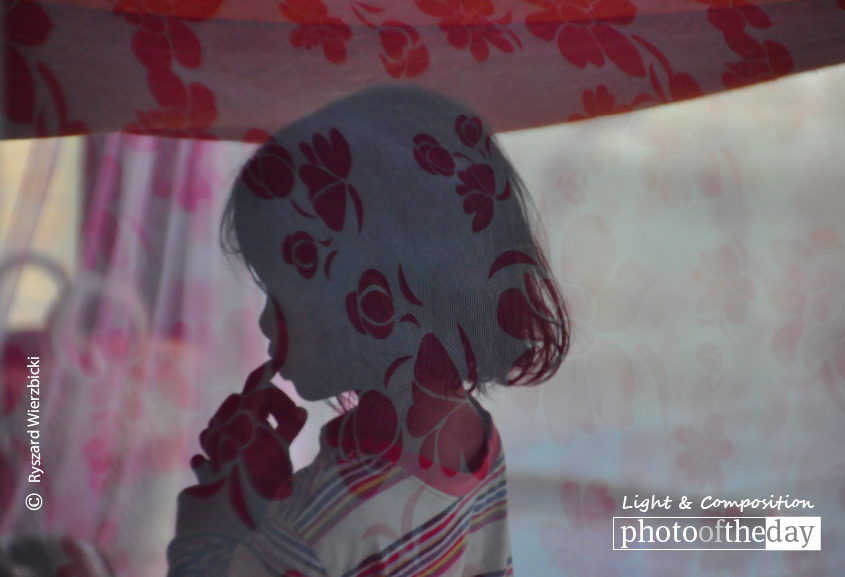
During a 2014 motorbike journey through the villages surrounding Siem Reap, Cambodia, the photographer discovered a small monastery housing a kindergarten and orphanage. Capturing a quiet moment during the midday siesta, the image features a young girl unable to sleep while others rested behind transparent curtains. The soft, diffused light filtering through the shelters creates a poignant atmosphere, highlighting the vulnerability and stillness of the scene. This photograph is award-worthy for its evocative storytelling and the photographer’s ability to document a deeply human, intimate moment with sensitivity and technical precision, transforming a chance encounter into a powerful visual narrative of childhood and resilience.
Ryszard Wierzbicki
Born in 1963 and a graduate of the University of Gdansk, Ryszard Wierzbicki transitioned from a career in social sciences and child care education to become a dedicated traveler and photographer. After relocating to the United Kingdom in 2006, he channeled his professional background into his passion for exploring South-East Asia, where he frequently volunteers with orphan charities. As the founder of the photography and travel forums Instant Travelling and World Around, Wierzbicki balances his work as a marketing advisor with his commitment to documenting the human experience through his lens.
Resonance Score Breakdown
Transparency Note: The resonance score (11.5/20) is calculated based on social engagement metrics collected before the award announcement.
Expert Photography Reviews · 7
The Architecture of Silence
We are often taught that childhood is a season of noise, a frantic blooming of voices and limbs. But there is a secret geography to the quiet hours, a time when the world thins and the light becomes a heavy, golden shroud.
Read the reflection →The Quiet Between Heartbeats
There is a sacred weight to the midday hour, a time when the world seems to hold its breath. In the heat of the day, when the sun stands tall and shadows retreat to the corners, we are invited to step out of the rush of our own making.
Read the reflection →Reviews & Comments
Share your thoughts about this award-winning photograph. Your reviews contribute to the community engagement score.
1/200sec at f/14, ISO 200, 27mm. Stopping down to f/14 on a D90 sensor invites diffraction, yet here it forces the background curtains into a sharp, clinical grid. It’s a rigid choice that anchors the subject’s isolation. I’ve spent years hating such narrow apertures in low light, but it works. The depth of field is unforgiving, pinning the girl against the architecture. It’s technically cold, but I’ll admit, the precision hits home. It’s a calculated, effective frame.
Before the eye identifies the girl, a sudden stillness anchors the chest. It’s the weight of that midday heat, the way the light bleeds through the curtains, trapping her in a waking solitude. I feel a phantom ache in my own throat, a memory of being small and forgotten in a quiet room. When I return to this, the silence feels heavier, as if she’s waiting for a life that hasn’t quite arrived yet.
The frame’s geometry is its salvation. The verticality of the curtains creates a rigid, rhythmic partition, pinning the subject against the picture plane. It’s a calculated containment. The negative space doesn’t collapse; it breathes. I’ve rarely seen such disciplined tension in a candid shot. The girl’s placement at the fulcrum forces the eye to remain anchored. It’s cold, yes, but the structural integrity is undeniable. It doesn’t need sentiment to justify its existence. It simply holds.
Most entries I review this year rely on heavy post-processing to manufacture emotion. Wierzbicki doesn’t. The way that girl’s silhouette cuts against the translucent curtain creates a tension between the collective rest behind her and her own singular, wide-eyed isolation. It’s a quiet ache I still feel when I look at it. Thirty years from now, that specific, fragile stillness will still matter. It’s a rare, honest capture of a childhood that doesn’t ask for pity.
We look at this girl and we feel the weight of her wakefulness. While the others drift behind those thin, ghostly curtains, she remains tethered to the present. It’s a quiet, aching solitude. I’ve spent my life listening to stories, and I can hear her silence echoing in this frame. She isn’t just resting; she’s waiting. It’s a photograph that asks to be returned to, because it’s impossible to look away from her eyes.
You waited. I can feel it. Most people would’ve rushed past those curtains, but you stayed in the heat of that Cambodian afternoon. It’s the girl’s eyes that get me; they’re heavy with a loneliness that doesn’t belong to a child. And because you didn’t force the moment, the light does the heavy lifting for you. It’s quiet, raw, and deeply human. You didn’t just take a picture; you sat with her. That’s rare.
The light here doesn’t just fall; it breathes. It’s a tracking shot frozen in the humidity of a Cambodian afternoon. The girl’s stillness against those translucent curtains creates a rhythm I haven’t felt in a long time. It’s the kind of frame an editor keeps because the cut would’ve been a mistake. I’m genuinely moved by how she anchors the silence. Wierzbicki didn’t just take a photo; he held his breath and caught the scene’s pulse.