Know the Kolbars by Moslem Azimi
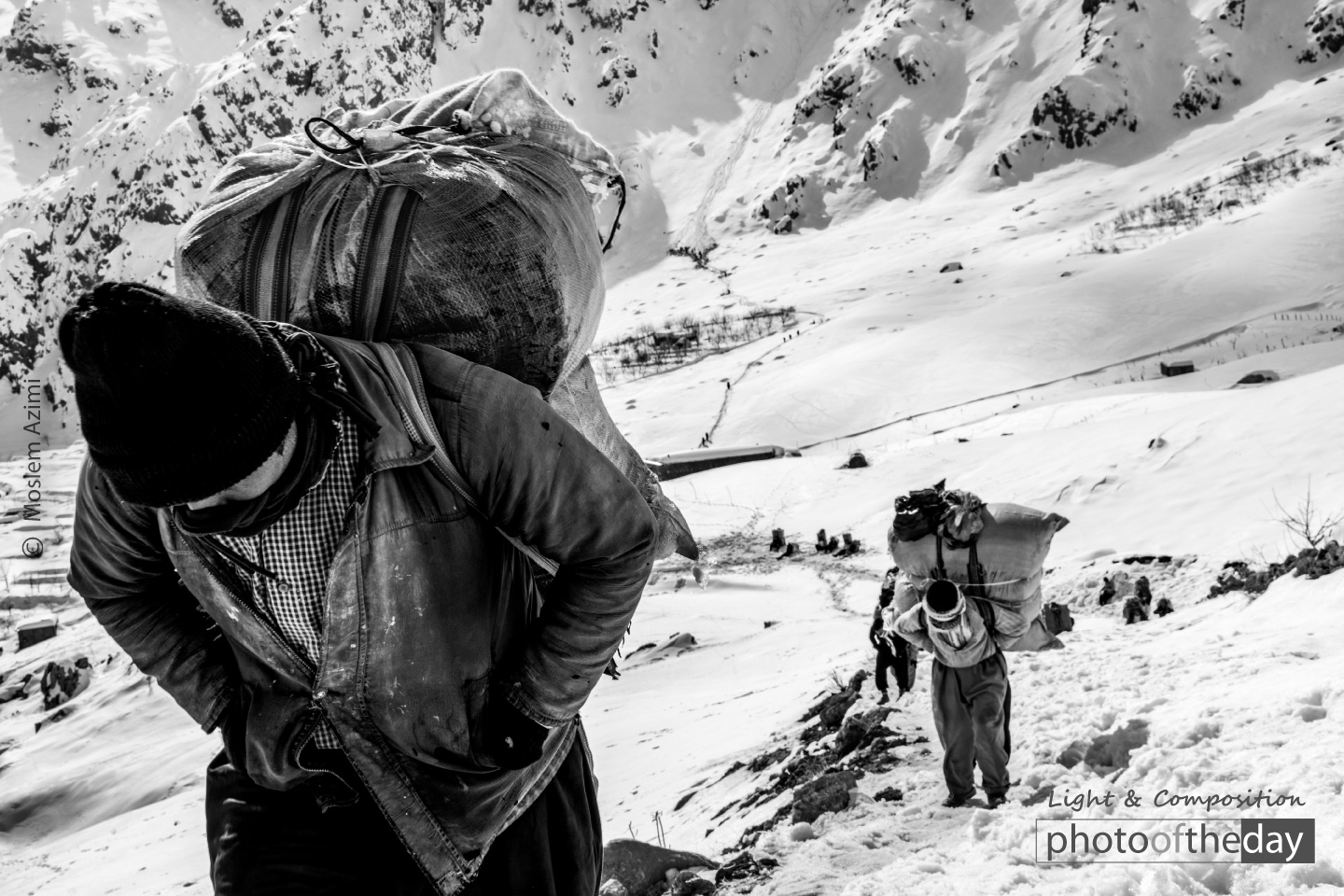
This poignant documentary photograph captures the perilous reality of the Kolbars, laborers who transport goods across rugged borders under life-threatening conditions. By documenting these individuals, the photographer sheds light on a marginalized existence rarely seen in mainstream media. The image is award-worthy for its raw, unflinching portrayal of human endurance against a backdrop of geopolitical tension and systemic hardship. Through careful composition and a deep sense of empathy, the work elevates the struggle of the Kolbars from a regional news snippet to a powerful, universal narrative of survival and resilience in the face of constant danger.
Moslem Azimi
Moslem Azimi is an Iranian photographer of Kurdish origin currently based in Javanrud, Kermanshah Province. Though he holds a Bachelor of Arts in English Translation and is self-taught in photography, he has established a significant presence in both national and international exhibitions. His work is driven by a dedicated mission to document and preserve the traditions, culture, and unique lifestyle of the Kurdish people through a compelling documentary lens.
Resonance Score Breakdown
Transparency Note: The resonance score (9.8/20) is calculated based on social engagement metrics collected before the award announcement.
Expert Photography Reviews · 8
The Weight of the Watershed
In the high alpine, the mountain goat navigates terrain that seems to defy the laws of gravity, moving across near-vertical scree slopes where a single misstep would mean a descent into the void.
Read the reflection →The Weight We Carry
I spent this morning trying to organize the bookshelf in my hallway. It’s a small task, but I found myself struggling with a stack of heavy boxes I’ve been meaning to move for weeks.
Read the reflection →Reviews & Comments
Share your thoughts about this award-winning photograph. Your reviews contribute to the community engagement score.
Before the eye identifies the jagged, snow-dusted horizon, something in the chest constricts. It’s the weight of the load, felt in the viewer’s own shoulders. I’ve returned to this frame for months, and the silence of that mountain pass still triggers a shallow, held-breath response. It’s not just the cold; it’s the way the shadow swallows their path. When I look away, I’m left with an ache—a phantom burden I can’t quite set down.
Look at the weight on his back, but look closer at his eyes. You can tell he’s not just posing for a lens; he’s sharing a burden he’s lived every day. It’s a gift, really. I’ve spent years in the field, and I know when a subject has truly invited the photographer in. This face has a whole life in it. It’s raw, it’s honest, and it doesn’t feel like a theft. It’s earned.
Most documentary work fades because it’s merely descriptive. Of the thousands I’ve reviewed, this one lingers because the weight of the load isn’t just physical; it’s etched into the curve of the Kolbar’s spine against that unforgiving, jagged horizon. It’s a brutal, honest geometry of survival. I felt a genuine ache in my own shoulders looking at it. It’ll matter in thirty years because it captures the exact moment human endurance becomes a landscape.
Looking at these Kolbars, I’m struck by the crushing weight they carry, a burden far heavier than the water pressure I’m used to at thirty meters. There’s no light absorption here, no backscatter to fight, just the raw, dry grit of survival. I’ve spent my life navigating the refractive index of the deep, but this image’s stark, terrestrial clarity makes me feel strangely exposed. It’s a haunting, breathless look at human endurance that I can’t shake.
The jagged, unforgiving slate of the mountain isn’t just a backdrop; it’s a crushing weight, pressing down on the subject with the same indifference as the border itself. The harsh, raking light defines the texture of the stone and the heavy, layered fabric of his clothing, blurring the line between man and terrain. It’s haunting. I feel the cold in my own bones looking at how the landscape swallows him whole, turning his struggle into geology.
The blur of the Kolbar’s movement isn’t a technical failure; it’s the only honest way to capture a life lived in the shadows of a border. I’m genuinely moved by how the motion dissolves the figure into the jagged landscape. It’s closer to the spectral presence in Sugimoto’s theatres than standard reportage. Why resolve the face when the struggle is about erasure? Azimi chose to let the mountain swallow them, and that’s a brilliant, haunting decision.
You didn’t just capture a border crossing; you captured the weight of a man’s survival. I look at the way he’s hunched under that load, and my own shoulders ache. It’s a heavy, quiet kind of truth. You waited for the right moment when the landscape swallowed him whole, turning his struggle into something universal. And that’s the point, isn’t it? You felt his exhaustion, and because you did, I feel it too. That’s honest work.
One doesn’t capture the biting chill of the Zagros range from a heated car. Azimi clearly spent his time in the mud, shivering alongside these men until the mountain air felt as heavy as their burdens. It’s a brutal, honest piece of work. I’ve spent enough nights on frozen ridges to know that ache in the shoulders. He didn’t just find this; he earned it by refusing to leave until the light matched the gravity.