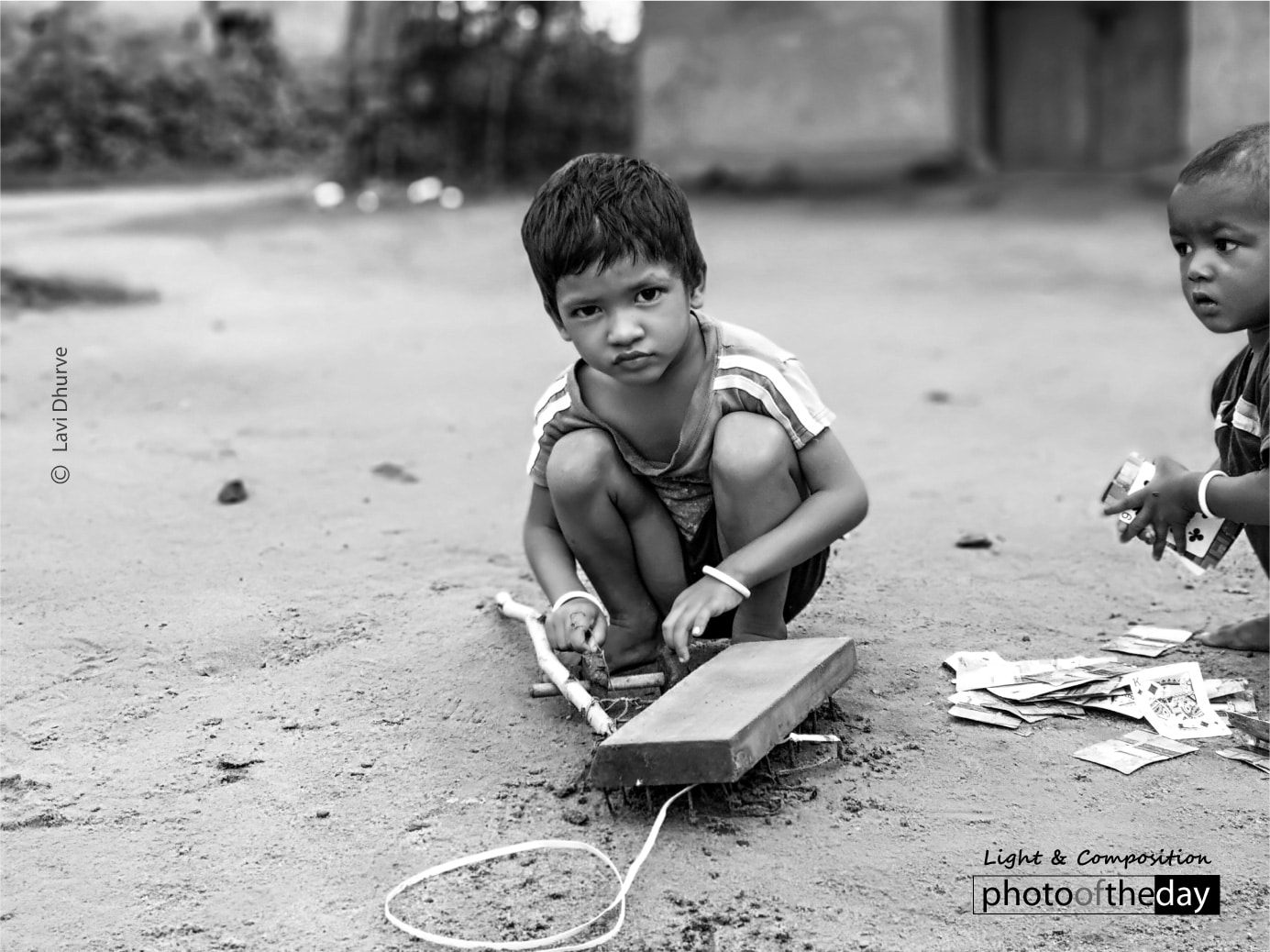
Playing with a Wooden Car by Lavi Dhurve
In the quiet alleys of a small village in Madhya Pradesh, the photographer captures a poignant moment of childhood solitude. While his mother works in the fields, young Vijay finds companionship in the simplest of objects: a handmade wooden car. The image masterfully balances the stark reality of rural life with the innocence of play, highlighting the resilience and imagination of a child left to his own devices. Through a lens of empathy, the photographer transforms a mundane afternoon into a timeless study of human connection and the quiet beauty found in everyday village existence.
Lavi Dhurve
Hailing from a small village in Madhya Pradesh, the 'Heart of India,' Lavi Dhurve finds deep inspiration in the rhythms of rural life. Her work is a celebration of art, culture, and the human spirit, with a particular focus on the beauty of children and the natural world. By documenting the people and landscapes of her home, she seeks to share the profound beauty she experiences in daily life, from the quietude of village alleys to the brilliance of sunrise and sunset.
Resonance Score Breakdown
Transparency Note: The resonance score (10.8/20) is calculated based on social engagement metrics collected before the award announcement.
Expert Photography Reviews · 8
The Weight of Small Things
I keep a small, smooth stone in my desk drawer, worn down by the friction of my own thumb over many years.
Read the reflection →The Architecture of Play
We often mistake the city for its infrastructure—the concrete, the steel, the zoning laws that dictate where we sleep and where we toil. But the true geography of a place is written in the margins, in the spaces where the formal design fails to reach.
Read the reflection →Reviews & Comments
Share your thoughts about this award-winning photograph. Your reviews contribute to the community engagement score.
The curator calls this solitude, but I see a child performing poverty for a lens. Why is the boy positioned so precisely against the peeling wall? Does the wooden car belong to him, or is it a prop for the photographer’s narrative of rural innocence? It makes me ache, honestly. We romanticize this “quiet beauty,” but who benefits from the aestheticization of his isolation? Is this child’s play, or is it just our voyeurism?
That wooden car isn’t just a toy; it’s a lifeline. I’m looking at the way the boy’s focus locks onto the ground, completely oblivious to the lens. It’s raw. If Lavi had waited another heartbeat, the posture would’ve shifted and the tension would’ve vanished. It’s that perfect, fleeting stillness that makes my chest ache. Cartier-Bresson would’ve tipped his hat to this. You caught the exact fraction of a second where solitude becomes pure, unadulterated imagination.
There’s a haunting echo of Helen Levitt’s street-level empathy here, yet Dhurve’s framing feels more tethered to the earth. The way the boy’s wooden car anchors the frame recalls the stark, unadorned honesty of early documentary work in the subcontinent. It’s a quiet, dusty scene, but the child’s focused gaze caught me off guard—it’s genuinely piercing. I’ve spent decades looking at such moments, but there’s a raw, unvarnished stillness in this composition that feels entirely fresh.
Most entries in this category rely on the sentimentality of poverty to force a reaction, but Lavi’s work avoids that trap. The way the boy’s gaze anchors the frame against the rough, textured ground makes the wooden car feel like a lifeline rather than a toy. It’s a quiet, aching reminder of how we construct worlds from nothing. I’ve looked at thousands of frames, yet this one still makes me want to reach out and touch it.
Dust settles on the wooden wheels. Vijay sits, small against the vast, unpeopled earth. It’s a quiet geometry. The frame doesn’t crowd him. It lets him breathe. I’ve spent minutes watching the way the light touches the grain of the toy. It’s enough. Nothing here is accidental. The empty corner is not empty. It holds the weight of his solitude. I feel a sudden, sharp ache for that stillness. It’s rare. It’s perfect.
f/2.8 at 50mm, 1/250s, ISO 400. A classic portrait configuration. The shallow depth of field isolates the boy from the chaotic background, forcing focus onto the wooden car. It’s a calculated choice that works. I’ve seen enough messy street shots to appreciate this discipline. The shutter speed is sufficient to freeze the movement, though the grain is a bit aggressive for my taste. Still, the technical execution holds the narrative together. It’s competent work.
The frame holds its breath. A boy, a wooden toy, the dust of Sarni. It’s a tracking shot frozen in time, the camera tracking the slow, rhythmic crawl of a child’s imagination. I’ve watched this scene a dozen times now; it’s the quiet intensity in his eyes that kills me. He isn’t just playing; he’s directing his own world. The cut would’ve been a mistake. This is the frame the editor keeps, perfectly still, perfectly alive.
You waited for the light to hit that wooden car just right, didn’t you? It’s a quiet, heavy kind of solitude. I’ve spent enough time in villages like Sarni to know that look on a child’s face—it’s not just play, it’s survival. And honestly, it made my chest ache a little. You didn’t force the scene; you just let the boy be. There’s something deeply honest happening here. You really saw him.