Burning Sky by Rob van der Waal
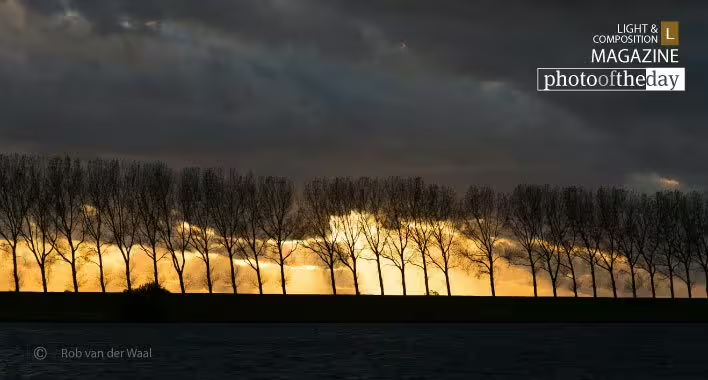
Captured during a fleeting autumn sunset in the Netherlands, Burning Sky showcases a dramatic interplay of light and shadow. The photographer patiently waited for the clouds to part, allowing golden sunlight to pierce through and illuminate the landscape in a spectacular display. This image is award-worthy for its masterful timing and the raw, atmospheric intensity of the scene. By capturing the transient beauty of the shifting clouds against the horizon, the photographer transforms a simple sunset into a profound, evocative narrative of nature's power, demonstrating a keen eye for the perfect moment.
Rob van der Waal
Born in 1957 in Rotterdam, Rob van der Waal developed a deep appreciation for photography through his father, who introduced him to the craft using Leica equipment and a home darkroom. An autodidact who refined his skills through practice and observation, van der Waal is defined by a pure and honest aesthetic. He frequently draws inspiration from maritime environments and the natural world near his home in Hellevoetsluis, constantly seeking new ways to interpret light and storytelling through his lens.
Resonance Score Breakdown
Transparency Note: The resonance score (12.9/20) is calculated based on social engagement metrics collected before the award announcement.
Expert Photography Reviews · 6
The Weight of the Horizon
The day does not end with a shout. It ends with a withdrawal. We watch the light retreat, pulling itself back from the fields, from the water, from the edges of our own skin.
Read the reflection →The Architecture of the End
In the study of thermodynamics, there is a concept known as entropy—the inevitable drift of all systems toward disorder. We see it in the way a room slowly gathers dust, or how a garden, left to its own devices, eventually surrenders to the wild.
Read the reflection →Reviews & Comments
Share your thoughts about this award-winning photograph. Your reviews contribute to the community engagement score.
Most sunset shots are forgettable clutter, but this one sticks. The 120mm compression forces the horizon into a claustrophobic, molten strip that feels genuinely heavy. I’ve seen thousands of Dutch landscapes, yet the way the light bruises the clouds here makes me hold my breath. It’s not just a pretty sky; it’s a volatile, physical weight. It’ll endure because it captures a rare, violent stillness that most photographers are too impatient to wait for.
A sunset in the Netherlands is rarely a singular event; it’s a war of attrition against the damp. Van der Waal clearly didn’t just stumble upon this. That 120mm compression suggests he was miles from the comfort of a car, likely shivering in the reeds while the light teased him. I’ve spent enough miserable evenings in similar marshes to recognize the grit here. He earned that gold. It’s a proper, hard-won bit of work.
The horizon line cuts the frame. It’s a clean, sharp division. Above, the clouds hold the fire. Below, the water waits. I’ve spent minutes watching the light hit the dark surface. It’s quiet. The vast, heavy sky doesn’t crowd the frame; it breathes. Nothing here is accidental. The empty corner is not empty. It’s a pause. I feel my own pulse slow down just looking at it. The silence is earned. It’s enough.
The horizon at Haringvliet doesn’t just glow; it surrenders. I’ve spent enough evenings in the damp Dutch air to know the exact moment the wind shifts and the clouds finally yield. Rob stood there as the light bruised the sky, waiting for that singular, piercing gold. It’s a quiet ache, watching the day expire like this. I find myself holding my breath, feeling the cold salt air against my own skin. It’s truly humbling.
The horizon line bisects the frame with clinical indifference. It’s a rigid fulcrum, anchoring the chaotic gradients of the Haringvliet sky. The weight of the lower shadows provides necessary resistance against the luminous upper register. While the atmospheric drama threatens to collapse into sentimentality, the structural discipline holds. I’ve grown weary of such sunsets, yet the deliberate placement of the light’s intensity here commands respect. It’s a rare instance where the architecture survives the spectacle.
The ochre bleeding into the bruised violet of the Haringvliet horizon recalls a Turner tempest, yet it’s the sudden, searing amber of the clouds that truly steals one’s breath. It’s a chromatic collision, a violent harmony where light doesn’t merely illuminate but consumes the atmosphere. I’ve rarely felt such a visceral ache watching the day expire; it’s as if the sky itself is mourning the light, dissolving into a liquid, molten gold that feels almost impossible to touch.