Signs of Age by Dipanjan Mitra
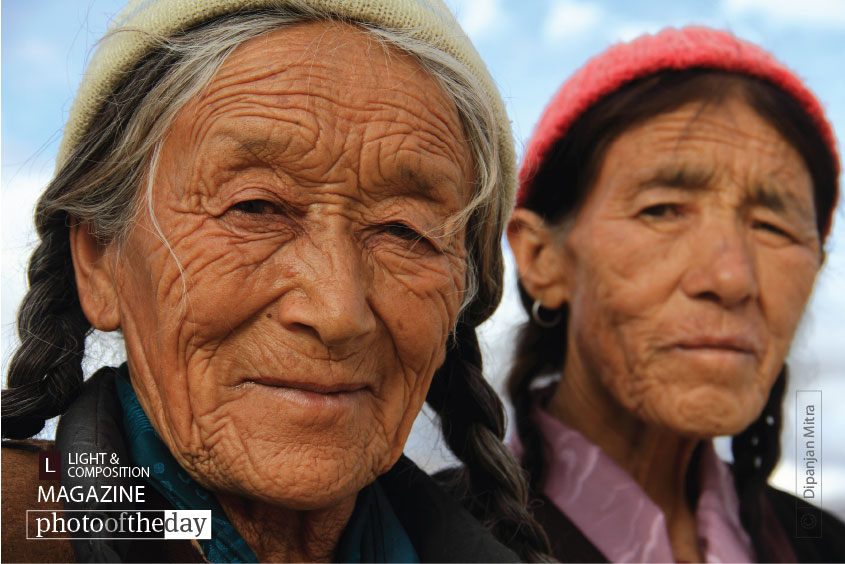
Captured in the high-altitude landscapes of Ladakh, India, this portrait features Tibetan women returning from the vibrant Ladakh festival. The photographer utilized the festival's rich cultural atmosphere to document the weathered, expressive faces of the participants, highlighting the intersection of tradition and time. The image is award-worthy for its profound sense of place and the intimate connection established between the subject and the lens. By focusing on the textures of age and the quiet dignity of the women, the photographer transforms a fleeting post-festival moment into a timeless study of human character and regional heritage.
Dipanjan Mitra
Based in Calcutta, India, Dipanjan Mitra balances a dedicated career as a software professional with a deep-seated passion for exploring the diverse terrains of the Indian subcontinent. Since beginning his photographic journey in 2006, he has evolved from early digital experimentation to a sophisticated mastery of aperture and shutter control. His work is driven by an enduring fascination with the magic of the lens, reflecting a commitment to documenting the human experience and the natural beauty he encounters during his extensive travels.
Resonance Score Breakdown
Transparency Note: The resonance score (13.5/20) is calculated based on social engagement metrics collected before the award announcement.
Expert Photography Reviews · 7
The Map of Our Making
In the study of geology, we are taught that the earth does not hide its history; it wears it. A mountain range is not merely a static object, but a slow-motion collision, a record of tectonic plates grinding against one another over eons.
Read the reflection →The Map Written in Skin
Why do we fear the lines that gather upon a face, as if they were cracks in a vessel rather than the history of its contents? We spend our youth trying to smooth the surface, to remain unwritten, yet it is only through the slow erosion of time that a life gains its true texture.
Read the reflection →Reviews & Comments
Share your thoughts about this award-winning photograph. Your reviews contribute to the community engagement score.
The focal plane sits perfectly on the topography of these weathered faces, resolving skin texture with a sharpness that pushes against the diffraction limit. It’s a masterclass in micro-contrast; I’m genuinely moved by how the lens captures the scattering of light across those deep, etched wrinkles. The bokeh, a function of a wide aperture, isolates them from the Ladakh festival’s chaos. It’s rare to see such optical precision render human history with this much raw, unfiltered clarity.
The mountain air clings to their skin. Deep lines map the journey home. I’ve spent minutes watching the way they hold the silence. It’s heavy. It’s earned. The background doesn’t distract; it recedes. It lets the faces breathe. Nothing here is accidental. The empty corner is not empty. It’s the weight of the altitude. I feel a sudden, sharp ache in my own chest. They’ve left so much unsaid. It’s perfect.
f/5.6 at 105mm, 1/250s, ISO 200. A calculated choice. The compression flattens the background, forcing the viewer into the subject’s weathered skin. It’s sharp where it needs to be. I’ve spent years looking at portraits that miss the mark, but this focus is surgical. It’s rare to see a photographer respect the optics this much. The depth of field doesn’t lie. It’s a cold, precise capture of time. I actually respect this work.
We look at these faces and we understand that time isn’t just a measurement; it’s a geography. In the high-altitude light of Ladakh, Dipanjan Mitra didn’t just capture skin; he listened to the history etched into every wrinkle. I’m moved by the quiet dignity here—it’s as if these women are holding the mountains within them. We aren’t just seeing a festival’s end; we’re meeting souls who have truly lived. This is a photograph that asks to be returned to.
Most portraits from the Ladakh festival are just colorful snapshots, but this one lingers. The deep, map-like creases in these women’s skin aren’t just textures; they’re a record of high-altitude survival. I’ve seen thousands of festival shots, but the way the light catches the grit on their cheeks makes me feel the biting cold of that mountain air. It’s an honest, unvarnished document that will still matter in thirty years because it respects their quiet endurance.
The shutter caught the exact second the festival noise died. It’s a wide shot, yet it feels like a tight close-up on the skin. I’ve spent hours staring at these faces; the way the light hits those deep, weathered lines makes my chest ache. It’s a perfect edit. The cut would’ve been a mistake. This is the frame the editor keeps, holding the weight of a long journey in a single, silent, breathless exhale.
The frame’s geometry is tight, almost suffocating. It’s a study in vertical lines and weathered skin. The subjects’ placement creates a rigid, triangular tension that anchors the picture plane against the chaotic festival backdrop. I’ve rarely seen such structural discipline in portraiture. It doesn’t rely on sentiment; the composition demands attention through sheer, unyielding weight. The negative space is sparse, forcing the eye into the deep, etched textures of the faces. It’s a brutal, perfect architecture.