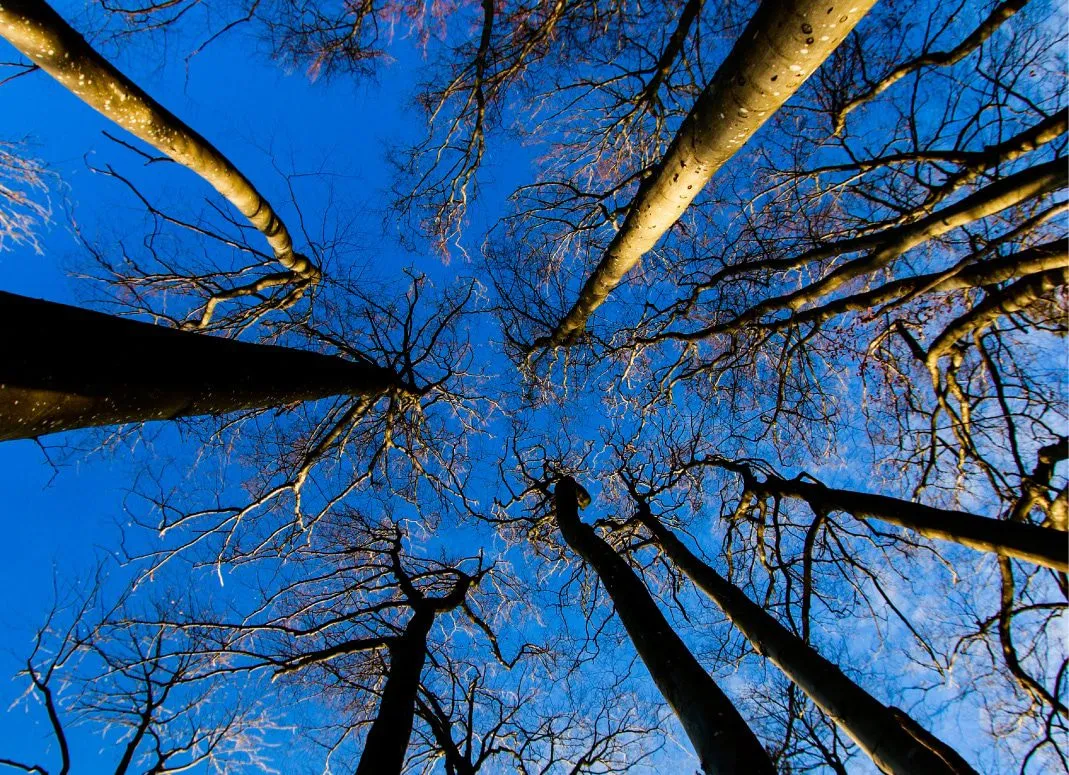
Trees in Winter by Frank Ivar Hansen
Captured within a serene deciduous forest on a biting winter day, this photograph highlights the monumental resilience of nature. The image focuses on the intricate architecture of trunks and branches as they reach toward the sky, standing firm against the freezing temperatures that halt transpiration. By isolating these skeletal forms against the winter landscape, the photographer emphasizes the quiet, stoic beauty of trees in dormancy. The composition is award-worthy for its ability to transform a harsh, frozen environment into a graceful study of endurance and structural elegance, inviting viewers to appreciate the silent strength of the forest.
Frank Ivar Hansen
Born in 1956 in Moss, Norway, Frank Ivar Hansen is a dedicated writer and photographer with a lifelong passion for the natural world. A long-standing member of the Norwegian photography organization Biofoto, he has spent decades documenting the diverse landscapes, flora, and fauna of his home country. Beyond his extensive photographic collection, Hansen has shared his expertise and love for the environment through the publication of three books focused on Norwegian nature, establishing himself as a significant voice in contemporary nature photography.
Resonance Score Breakdown
Transparency Note: The resonance score (11.3/20) is calculated based on social engagement metrics collected before the award announcement.
Expert Photography Reviews · 4
The Architecture of Silence
I keep a small, silver thimble in my desk drawer that belonged to my grandmother. It is worn smooth at the tip, a testament to thousands of hours spent mending what had frayed, pushing needles through heavy wool and delicate silk alike.
Read the reflection →The Architecture of Silence
There is a particular, brittle clarity that arrives only when the temperature drops low enough to snap the air into stillness. In the deep midwinter, the light loses its warmth and becomes a thin, silver veil that clings to the bark of dormant trees.
Read the reflection →Reviews & Comments
Share your thoughts about this award-winning photograph. Your reviews contribute to the community engagement score.
It’s a familiar motif, echoing the stark, graphic winter studies of Bill Brandt, yet Hansen’s skeletal trees possess a brittle, crystalline clarity that feels remarkably fresh. He’s eschewed the romanticism of the Pictorialists for a sharper, structural rigor. I’ve spent decades cataloging such arboreal silhouettes, but the way these branches fracture the pale Norwegian light genuinely stopped me in my tracks. It’s not just a forest; it’s a precise, cold geometry that feels entirely necessary today.
The jury’s obsession with clarity here feels stifling. Hansen’s trees are trapped in a clinical sharpness that denies the biting, kinetic energy of a Norwegian winter. I’m craving a collapse of form, something closer to Sugimoto’s long-exposure theatres where the atmosphere actually breathes. Why resolve every twig? I’d trade this entire high-resolution study for a single, intentional blur that captures the wind’s violence. It’s technically competent, sure, but it’s just so terribly, predictably safe.
We look at these skeletal trunks and we don’t see mere timber; we see ancestors waiting for the thaw. Frank Ivar Hansen has listened to the silence of the Norwegian woods, capturing the patience of a long, cold breath. It’s a portrait of endurance, not just nature. I feel a shiver when I trace those reaching branches. It’s a photograph that asks to be returned to, because it’s really a story about how we survive the winter.
Looking at these skeletal branches, I’m struck by the absence of the refractive index’s distortion. Down here, water steals the light, turning everything into a monochromatic blur of blue. These trees don’t have to fight the physics of backscatter or the rapid absorption of red wavelengths. It’s hauntingly clear. I’ve spent my life chasing light through the deep, so seeing such crisp, dry stillness feels almost alien. It’s a beautiful, quiet relief from the pressure.