Floppy Ears by Shirren Lim
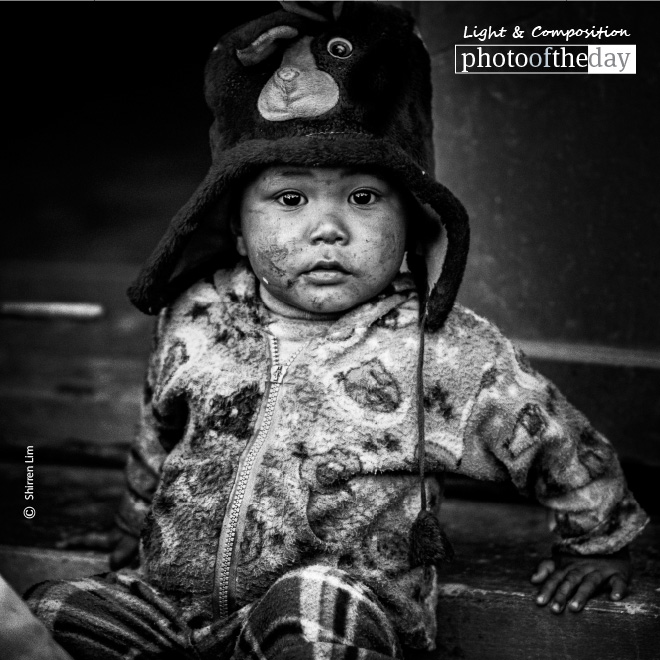
While wandering through the remote town of Mindat, Myanmar, the photographer encountered a group of local children at play. Her attention was immediately drawn to a young child wearing a charming bunny hat with distinctive floppy ears. Capturing the subject required patience and agility, as the child was constantly in motion; after experimenting with various angles, the photographer settled on this specific framing to highlight the child's endearing expression. The image is award-worthy for its authentic portrayal of childhood innocence, combined with a keen eye for spontaneous, human-centric storytelling that captures the spirit of the region.
Shirren Lim
Born on Penang Island, Malaysia, in 1970, Shirren Lim is a Jakarta-based photographer who discovered her true passion for the craft in 2009. Specializing in portraiture, she seeks to capture the raw sincerity and humanity found in the expressions of her subjects. Her work, often described as intense and earthy, is deeply influenced by the iconic imagery of Steve McCurry, driving her ongoing pursuit to capture profound, world-changing moments through her lens.
Resonance Score Breakdown
Transparency Note: The resonance score (11.4/20) is calculated based on social engagement metrics collected before the award announcement.
Expert Photography Reviews · 5
The Weight of Play
I found a small, knitted toy under the sofa this morning while I was looking for my keys. It belonged to my niece, who hasn't visited in months, but holding it brought back the sound of her laughter so clearly I almost turned around to answer her.
Read the reflection →The Weight of Softness
The smell of damp wool always brings me back to the winters of my childhood, when my mother would pull a thick, scratchy sweater over my head. It was a heavy, suffocating embrace that smelled of rain and cedar chests.
Read the reflection →Reviews & Comments
Share your thoughts about this award-winning photograph. Your reviews contribute to the community engagement score.
The vertical axis here is anchored by the child’s gaze, perfectly bisecting the frame. Those floppy ears create a soft, parabolic arc that breaks the rigidity of the surrounding negative space. It’s a clever 1:2 ratio of subject mass to background, grounding the composition. I’m genuinely charmed by how the ears’ curvature echoes the child’s rounded features. It’s a solved spatial equation where the geometry doesn’t just hold the subject; it elevates the innocence.
That bunny hat feels like a costume imposed on a remote reality. Why does the curator insist on innocence when the child’s eyes look so guarded? I’m unsettled by how we consume this “charming” aesthetic from Mindat. Does the hat bridge a cultural gap, or does it just mask the subject’s actual identity for our comfort? It’s a polished frame, sure, but I can’t shake the feeling that we’re just playing tourist with someone else’s childhood.
The light in Mindat doesn’t just fall; it settles, heavy and soft against the child’s face. Shirren waited for the motion to cease, for the spirit of the place to align with those floppy ears. I’ve stood in such mountain air, feeling the stillness return after a storm. It’s a quiet, holy pause. Looking at this, I feel a sudden, sharp ache for the simplicity of that moment. She listened well. It’s beautiful.
Most portraits of children in remote regions lean heavily on the crutch of exoticism, but this avoids that trap entirely. The floppy ears of the hat aren’t just a prop; they anchor the frame, grounding the child’s fleeting, mischievous gaze. I’ve seen thousands of travel portraits, yet this one makes me smile every time. It’s the raw, unposed honesty that ensures it’ll still matter in thirty years. It doesn’t need to be perfect to be unforgettable.
The bunny hat’s absurdity masks a deeper, colder truth. Lim captures the child, but it’s the encroaching gloom behind those floppy ears that haunts me. I’ve spent hours staring into that darkness, feeling the weight of a world that doesn’t care for innocence. It’s not a portrait of play; it’s a confrontation with the void. When I look at those eyes, I don’t see joy. I see a soul bracing itself against the coming night.