Pillars of the Mind by Liesl Cheney
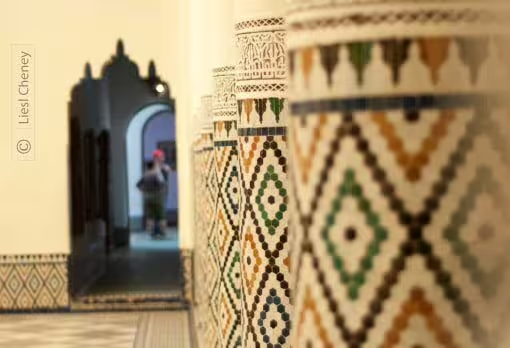
In this striking architectural study, the photographer captures the intricate symmetry and geometric precision of Morocco’s El Bhahia Palace. By utilizing a wide aperture, the composition balances the ornate, delicate details of the palace’s traditional decoration with the grand, imposing scale of the room itself. The result is a harmonious interplay of light and structure that invites the viewer to wander through the space. This image is award-worthy for its masterful ability to transform a static interior into a narrative of cultural depth, showcasing a keen eye for the rhythmic patterns that define Moroccan design.
Liesl Cheney
Based in Surrey, UK, Liesl Cheney is a professional wedding and portrait photographer celebrated for her ability to capture the authentic emotion and personality of her subjects. Beyond her primary portraiture work, she collaborates with food stylists and suppliers to craft compelling marketing portfolios. An avid traveler, Cheney frequently explores the world through her lens, applying her technical precision and artistic sensibility to architectural and travel photography alike.
Resonance Score Breakdown
Transparency Note: The resonance score (12.8/20) is calculated based on social engagement metrics collected before the award announcement.
Expert Photography Reviews · 6
The Architecture of Silence
In the quietest hours of the morning, when the house is still settling into its foundations, I often think about how we build our own internal cathedrals.
Read the reflection →The Echo of Stone
The air in an old, vaulted room has a specific weight, a coolness that clings to the skin like damp silk. I remember the smell of sun-baked limestone—a dry, mineral scent that tastes like dust on the back of the throat.
Read the reflection →Reviews & Comments
Share your thoughts about this award-winning photograph. Your reviews contribute to the community engagement score.
El Bahia’s geometry doesn’t invite; it demands a reckoning with the void. By pushing the aperture to f/1.8, Cheney forces the ornate plasterwork into a blur, leaving the deep, encroaching shadows to anchor the room’s true weight. It’s unsettling. I’ve spent hours staring into those dark recesses, feeling the silence of Moroccan stone press against my own skin. Shadows here aren’t merely absences; they’re the architecture’s subconscious, finally allowed to breathe in the dark.
The aperture choice is a curious gamble, blurring the periphery into a soft, dreamlike haze. One wonders if Cheney spent the morning dodging tourists or if she simply arrived before the sun hit the tiles. It’s a quiet, disciplined study. I’ve spent enough hours in Moroccan heat to know that stillness is never accidental. She clearly waited for the shadows to align perfectly. It’s a rare, earned serenity that makes me want to sit there myself.
The light here doesn’t just illuminate; it breathes through the arches of El Bhahia. I can feel the stillness Liesl must have held while waiting for the shadows to soften against those intricate carvings. It’s a quiet, sacred geometry. When I look at the way the focus falls so gently, I’m reminded of the desert’s own patience. It’s rare to find a space that feels this alive. I’d have stayed there until the sun vanished.
Most architectural shots of El Bhahia are sterile, cold exercises in geometry. What separates this from the field is the choice of f/1.8; it softens the ornate tile work just enough to make the room feel breathable, almost lived-in. I’ve stared at this for years, and it still pulls me into that cool, shadowed corridor. It’s rare to find a static space that feels like it’s actually waiting for someone to walk through it.
The aperture choice here is a tactical error. By blurring the background, Cheney sabotages the structural integrity of the palace’s geometry. The foreground pillars don’t anchor the frame; they float in a shallow, unearned haze. It’s frustrating. The rhythmic tile work demands a deep, consistent focus to maintain the picture plane’s tension. Without that, the architecture collapses into mere decoration. It doesn’t hold. I’d have preferred a stopped-down lens to force the space into submission.
The ochre of the Moroccan plaster, a shade reminiscent of Morandi’s dustiest pigments, breathes against the cool, shadowed recesses of the arches, creating a chromatic tension that’s frankly intoxicating. It’s as if the light itself has been distilled through centuries of desert heat, settling into the intricate tilework with a quiet, Vermeer-like precision. I’ve found myself utterly lost in these golden, rhythmic depths; it’s a rare, luminous harmony that doesn’t merely decorate, but truly sings.