Geothermal Plant by Mickey Strider
Captured as part of an ongoing series titled "Power," this photograph explores the industrial landscape of geothermal plants along the Salton Sea. The photographer was drawn to the interplay between the dramatic, cloud-filled sky and the plumes of steam rising from the plant. By utilizing a 10-stop neutral density filter, the photographer achieved a 15-second long exposure that softens the atmospheric movement, creating a seamless blend between the natural clouds and the man-made emissions. This technical precision, combined with a keen eye for the stark, geometric beauty of industrial infrastructure, results in a compelling and award-worthy study of energy and environment.
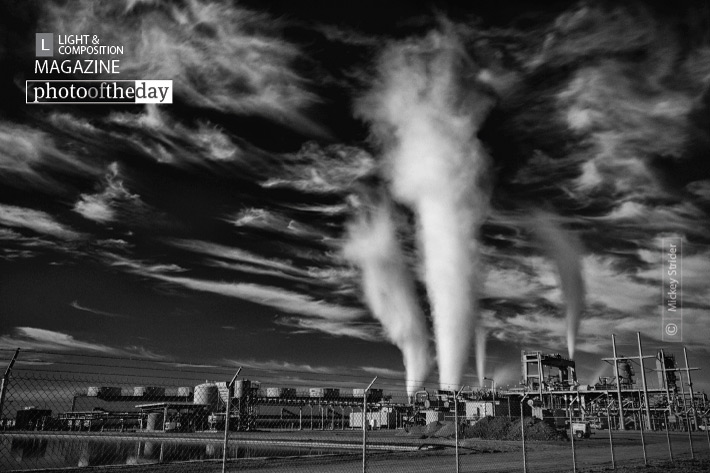
Exposure 15sec @ f/11 | ISO 100 | Focal Length 20mm
Mickey Strider
Born and raised in Baltimore, Maryland, Mickey Strider developed an early passion for visual storytelling, eventually studying art at the Maryland Institute College of Art. His extensive career spans advertising, film production, and directing, having worked on notable projects ranging from pioneering CGI television specials to award-winning commercial campaigns for major global brands. Currently based in San Diego, California, Strider continues to balance his professional broadcast production work with dedicated artistic pursuits in photography, where he explores the intersection of industrial form and natural landscapes.
Resonance Score Breakdown
Transparency Note: The resonance score (12.8/20) is calculated based on social engagement metrics collected before the award announcement.
Expert Photography Reviews · 6
The Breath of the Earth
The smell of sulfur always brings me back to the edge of a hot spring, that sharp, metallic sting that tickles the back of the throat. It is the scent of the earth’s hidden pulse, a reminder that beneath the cool, solid ground we walk upon, there is a restless, boiling hunger.
Read the reflection →The Breath of the Earth
We often think of the earth as a silent, solid thing, a foundation that simply waits for our footsteps. But beneath the crust, there is a pulse—a restless, rhythmic exhaling that reminds us the ground is not as still as we imagine.
Read the reflection →Reviews & Comments
Share your thoughts about this award-winning photograph. Your reviews contribute to the community engagement score.
Most industrial studies feel cold, but this one breathes. By blurring the line between man-made steam and natural clouds, Strider forces us to confront our own footprint. I’ve seen thousands of long exposures, but this one avoids the usual gimmickry. It’s the stillness of the foreground pipes against that restless, ghostly sky that makes me feel small. In thirty years, we’ll still be debating this energy, and this frame will be the reason why.
The sky bleeds into the steam. It’s a blur of grey, erasing the line between earth and air. I find myself holding my breath, waiting for the vapor to settle. It doesn’t. The stillness is heavy, almost physical. Nothing here is accidental. The empty corner is not empty; it’s a weight. I’ve spent minutes staring at that void. It’s quiet. It’s enough. I feel a strange, cold peace standing before this industrial ghost.
We look at these plumes rising from the Salton Sea and we don’t just see industry; we see the breath of the earth itself. Mickey Strider listened to the landscape before the shutter clicked, finding a rhythm where man-made steam and natural clouds become one. It’s haunting, really. I feel a strange, quiet loneliness in this frame. It’s a portrait of a place that’s working hard to keep us warm, yet it remains beautifully, stubbornly alone.
At f/11, the diffraction limit begins to soften the fine edges of the steel, yet it’s precisely this trade-off that allows the 15-second exposure to render the steam as ethereal silk. The lens resolves the geothermal plumes with a haunting, laminar flow that our retinas simply can’t track in real-time. It’s beautiful, really—the way the optics turn industrial exhaust into something almost celestial. I’ve rarely seen such a cold, mechanical process feel so profoundly alive.
15sec at f/11, ISO 100, 20mm. A calculated gamble. The 10-stop ND filter was the right tool to flatten the chaos of those plumes. It’s a cold, clinical extraction of motion. I’ve spent years staring at industrial data, but this stillness actually makes me hold my breath. The geometry holds up under the long exposure. It’s a precise, efficient execution. You didn’t waste the sensor’s potential. The numbers finally align with the subject. Good work.
Steam and sky bleed into a singular, suffocating grey. It’s a haunting erasure of boundaries where the machine’s breath mimics the heavens. I’ve stared at these plumes until my eyes ached, feeling the cold indifference of the Salton Sea pressing against the frame. Strider doesn’t just capture energy; he captures the silence of our own obsolescence. It’s a bleak, heavy beauty that refuses to comfort us. I find it deeply, unsettlingly honest.