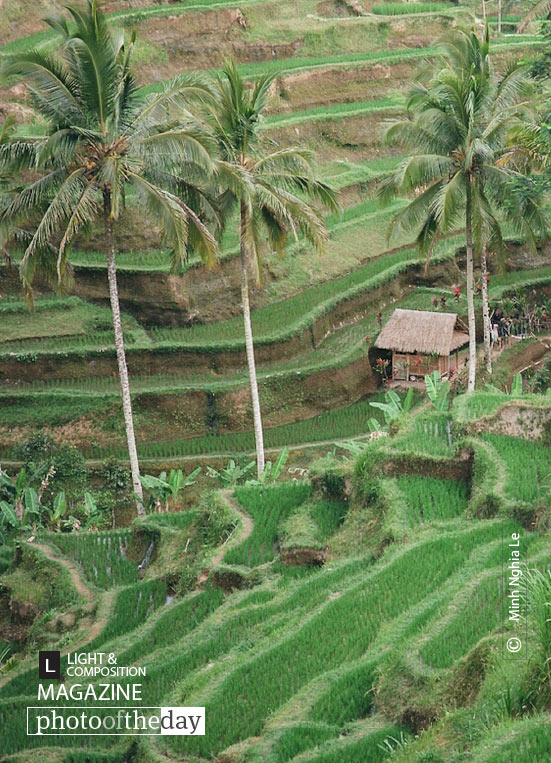
Tegalalang Rice Field by Minh Nghia Le
Captured on a sweltering day amidst the bustling energy of Bali, this photograph highlights the exquisite, rhythmic curvature of the Tegalalang rice terraces. The photographer sought refuge from the local traffic in the vast, verdant landscape, finding peace in the intricate patterns carved into the hillside. By utilizing medium format film, the image preserves the lush textures and vibrant greens of the Balinese countryside with remarkable depth. This work is award-worthy for its ability to transform a popular tourist destination into a serene, timeless study of agricultural beauty and natural harmony.
Minh Nghia Le
Based in Singapore, Minh Nghia Le is a dedicated photographer who balances a professional career with a long-standing passion for the visual arts. Alongside his wife and creative partner, Mai Phuong Duong, he explores the world through a lens, focusing on capturing the beauty of diverse landscapes and cultures. His work reflects a deep commitment to storytelling, aiming to share his unique perspective on the world with an international audience through evocative and carefully composed imagery.
Resonance Score Breakdown
Transparency Note: The resonance score (14.5/20) is calculated based on social engagement metrics collected before the award announcement.
Expert Photography Reviews · 6
The Pulse of Green
The smell of wet earth always brings me back to the damp hem of a skirt, heavy with dew. It is a thick, humid scent, like crushed stems and the breath of a forest waking up.
Read the reflection →The Architecture of Patience
To carve a hillside is to enter into a long conversation with the earth. It is not a sudden act, but a slow, rhythmic negotiation between the hunger of the body and the stubbornness of the soil.
Read the reflection →Reviews & Comments
Share your thoughts about this award-winning photograph. Your reviews contribute to the community engagement score.
Tegalalang is a photographer’s graveyard, usually yielding nothing but postcard clichés. Of the thousands of submissions I’ve reviewed, most fail to escape the tourist trap. What separates this from the rest is the Bronica’s 150mm compression; it flattens the terraces into a rhythmic, almost architectural topography. I’ll admit, it makes me want to step right into that green silence. It’s a rare, enduring study of geometry that won’t look dated in thirty years. It’s earned its place.
Tegalalang is usually a chaotic circus of selfie sticks and humidity. One suspects Le found a quiet corner by simply refusing to leave when the tour buses arrived. The Bronica’s 150mm lens compresses those terraces into a rhythmic, almost hypnotic geometry. It’s a disciplined frame, devoid of the usual clutter. I’ve spent enough time sweating in tropical valleys to respect the patience required here. He didn’t just find this; he sat in the mud and earned it.
The Zenzanon-S 150mm renders these terraces with a clinical precision that medium format film uniquely sustains. At this focal length, the diffraction limit remains well-managed, allowing the micro-contrast of the rice stalks to pop against the soft, atmospheric haze. It’s breathtaking how the lens resolves the rhythmic curvature of the soil. I’ve spent hours staring at these textures; the way the light scatters across the verdant slopes feels almost tactile. It’s a rare, quiet optical triumph.
The verdant swells of Tegalalang don’t merely sit; they pulse with the acidic, electric lime of a young Vermeer leaf, vibrating against the deep, bruised shadows of the valley floor. It’s a chromatic fever dream that makes my heart ache for the humidity of the tropics. One finds here a Morandi-esque restraint in the terraced geometry, yet the light—that heavy, golden Balinese weight—drenches the stalks in a liquid, shimmering emerald I’ve rarely seen captured so tenderly.
The terraces curve. They don’t shout. I’ve stood in this heat, yet here, the air feels still. The Bronica captures the slope, not the crowd. It’s a quiet geometry. I find myself breathing slower just looking at the green edges. Nothing here is accidental. The empty corner is not empty. It’s a pause. A rare, deliberate silence in a place usually defined by noise. It’s enough. I’m grateful for the restraint.
The Zenzanon-S lens compresses the terraces into a rigid, rhythmic topography. It’s a disciplined exercise in repetition. The horizontal lines anchor the frame, preventing the verdant mass from collapsing into chaos. I’m genuinely unsettled by how the negative space at the apex refuses to resolve, leaving the viewer suspended. It’s a rare instance where the architecture of the landscape dictates the eye’s path with such cold, calculated authority. The frame holds, barely. It’s structurally sound.