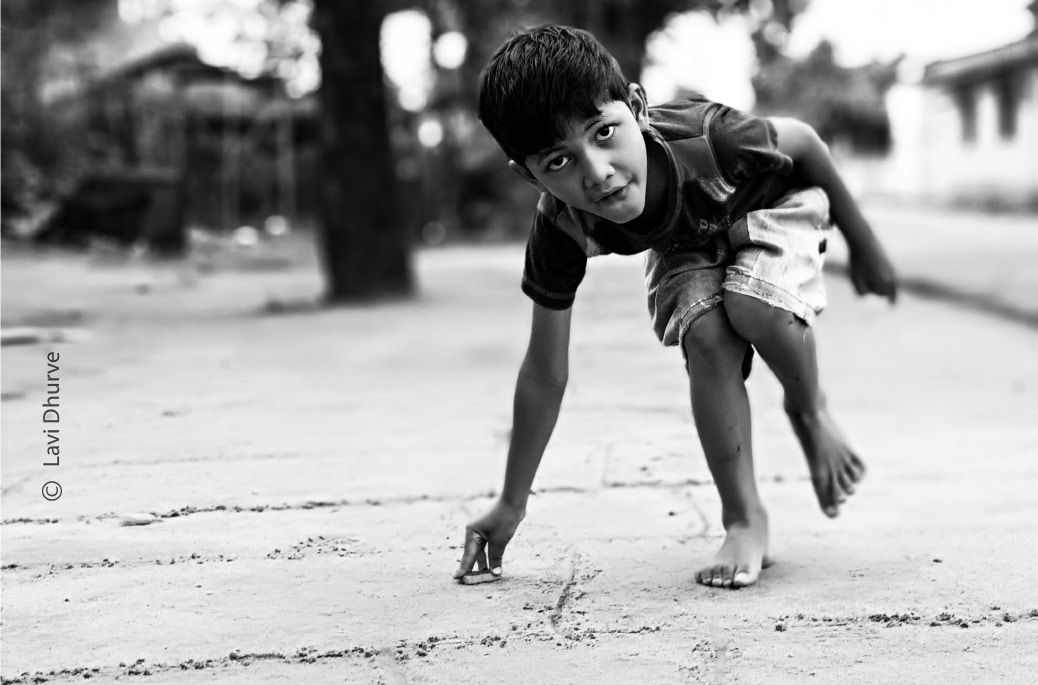
Playing Stapoo by Lavi Dhurve
Captured in the soft light of a July morning, this poignant image documents a quiet moment of childhood innocence. As the sun rises, Lavi Dhurve’s younger brother, Yuvraz, engages in a solitary game of Stapoo—a traditional Indian hopscotch variant. The photographer masterfully frames the scene to emphasize the simplicity of village life, where a child’s imagination transforms a humble outdoor space into a playground. The composition is award-worthy for its ability to elevate a fleeting, everyday activity into a timeless narrative of resilience and joy, highlighting the beauty found in the quiet corners of the Indian countryside.
Lavi Dhurve
Hailing from a small village in Madhya Pradesh, the 'Heart of India,' Lavi Dhurve finds profound inspiration in the rhythms of rural life. Her photographic practice is deeply rooted in a love for art, culture, and the human spirit, with a particular focus on capturing the beauty of children and the natural world. By documenting the simple elegance of her surroundings, from the glow of a sunrise to the daily lives of her community, she seeks to share her optimistic perspective on the inherent beauty of existence.
Resonance Score Breakdown
Transparency Note: The resonance score (11.4/20) is calculated based on social engagement metrics collected before the award announcement.
Expert Photography Reviews · 6
The Geometry of Dust
We draw lines on the earth to feel less lost. A square, a circle, a path marked out with stones or chalk. It is a way of saying: here is where I stand, and here is where I might go next.
Read the reflection →The Architecture of Play
Mycelium networks do not grow in straight lines; they follow the path of least resistance, branching out to find nutrients in the dark, damp soil.
Read the reflection →Reviews & Comments
Share your thoughts about this award-winning photograph. Your reviews contribute to the community engagement score.
Stapoo isn’t merely a game here; it’s a geometry of longing etched into the dust. Dhurve understands that shadows are the architecture of memory. When I look at Yuvraz’s solitary leap, I’m struck by a sudden, sharp ache for my own lost stillness. The light doesn’t reveal the child; it defines the boundaries of his world. It’s a heavy, silent resistance against the encroaching void. We don’t just watch him play; we watch him endure.
In this monochrome study, the absence of pigment doesn’t diminish the light; it’s a charcoal-dusted meditation on texture, reminiscent of Morandi’s hushed, dusty still lifes. The silver-grey light clinging to the boy’s skin feels like damp stone at dawn. I’m truly moved by how the shadows pool like ink in the cracks of the earth. It’s a quiet, aching symphony of greys that whispers of childhood, where the lack of colour feels like a profound, necessary truth.
In the soft dust of Sarni, we find young Yuvraz caught in the rhythm of Stapoo. It’s a quiet, solitary dance. Before Lavi clicked the shutter, I suspect he sat with his brother, listening to the scrape of stone against earth. We see that patience in the boy’s focused gaze. It’s a beautiful, fleeting stillness that makes my heart ache for the simplicity of my own childhood. This is a photograph that asks to be returned to.
There’s a quiet grace in how Yuvraz occupies that dusty ground. He isn’t performing for a lens; he’s lost in the geometry of his game. It’s clear he trusts his brother enough to forget he’s even there. That’s the secret to a real portrait. Looking at his focused stance, I’m reminded of my own childhood in the dirt. This face has a whole life in it, captured with the gentle patience of a sibling who truly sees.
Stapoo’s geometry echoes the stark, chalked grids of Helen Levitt’s New York streets, yet here, the dust of Madhya Pradesh softens the edges. It’s a quiet, rhythmic composition that avoids the sentimentality often plaguing rural documentation. I’m genuinely struck by the way the light catches the boy’s posture; it’s a fleeting, tactile grace I haven’t seen captured quite this way in years. It’s not just a game; it’s a profound, dusty meditation on childhood’s universal architecture.
You didn’t just photograph a game; you caught the exact second a boy forgets the world exists. Watching Yuvraz focused on those chalk lines, I’m reminded of my own childhood in the dust. It’s quiet, but it’s loud with life. You waited for that stillness, and it pays off. Because you were there with him, I can feel the humidity of that July morning. There’s something honest happening here. You’ve captured a real, breathing moment.