Hornets in My Garden by Lothar Seifert
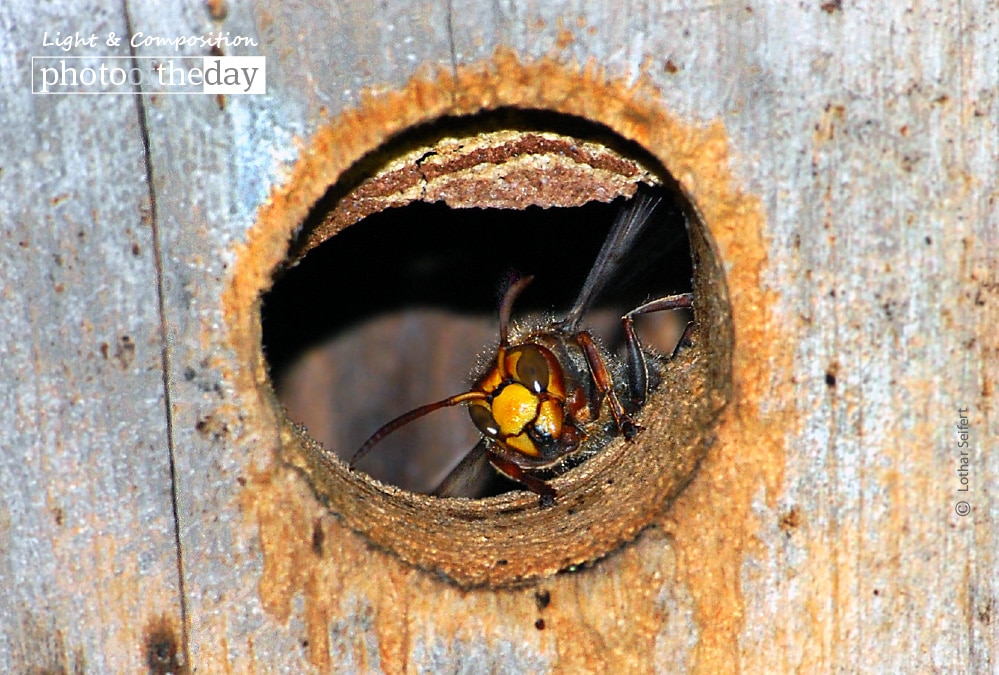
In this striking macro study, Lothar Seifert captures the intricate world of hornets nesting within a bird box. By positioning the camera in close proximity to the nest, the photographer reveals the fascinating, often misunderstood behavior of these insects. The image serves as a powerful testament to the importance of biodiversity, challenging the perception of hornets as aggressive pests and instead highlighting their vital role in the ecosystem. Seifert’s technical precision, combined with his deep respect for the natural world, creates an award-worthy perspective that invites viewers to appreciate the delicate balance of life within their own gardens.
Lothar Seifert
Born in 1955 in Germany, Lothar Seifert is a design engineer and environmental officer who balances his professional career with a profound dedication to photography. His work is deeply influenced by his extensive travels across Asia, where he developed a keen eye for portraiture and a compassionate focus on the lives of the underprivileged. Beyond his humanitarian efforts in the Himalayas, Seifert is an avid macro photographer who uses his lens to document the intricate beauty of insects and plants, aiming to foster a greater understanding and protection of the natural environment.
Resonance Score Breakdown
Transparency Note: The resonance score (11.4/20) is calculated based on social engagement metrics collected before the award announcement.
Expert Photography Reviews · 8
The Architecture of the Unseen
My neighbor, Elias, spent three summers trying to evict a colony of wasps from his porch. He saw them as invaders, a threat to his Sunday morning coffee routine. One afternoon, I found him standing perfectly still, watching them work.
Read the reflection →The Architecture of Quiet
We often mistake stillness for an absence of life, forgetting that beneath the surface of the ordinary, a frantic, rhythmic industry is always unfolding.
Read the reflection →Reviews & Comments
Share your thoughts about this award-winning photograph. Your reviews contribute to the community engagement score.
Before the eye identifies the chitinous armor, something in the chest tightens. It’s a primal, visceral activation—the sudden, sharp awareness of a threat held behind glass. I’ve spent weeks returning to these hornets, and the initial spike of adrenaline has softened into a strange, rhythmic fascination. Their architecture is terrifyingly precise. When I look at them now, I don’t see pests; I feel the hum of a hive that doesn’t care if I’m watching.
Most macro work is just clinical documentation, but this shot forces a visceral reaction. I’ve spent years looking at insect studies, and they’re usually sterile. Here, the chaotic, paper-like texture of the nest against the sharp, menacing geometry of the hornets creates a genuine tension. It’s unsettling, yet I can’t look away. In thirty years, this won’t just be a bug photo; it’ll be a reminder of the wild, complex architecture we’ve ignored in our own backyards.
It’s fascinating how Seifert treats this nest as a structural typology. The paper-thin lamellae create a complex, rhythmic fenestration that mimics our own obsession with solid and void. I’m struck by the way the light catches those delicate, tiered surfaces; it’s almost like looking at a section of a brutalist dome. It’s a claustrophobic, yet perfectly ordered space. I’ve spent my career studying buildings, but I’ve never seen a structure so beautifully, terrifyingly precise.
Sticking a lens into a hornet’s nest is a peculiar way to spend an afternoon, though I’ve certainly done sillier things for a frame. Most would have retreated at the first buzz, yet Seifert clearly lingered until the insects stopped viewing him as a threat. It’s a brave bit of work. I find myself itching just looking at it, but one must respect the sheer, stubborn patience required to earn such proximity. A proper, earned shot.
The nest hangs in the dark. Paper walls. A fragile architecture of labor. I’ve spent minutes watching the blur of wings against the wood. It’s quiet here. The hornets don’t rush. They occupy the frame with purpose, yet leave enough room for the shadows to breathe. Nothing here is accidental. The empty corner is not empty. It’s a weight. I feel a sudden, sharp urge to hold my breath. It’s perfect.
The frame’s geometry is tight, almost claustrophobic. Seifert’s aperture choice forces a relentless depth of field, pinning every chitinous segment against the wood grain. It’s a brutal, structural grid. The hornets’ chaotic movement is contained by the rigid verticality of the box. I’d argue the composition doesn’t just hold; it traps the eye. It’s a cold, calculated architecture of nature. Honestly, the sheer clinical precision of this arrangement makes me hold my breath.
Macro lenses often turn nature into a spectacle, but Seifert’s work feels different. By invading this bird box, he forces a proximity that makes me physically recoil. Is it respect to document them this closely, or just an intrusion into their private architecture? He frames these hornets as subjects, yet he’s still the one holding the power of the lens. Does the insect care about his biodiversity agenda, or is it just trying to survive?
You stood there with a D40X, inches from a nest of hornets. Most people would’ve run, but you stayed to watch them work. There’s a quiet, vibrating tension in this frame that I can feel in my own chest. You didn’t just document insects; you respected their space. Because you were patient, you captured the architecture of their survival. It’s a brave piece of work. I’ve got a lot of respect for that kind of focus.