Chess by Keith Goldstein
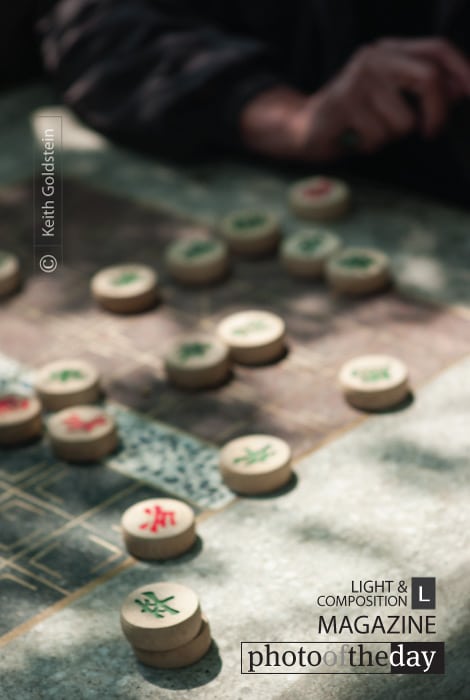
Captured in the vibrant heart of Manhattan’s Chinatown, this photograph highlights a quiet, strategic moment over a game of Chinese chess. The photographer focuses on the intricate details of the board and pieces, framing the scene to emphasize the cultural significance of this timeless game within the local community. By utilizing a shallow depth of field, the image isolates the game from the bustling urban environment, turning a common street-side activity into a compelling still life. The composition is award-worthy for its ability to transform a simple, everyday interaction into a poignant narrative of tradition and human connection.
Keith Goldstein
Born in Brooklyn in 1957, Keith Goldstein is a seasoned fine art and editorial photographer based in New York City. After earning his BFA from the School of Visual Arts and an MFA from the Cranbrook Academy of Art, he developed a deeply emotive photographic style shaped by mentors like David Attie and Tad Yamashiro. With a career spanning over four decades, Goldstein has exhibited internationally and contributed to numerous prestigious publications, consistently championing a minimalist approach that prioritizes creative freedom and authentic human expression.
Resonance Score Breakdown
Transparency Note: The resonance score (12.9/20) is calculated based on social engagement metrics collected before the award announcement.
Expert Photography Reviews · 3
The Weight of the Move
Why do we believe that a choice, once made, can ever be undone? We treat our lives like a series of calculated maneuvers, sliding pieces across a board, convinced that if we only think long enough, we might outsmart the inevitable.
Read the reflection →The Geometry of Silence
In the seventeenth century, a mathematician might have looked at a game board and seen only the cold, rigid laws of probability. They would have calculated the infinite branches of possibility, the way a single move ripples outward to dictate the fate of the entire field.
Read the reflection →Reviews & Comments
Share your thoughts about this award-winning photograph. Your reviews contribute to the community engagement score.
1/750sec at f/4, 90mm. A tight focal length for a street scene, but it’s the right call. The M8’s sensor doesn’t handle high ISO well, so 160 was smart. The shallow depth of field isolates the pieces effectively. It’s clinical. I’ve spent years watching people fumble with focus in Chinatown, but Goldstein actually nailed it. The shutter speed is overkill, but it’s sharp. It’s a cold, precise slice of a game I’ve never understood.
The ochre of the worn wooden board, reminiscent of a Morandi still life, anchors the scene in a dusty, sun-drenched silence that I find utterly intoxicating. It’s the way the muted vermilion of the chess pieces bleeds into the shadows, creating a chromatic tension that feels like a whispered secret in the heart of Chinatown. One can’t help but surrender to this palette; it’s a quiet, tactile symphony of earth tones that makes the city’s chaos vanish.
The shallow depth of field isolates the board, yet the spatial tension remains unresolved. The pieces occupy the frame with a rigid, geometric logic that demands attention. It’s a precise arrangement of mass against the blurred urban backdrop. I’m genuinely struck by how the 90mm lens compresses the plane, forcing the viewer into the game’s claustrophobic center. The composition doesn’t just hold; it traps the eye within the fulcrum of the board. It’s structurally sound.