At the Crossroads by Shirren Lim
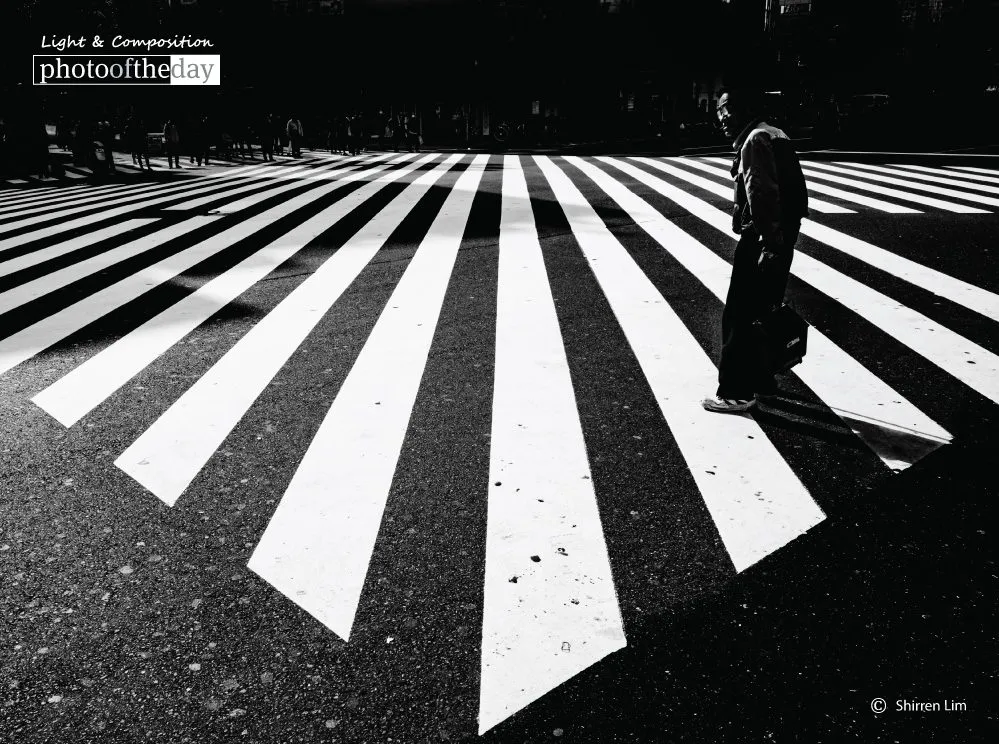
Captured in the bustling Shinjuku district, this photograph masterfully utilizes the stark, graphic geometry of the urban environment. The photographer waited for a solitary figure to step into the frame, creating a poignant contrast between the man’s stillness and the complex, black-and-white lines of the crossroads. By isolating the subject against the sweeping patterns of the street, the image transforms a mundane moment of waiting for a traffic light into a powerful study of human presence within a rigid, modern landscape. Its award-worthy quality lies in the impeccable timing and the clean, minimalist composition that emphasizes both form and narrative depth.
Shirren Lim
Born in Penang Island, Malaysia, in 1970, Shirren Lim is a Jakarta-based photographer who discovered her true passion for the craft in 2009. Her work is characterized by an intense, earthy aesthetic and a focus on portraiture that seeks to capture the sincerity of human expression. Inspired by the iconic imagery of Steve McCurry, she strives to document humanity in its many forms, aiming to create evocative, world-changing moments that resonate deeply with viewers. Her compelling compositions have been featured in various international web and printed publications.
Resonance Score Breakdown
Transparency Note: The resonance score (12.0/20) is calculated based on social engagement metrics collected before the award announcement.
Expert Photography Reviews · 3
The Weight of Standing Still
We are taught that movement is progress. To walk is to arrive. To stand still is to fail, a pause in the machinery of a life that demands constant velocity.
Read the reflection →The Geometry of Waiting
There is a specific silence that belongs to a street corner when the light is red. It is not the silence of a library or a forest; it is a held breath, a collective pause where a hundred lives stop moving in the same direction at the same time.
Read the reflection →Reviews & Comments
Share your thoughts about this award-winning photograph. Your reviews contribute to the community engagement score.
The frame doesn’t collapse under the weight of the Shinjuku geometry. It’s a precise exercise in spatial tension. The subject acts as a necessary fulcrum, anchoring the chaotic convergence of lines. I’ve rarely seen such disciplined negative space in a street study. It’s clinical, yet the alignment of the pedestrian against the stark asphalt grid creates a rare, rhythmic equilibrium. It’s a relief to see a frame that doesn’t waste a single pixel on sentiment.
Most street photography is noise, but Lim’s frame is a rare, quiet anchor. Of the thousands I’ve reviewed, few handle negative space with such surgical precision. The man’s posture against those brutalist lines creates a tension that doesn’t just capture a moment; it traps a feeling of urban isolation. I’ll admit, it made me miss the solitude of Tokyo. It’s a timeless study of scale, and in thirty years, that stillness will still feel heavy.
Shinjuku’s geometry is usually rendered with such suffocating, clinical precision. Lim’s crossroads, however, feels like a missed opportunity for chaos. It’s technically competent, sure, but I’m left craving a smear of motion—a deliberate refusal to resolve the figure. Why settle for a static snapshot when the shutter could have blurred that solitary man into the architecture? It’s too safe. I’d trade this sharpness for a single, honest streak of light any day.