Serengeti Wildebeest Migration by Martin Meyer
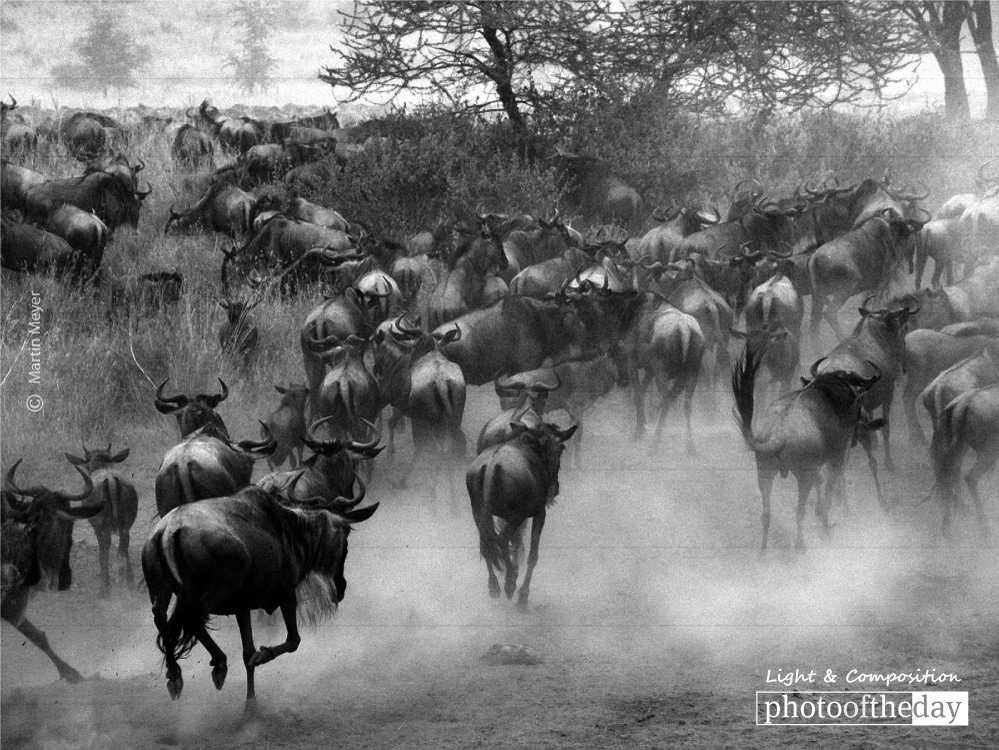
Captured amidst the vast northern Serengeti plains of Tanzania, this photograph documents the raw, rhythmic power of the great wildebeest migration. The image freezes a moment of this natural spectacle, highlighting the sheer scale and movement of the herds as they traverse the landscape. By focusing on the interplay between the animals and their environment, the photographer emphasizes the urgency and majesty of one of the world’s most iconic wildlife events. The composition’s strength lies in its ability to translate the chaotic energy of the migration into a singular, compelling narrative of survival and natural order.
Martin Meyer
Based in Cape Town, South Africa, Martin Meyer is a distinguished photographer and qualified field guide with extensive expertise in leading expeditions across Southern and East Africa. Alongside his partner Nicole, he has cultivated a unique brand that integrates high-end photographic safaris with natural history education and bespoke travel experiences. With a deep-rooted passion for the outdoors and a background in emergency response, Meyer combines technical photographic skill with an intimate knowledge of African ecosystems, establishing himself as a sought-after authority in wildlife documentation and adventure travel.
Resonance Score Breakdown
Transparency Note: The resonance score (10.7/20) is calculated based on social engagement metrics collected before the award announcement.
Expert Photography Reviews · 4
The Weight of the Herd
There is a rhythm to survival that does not require a name. It is a pulse, felt in the soles of the feet, a collective agreement to move forward because the alternative is to be left behind.
Read the reflection →The Rhythm of the Dust
I remember sitting in a Land Rover outside of Arusha, watching a local guide named Elias trace a line in the dirt with his boot. He told me that the land doesn't belong to the people, or the animals, but to the movement itself.
Read the reflection →Reviews & Comments
Share your thoughts about this award-winning photograph. Your reviews contribute to the community engagement score.
The frame operates on a rigorous diagonal tension, forcing the wildebeest into a cascading vector that bisects the negative space. It’s a masterclass in recursive geometry; the herd’s density creates a fractal rhythm against the horizon’s flat, horizontal axis. I’ve rarely seen such chaotic movement resolved into a perfect 3:5 ratio of mass to void. It’s mathematically exhilarating. Honestly, the way those converging lines pull my eye toward the center of gravity makes my pulse race.
The dust hangs heavy, caught in that low, golden light that only arrives when the sun finally relents. Martin didn’t chase this; he waited for the plains to exhale. I feel a sudden, sharp ache in my own chest looking at the sheer weight of their movement. It’s not just a migration; it’s a prayer of survival. He stood in the cooling hour, listening to the earth tremble, until the land finally gave him this truth.
f/8 at 1/1000s, 400mm, ISO 400. A calculated choice to freeze the dust and the chaos. The shutter speed is adequate, but the depth of field at f/8 leaves the background wildebeest uncomfortably soft. It’s a functional compromise. I’ve spent hours staring at these herds, and the sheer kinetic noise here actually makes my pulse quicken. Meyer didn’t overthink the optics. He prioritized the movement. It’s technically sound, even if it lacks surgical sharpness.
The dust kicks up, a frantic, golden haze that swallows the horizon. It’s a tracking shot frozen in time. Meyer caught the exact beat where the herd’s chaos finds its rhythm. I’ve watched this migration a dozen times, but here, the shutter speed holds the tension perfectly. Any faster and the motion dies; any slower and it’s just a blur. It’s breathless. I can almost hear the thunder of hooves echoing against the Serengeti floor.