A View from the Sky Bridge by Siew Bee Lim
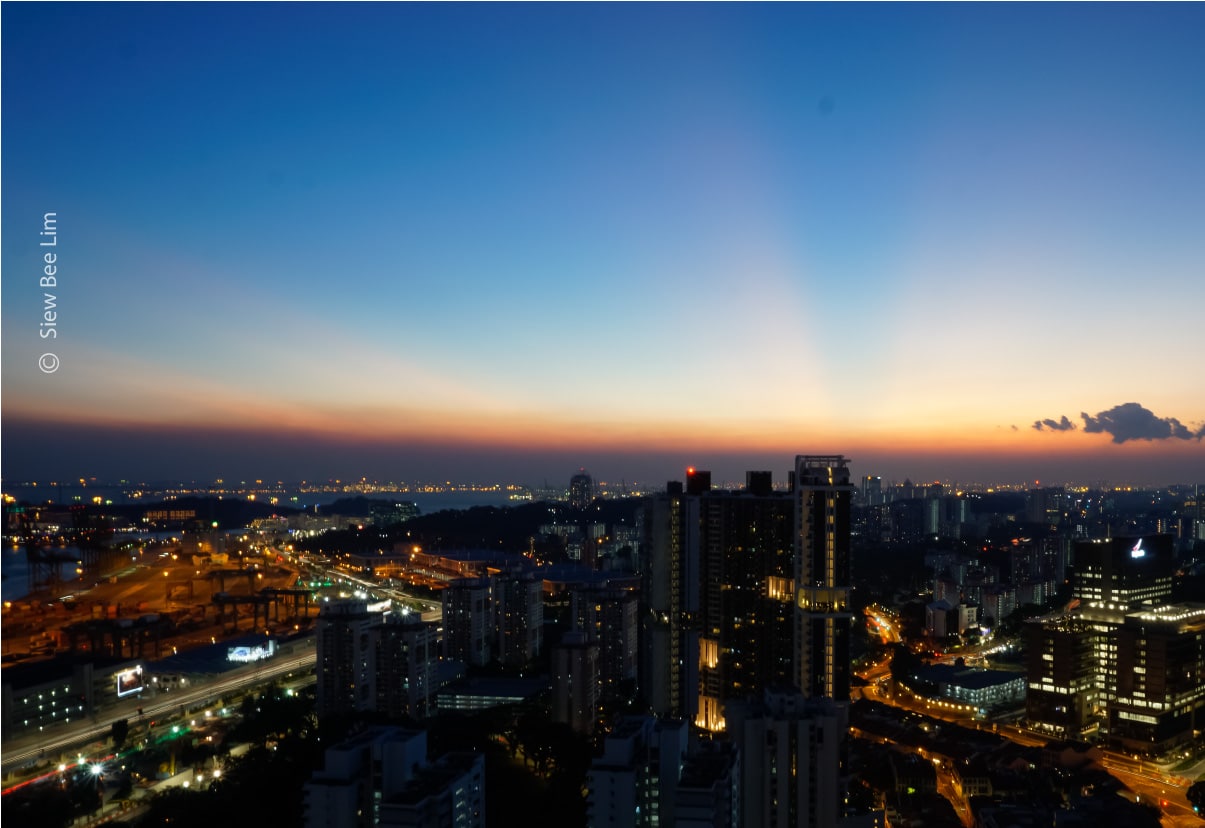
Captured from the 50th-floor sky bridge of The Pinnacle @ Duxton in Singapore, this image offers a serene perspective of the city after sunset. The photographer utilized an eight-second exposure to capture the vibrant urban lights, transforming the unique architectural feature of this public housing project into a glowing vantage point. By choosing a wide-angle focal length, the composition emphasizes the vastness of the sky garden and the intricate connectivity of the seven residential blocks. This photograph is award-worthy for its technical precision in low-light conditions and its ability to elevate a modern urban structure into a compelling, atmospheric narrative of city life.
Siew Bee Lim
Born in 1965 in Singapore, Siew Bee Lim is a dedicated photographer who rediscovered her passion for the craft later in life. After a brief introduction to darkroom techniques during her early career as a programmer, she has returned to photography with a renewed commitment to formal learning and artistic growth. Drawing inspiration from her lifelong appreciation for literature and traditional Chinese painting, she seeks to translate her unique perspective into compelling imagery. Currently, she is refining her technical skills through the Light & Composition platform to further develop her creative voice.
Resonance Score Breakdown
Transparency Note: The resonance score (10.7/20) is calculated based on social engagement metrics collected before the award announcement.
Expert Photography Reviews · 6
The Architecture of Starlight
We spend our lives building nests of brick and glass, trying to tether ourselves to the earth, yet we are always looking upward. There is a quiet hunger in the way we climb, seeking a vantage point where the noise of the street dissolves into a hum of distant gold.
Read the reflection →The City That Never Sleeps
I stood on my balcony this evening, watching the cars crawl along the highway like glowing ants. It was one of those nights where the humidity hangs heavy, and the city feels like it is breathing right along with you.
Read the reflection →Reviews & Comments
Share your thoughts about this award-winning photograph. Your reviews contribute to the community engagement score.
Eight seconds is an eternity on the street. It’s a gamble against chaos. While the geometry of The Pinnacle’s sky bridge is clean, it’s static. I miss the grit of Winogrand here. Where’s the human pulse? It’s technically sharp, sure, but the decisive moment is missing. I want to see someone running, a shadow shifting, life interrupting the architecture. It’s a beautiful postcard, but it doesn’t breathe. I’d trade that long exposure for one heartbeat of truth.
At f/16, the diffraction limit begins to soften the city’s distant points of light, yet it’s a calculated trade-off for that deep, expansive focal plane. I’m genuinely moved by how the 16mm wide-angle optics render the sky bridge’s geometry; it’s a crisp, clinical capture of urban density. While the sensor’s dynamic range struggles slightly with the high-contrast highlights, the sheer clarity of the architecture against the night sky is, quite frankly, a beautiful optical achievement.
8sec at f/16, ISO 100, 16mm. Stopping down to f/16 on a kit lens creates diffraction that softens the city lights into mushy, bloated starbursts. It’s a technical error that compromises the sharpness of the Duxton blocks. I’ve spent years looking at these sensors; they don’t handle that aperture well. The long exposure is fine, but the optics are fighting the settings. It’s frustrating to see such a clean vantage point sabotaged by basic diffraction.
Fifty floors up, the wind at the Pinnacle bites harder than most realize. It’s a cold, lonely vigil, and I’ve spent enough nights shivering on rooftops to know when someone’s actually put in the hours. The eight-second exposure here isn’t just a technical choice; it’s a commitment to the stillness. One can feel the patience in those crisp, glowing lines. It’s a rare, quiet dignity for a city that usually refuses to sit still.
The Pinnacle’s sky bridge is a triumph of datum, yet here, the long exposure flattens the city into a static, glowing carpet. It’s a clean composition, but it misses the vertigo—that visceral, wind-swept threshold between solid and void. I’ve walked those decks; they’re about the scale of the human body against the infinite. While the light hits the fenestration beautifully, I’m left wanting the grit of the people who actually inhabit this vertical neighborhood.
The steel curves of the sky bridge frame the city like a modern, glowing proscenium. I’m struck by how the cold, geometric lines of The Pinnacle force us to look outward, turning the residents into mere silhouettes against the vast, electric pulse of Singapore. It’s a lonely, beautiful vantage point. The architecture doesn’t just house these people; it defines their isolation. I find myself shivering slightly, feeling the weight of that immense, silent height beneath their feet.