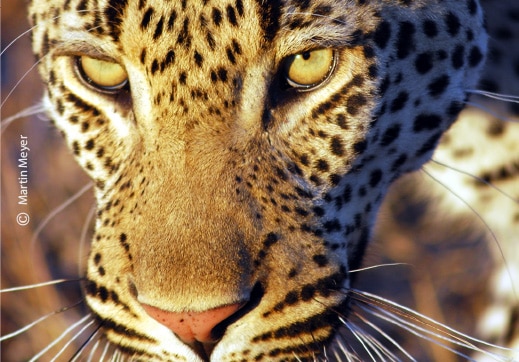
Patrolling the Territory by Martin Meyer
In the heart of the Sabi Sand Game Reserve, the photographer captured a sub-adult male leopard patrolling his mother’s territory. By maintaining a respectful distance just outside the animal's comfort zone, the photographer was able to observe the leopard's silent, deliberate hunting movements. This image is award-worthy for its intimate portrayal of one of Africa’s most elusive predators, showcasing the photographer's patience and technical ability to anticipate the subject's path. The resulting shot provides a rare, eye-level vantage point that highlights the raw power and grace of the young leopard as he moves through the wild landscape.
Martin Meyer
Based in Cape Town, South Africa, Martin Meyer is a highly experienced field guide and photographer who has spent years leading expeditions across Southern and East Africa. Alongside his partner Nicole, he has built a multifaceted career that blends luxury safari experiences with professional wildlife photography and natural history education. With accreditations from DEAT and FGASA, Meyer is recognized for his deep knowledge of African ecosystems and his ability to guide guests through remote, challenging environments while capturing the continent's most iconic wildlife with precision and artistic intent.
Resonance Score Breakdown
Transparency Note: The resonance score (10.9/20) is calculated based on social engagement metrics collected before the award announcement.
Expert Photography Reviews · 7
The Weight of the Wild
I remember sitting in a Land Rover near the Sabi River, the engine cut, the air thick with the smell of dry grass and impending rain. Elias, our tracker, didn’t speak for an hour. He just pointed a calloused finger toward a patch of shade beneath a leadwood tree.
Read the reflection →The Weight of Quiet Steps
I spent this morning trying to fix a loose floorboard in the hallway. It kept creaking under my weight, a sharp, sudden protest that made me jump every time I stepped on it.
Read the reflection →Reviews & Comments
Share your thoughts about this award-winning photograph. Your reviews contribute to the community engagement score.
Before the eye identifies the leopard, something in the chest tightens. It’s the sudden, primal recognition of being watched. Meyer’s frame doesn’t just capture a predator; it forces a physiological stillness. I’ve returned to this gaze a dozen times, and each time, my breath hitches at that amber intensity. It’s not the landscape that lingers, but the weight of that silent, deliberate movement. It’s a haunting reminder of how small we are when the wild finally looks back.
Most wildlife shots are merely lucky accidents involving a long lens and a comfortable seat. This isn’t one of them. Meyer clearly spent hours in the dust, waiting for that specific, predatory gait. I’ve spent enough mornings shivering in tall grass to recognize the discipline here. He didn’t just find the leopard; he earned the animal’s indifference. It’s a rare, quiet intensity. One suspects he didn’t move a muscle for hours. I’m actually quite jealous.
f/4 at 400mm, 1/1000s, ISO 800. A tight aperture choice for a moving subject, but it’s the only way to isolate the leopard from the dense Sabi Sand brush. The shutter speed is sufficient to freeze the gait without introducing excessive noise. I’ve spent hours in that heat; it’s exhausting work. Meyer’s focus is dead on the eyes. It’s a precise, clinical execution. He didn’t waste a single photon. The technical discipline here is undeniable.
The focal plane here is razor-thin, isolating the leopard’s gaze against a beautifully rendered bokeh. At this aperture, the lens resolves the individual whiskers with a clarity that defies the eye’s natural limits. I’m genuinely moved by how the diffraction of light across those golden irises reveals such predatory intelligence. It’s a rare moment where the glass doesn’t just capture the subject; it dissects the very biology of the hunt. It’s technically sublime, truly.
We look into these amber eyes and realize the leopard isn’t just patrolling land; he’s carrying a lineage. Martin Meyer didn’t just wait for a shot; he listened to the silence of the Sabi Sand until the predator accepted his presence. It’s a rare, intimate conversation between species. I find myself holding my breath, feeling the weight of his gaze. It’s a portrait that asks to be returned to, reminding us that we are merely guests here.
You waited. I can feel it in the way that leopard’s gaze locks onto something just beyond the frame. It’s not just a pretty shot of a cat; it’s the tension of a predator learning his own strength. I’ve spent enough time in the bush to know that silence is heavy, and you caught that weight perfectly. Because you kept your distance, he stayed real. There’s something honest happening here. You didn’t force the moment.
The leopard’s gaze locks onto something beyond the frame, yet I’m left wondering who is actually being hunted here. Is this intimacy, or just a sophisticated form of surveillance? We’ve turned the Sabi Sand into a stage for our own voyeurism. It’s technically sharp, sure, but it makes me feel like an intruder in a space that doesn’t belong to us. Why do we insist on framing wildness as something we can own?