Lighthouse by Hanks Tseng
Captured along the harbor, this evocative long-exposure photograph portrays a lighthouse as a guiding beacon beneath a sky of radial clouds. The photographer masterfully utilizes a slow shutter speed to soften the fierce sea, transforming the crashing waves into a welcoming presence for returning fishing vessels. This image is award-worthy for its poetic interpretation of maritime safety and its ability to turn a functional harbor scene into a serene, ethereal landscape. The interplay between the lighthouse’s steady light and the dynamic, blurred motion of the water creates a profound sense of peace and arrival.
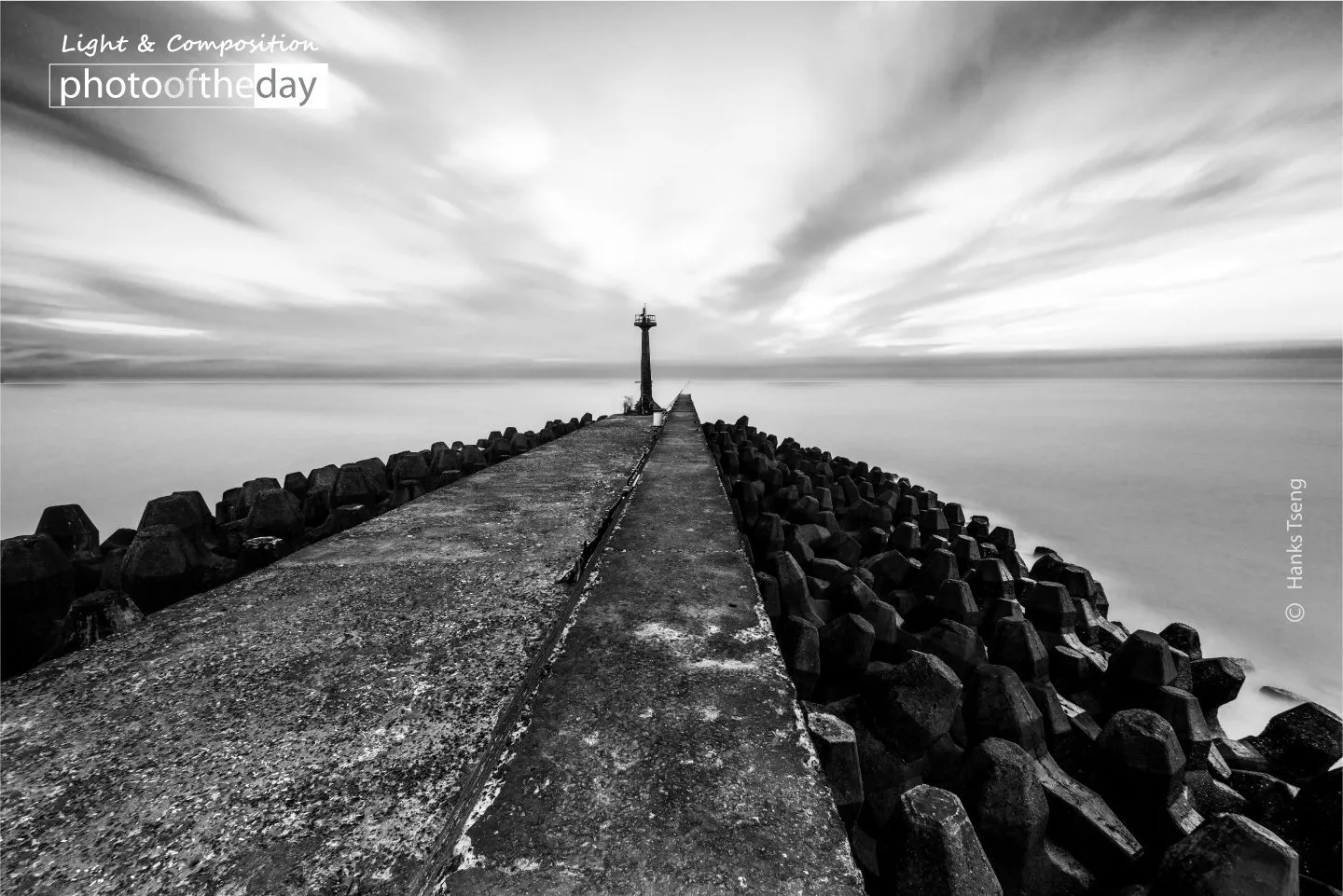
Hanks Tseng
Born in Taoyuan, Taiwan, Hanks Tseng is a dedicated photographer who finds his greatest inspiration in the natural world. Now retired, he spends his days capturing the beauty of landscapes, with a particular expertise in seascapes, forests, and streams. His signature style utilizes slow shutter speeds to evoke a sense of profound peace and quietude, transforming ordinary environments into ethereal, beautiful compositions that he shares with an international audience.
Resonance Score Breakdown
Transparency Note: The resonance score (12.2/20) is calculated based on social engagement metrics collected before the award announcement.
Expert Photography Reviews · 4
The Anchor of the Dark
I keep a small, rusted brass compass in the top drawer of my desk, its needle long ago surrendered to the stillness.
Read the reflection →The Constant in the Dark
I remember sitting on a rusted bench in Marseille with an old fisherman named Elias. He spent his days watching the harbor entrance, his hands calloused and stained by decades of salt.
Read the reflection →Reviews & Comments
Share your thoughts about this award-winning photograph. Your reviews contribute to the community engagement score.
The shutter stays open, and the sea turns to silk. It’s a long take that breathes. I’m struck by how the lighthouse anchors the frame while the sky spins in a radial blur. It’s a perfect edit; the cut would’ve ruined the rhythm. Tseng understands that time isn’t just captured here, it’s stretched. I’d give anything to stand on that pier. It’s the kind of frame an editor keeps because it holds the silence.
The radial sky here feels less like a weather report and more like a deliberate dismantling of the horizon. It’s closer to Hiroshi Sugimoto’s long-exposure theatres than to conventional maritime documentation. I’m genuinely struck by the lighthouse’s refusal to anchor the frame; it’s a ghost in its own harbor. Why resolve the architecture when the motion tells the real story? Tseng’s choice to dissolve the sea into static vapor is a brave, welcome rejection of sharpness.
The lighthouse anchors the frame, providing a necessary fulcrum against the radial sky. It’s a rigid verticality that prevents the long-exposure blur from dissolving into mere chaos. The negative space above the horizon line is balanced by the heavy, softened foreground. I’m genuinely unsettled by how the structure holds the composition together despite the motion. It doesn’t collapse. The visual architecture is precise, disciplined, and entirely necessary to keep the frame from drifting into sentimentality.
It’s a strange relief to see the sea rendered in monochrome. Down here, I’m constantly battling the refractive index and the brutal way water steals the red spectrum, leaving us in a blue-grey void. Tseng’s long exposure turns the chaotic, frothing surge into a velvet stillness I rarely find beneath the surface. It’s hauntingly quiet. I’d give anything to dive into that silk-smooth water, knowing exactly how much energy those waves usually hold.
It’s greatest
Thanks
Love this picture so much!
Thanks
Nice?
Thanks
Great shot! Beaultiful work of composition and light.
Thanks