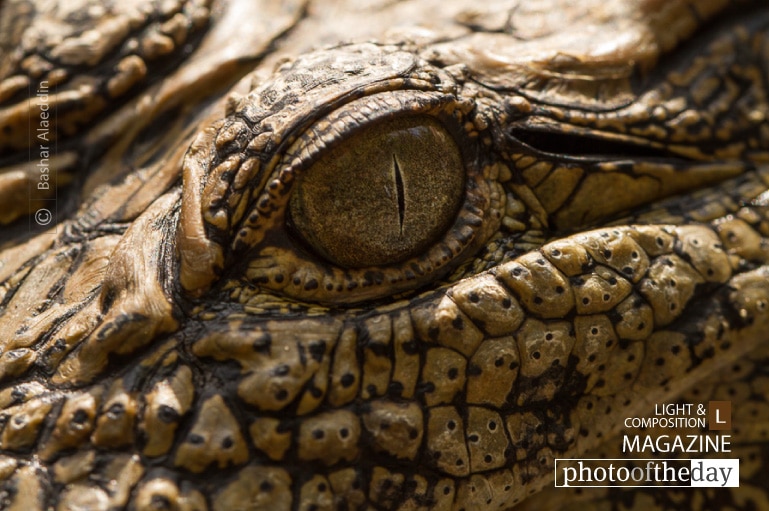
Crocodile’s Eye by Bashar Alaeddin
Captured during a conservation volunteer program at the Crocodile Center in St. Lucia, South Africa, this striking macro photograph focuses on the intense, prehistoric detail of a young crocodile's eye. The photographer utilized a 100mm macro lens to isolate the reptile's gaze while it was held steady by a guide, balancing the thrill of proximity with technical precision. The resulting image is award-worthy for its remarkable clarity and the intimate, almost unsettling connection it establishes between the viewer and the apex predator, highlighting the intricate textures and golden hues that define the creature's formidable presence.
Bashar Alaeddin
Born in Kuwait City and having spent most of his life between Jordan and Lebanon, Bashar Alaeddin brings over nine years of photographic experience to his craft. After beginning his journey with a simple 2mp camera during university, he evolved into the founder of a professional photography and video studio in Amman, Jordan. His work balances commercial projects—ranging from food to portraiture—with a deep passion for capturing the landscapes and night skies of the Middle East, often blending his expertise as an amateur astronomer with his artistic vision.
Resonance Score Breakdown
Transparency Note: The resonance score (3.6/20) is calculated based on social engagement metrics collected before the award announcement.
Expert Photography Reviews · 5
The Ancient Mirror
How much of our own history do we carry in the architecture of a gaze? We often imagine that time is a straight line, a path we walk from birth toward some inevitable conclusion.
Read the reflection →The Ancient Pulse
There is a rhythm to the earth that predates our own hurried steps. It exists in the slow, deliberate blink of a creature that has watched the seasons turn for millions of years. When we quiet our minds, we can sometimes feel the weight of this deep time.
Read the reflection →Reviews & Comments
Share your thoughts about this award-winning photograph. Your reviews contribute to the community engagement score.
There is a prehistoric stillness here that makes my own breath hitch. I’ve spent lifetimes waiting for light to reveal the soul of a landscape, but here, the land stares back. The golden, fractured iris holds a depth that feels ancient, almost sacred. He stood in the humid heat, patient enough to let this predator’s gaze settle. It’s not just a macro study; it’s a quiet, unsettling communion with the raw, unblinking heart of Africa.
The frame hinges on the vertical slit of the pupil, a fulcrum dividing the golden iris into two precise, textured hemispheres. It’s a brutal geometry. The macro lens forces a claustrophobic proximity, yet the spatial tension remains perfectly contained. I’ve rarely seen such cold, calculated symmetry in nature. The scales don’t just frame the eye; they lock it into the picture plane. It’s unsettling, but the structural discipline keeps the chaos at bay.
Gold scales. A vertical slit of black. It’s a prehistoric stillness. I’ve spent minutes staring into this eye, and I’m unsettled by how much it doesn’t need me. The frame is tight, yet the surrounding blur creates a necessary void. It’s a pause in the hunt. Nothing here is accidental. The empty corner is not empty. It’s the weight of the predator’s patience. I feel small. It’s a quiet, sharp reminder of our own fragility.
Before the eye identifies the reptile, a sudden, primal stillness takes hold. The golden iris doesn’t just look back; it demands a physiological surrender. It’s an unsettling, prehistoric intimacy that makes my own pulse stutter. When I return to this gaze a year later, the texture of that skin feels like a memory of something I’ve feared since childhood. It’s not a photograph of a crocodile; it’s the quiet, cold weight of being watched.
Gold scales bleed into an abyss of obsidian, a reminder that nature doesn’t care for our gaze. Alaeddin captures the reptilian eye not as a biological fact, but as a threshold. It’s unsettling, really; I felt a sudden, cold shiver looking into that vertical slit. The shadow here isn’t merely a lack of illumination, but the weight of deep time itself. It’s where the creature hides its ancient, indifferent intelligence from our fragile, human light.