Inle Lake Hooligans by Ryszard Wierzbicki
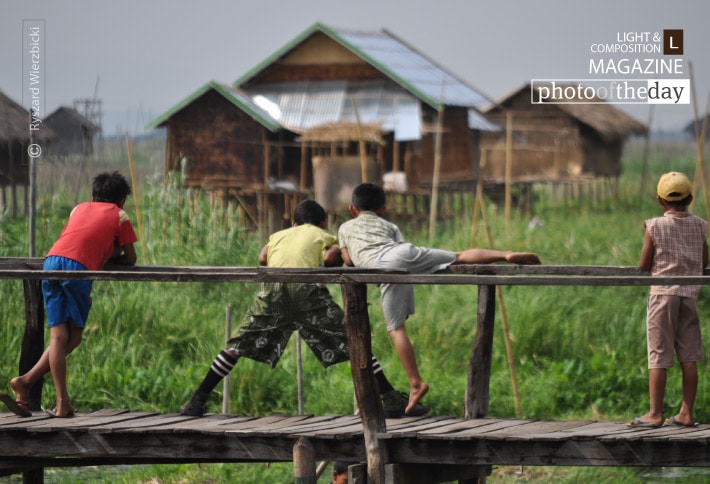
Captured during an Easter journey through Myanmar in 2011, this image offers an intimate glimpse into life on Inle Lake. While resting on the terrace of a floating hut, the photographer observed local children—affectionately dubbed 'hooligans'—watching the daily activities of fishermen nearby. The composition highlights the unique cultural landscape of the Intha people, who reside in stilt houses and navigate the waters with their distinctive leg-rowing technique. This photograph is award-worthy for its candid storytelling and its ability to capture a fleeting, authentic moment of childhood curiosity amidst the serene, drifting gardens of a remote aquatic community.
Exposure 1/250sec @ f/5 | ISO 500 | Focal Length 145mm
Ryszard Wierzbicki
Born in 1963 and a graduate of the University of Gdańsk, Ryszard Wierzbicki transitioned from a career in social sciences and marketing to become a dedicated traveler and photographer after emigrating to the United Kingdom in 2006. His work is deeply influenced by his extensive explorations of South-East Asia and his volunteer efforts with orphanages in Thailand and Myanmar. As the founder of the travel and photography forums Instant Travelling and World Around, Wierzbicki balances his professional life as a marketing advisor with a profound passion for documenting the world through his lens.
Resonance Score Breakdown
Transparency Note: The resonance score (11.1/20) is calculated based on social engagement metrics collected before the award announcement.
Expert Photography Reviews · 7
The Architecture of Play
There is a specific gravity to childhood that adults often misremember. We tend to view the early years as a state of aimless wandering, a soft-focus period of innocence before the hard edges of responsibility take hold.
Read the reflection →The Weight of Water
There is a specific kind of stillness that only exists near deep water. It is not the absence of sound, but a suspension of it. We spend our lives building foundations on solid ground, convinced that permanence is a virtue.
Read the reflection →Reviews & Comments
Share your thoughts about this award-winning photograph. Your reviews contribute to the community engagement score.
The frame holds a restless energy, a freeze-frame of childhood kineticism before the splash. It’s the shot an editor keeps because the tension is palpable. I’ve watched these kids on the water; they’re waiting for the cut that never comes. That 145mm focal length compresses the space, pushing the stilt houses into a tight, rhythmic backdrop. It’s a beautiful, chaotic moment. I honestly wish I’d been there to hear the water hit those wooden hulls.
Before the eye identifies the children, something in the chest tightens. It’s the stillness of the water, that heavy, humid silence of Inle Lake. I feel a sudden, sharp ache for the uncomplicated curiosity of those faces. When I return to this, I don’t see the gear or the technique; I see the fleeting, restless energy of youth anchored to a stilt house. It’s a quiet, drifting reminder of how quickly our own childhoods dissolve.
The light here doesn’t merely illuminate; it interrogates the wooden slats of the stilt house. These children aren’t just watching fishermen; they’re suspended in a liminal space between the water’s dark, heavy depths and the harsh, unforgiving sun. I’m unsettled by how the shadows cling to their limbs, anchoring them to a reality that feels fragile. It’s a haunting reminder that childhood is often just a brief, sun-drenched pause before the inevitable, encroaching dark claims us all.
The light here isn’t just illumination; it’s the soft, humid breath of Inle Lake itself. Wierzbicki didn’t chase these children. He sat on that terrace until the water turned to glass and the air grew still enough for them to forget he was there. I feel a sudden, sharp ache in my chest looking at their faces—it’s the quiet recognition of a world that doesn’t know it’s being watched. He listened, and the lake spoke back.
The ochre of the children’s skin, echoing the sun-drenched timber of these stilt houses, creates a chromatic resonance that feels like a Vermeer interior cast adrift upon the water. It’s the muted, dusty teal of the lake that truly haunts me; it’s a melancholy, shallow-tide blue that makes my heart ache for a stillness I’ve never known. One finds here a palette of quiet, humid intimacy, where light doesn’t merely illuminate, but breathes.
At 145mm, the Nikon’s variable aperture creates a shallow focal plane that isolates these children against the lake’s soft, refractive bokeh. It’s a delicate balance; the diffraction limit at f/5 keeps the textures of their skin and the weathered wood sharp, while the light scattering off the water feels almost liquid. I’m genuinely moved by how the lens captures that fleeting curiosity. It’s not just a snapshot; it’s a precise, optical rendering of a quiet, human moment.
It’s easy to snap a shutter from a terrace while the tea stays warm. One suspects Wierzbicki didn’t spend much time shivering in the reeds for this one. It’s a pleasant enough scene, but it lacks the grit of a long, damp vigil. I’ve spent enough hours waiting for the light to turn to know when a photographer has simply been lucky. It’s a charming snapshot, but it hasn’t been earned. It’s just a holiday souvenir.