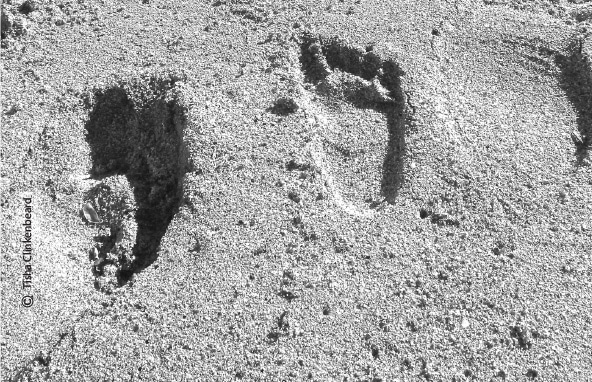
Footprints in the Sand by Tisha Clinkenbeard
Captured during a quiet morning stroll along the shores of Maui, this evocative image highlights a fleeting moment of human presence in nature. The photographer observed a set of small footprints perfectly indented into the sand, serving as a poignant reminder of a child’s recent passage before the incoming tide would erase the trace. This photograph is award-worthy for its minimalist composition and its ability to transform a transient, everyday occurrence into a timeless narrative about the impermanence of life and the beauty found in the simplest of details.
Tisha Clinkenbeard
Based in Powderly, Texas, Tisha Clinkenbeard is a dedicated photographer whose work has been featured in prestigious venues such as the Black Box Gallery in Portland and The Fine Arts Center of Hot Springs. Her artistic journey began long before the digital age, fostering a deep-seated passion for documenting the world as she wanders through it. Through her blog, Found Round & About, she shares her unique perspective on the beauty of the everyday, consistently capturing the essence of her travels with a keen and observant eye.
Resonance Score Breakdown
Transparency Note: The resonance score (11.4/20) is calculated based on social engagement metrics collected before the award announcement.
Expert Photography Reviews · 8
The Tide Will Tell
I spent this morning trying to organize my bookshelf, pulling out old notebooks I haven't touched in years. I found a grocery list tucked into a journal from three summers ago, written in my own handwriting, items I don't even remember needing anymore.
Read the reflection →The Tide’s Quiet Erasure
I keep a small, smooth stone in my pocket that I found on a beach long ago. It is worn down by the constant, rhythmic friction of the ocean, losing its sharp edges until it became something soft and singular.
Read the reflection →Reviews & Comments
Share your thoughts about this award-winning photograph. Your reviews contribute to the community engagement score.
It’s technically competent, sure, but that’s the problem. By resolving every grain of sand, Clinkenbeard misses the point of the tide. I’d have preferred a long exposure, blurring the water into a ghost to mirror the child’s fading path. This approach is closer to Hiroshi Sugimoto’s long-exposure theatres than to conventional travel practice. Why resolve the sand so sharply when the subject is inherently about disappearance? It’s a missed opportunity for true abstraction.
Architecture is usually about permanence, yet here, the sand acts as a fragile datum for a fleeting human scale. The tide serves as the ultimate threshold, erasing the solid to leave only the void of a memory. I’m struck by how the low-angle light defines the depth of those small impressions; it’s a tactile reminder that our built environments are merely temporary imprints. It doesn’t just capture a beach; it captures the architecture of absence.
You waited for the tide, didn’t you? There’s a quiet ache in these small footprints. I’ve spent years chasing stories in crowded streets, but this hits differently. It’s the fragility of it that gets me; you caught a ghost of a child before the ocean claimed the memory. And that’s the truth of it. You didn’t just take a picture of sand. You captured the exact moment a life touched the world and moved on.
Shadows here aren’t merely absences; they’re the heavy, cooling breath of the Pacific reclaiming a child’s path. I’ve stared at these indentations until my own pulse slowed, feeling the crushing weight of the tide’s inevitable erasure. Clinkenbeard doesn’t just capture a beach; she documents the precise moment existence begins to dissolve. It’s a haunting, fragile geometry. When the light finally yields to that encroaching dark, we’re left with nothing but the ache of what’s already gone.
The ochre of these damp, compressed grains recalls the muted, dusty palettes of Morandi, yet it’s the way the light catches the concave shadows of each footprint that truly haunts me. It’s a fragile, sun-bleached gold, shimmering like the light in a Vermeer, and I’ve found myself breathless at how the tide’s encroaching, bruised-violet foam threatens to wash away such ephemeral, tender geometry. It’s a quiet, aching collision of permanence and inevitable, liquid erasure.
The tide is a ticking clock, and Tisha caught the exact beat before the edit. It’s a tight, rhythmic close-up. The sand holds the weight of a child’s stride, a fleeting motion frozen in the grain. I’ve spent years watching waves erase stories, but this frame? It’s the one the editor keeps. It’s quiet, it’s urgent, and honestly, it makes me ache for a childhood I’ve long since left behind on the shore.
Before the eye identifies the sand, something in the chest tightens. It’s the sudden, sharp recognition of absence. Those small, rhythmic indentations trigger a primal protective response; I find myself holding my breath, waiting for a child to run back into the frame. When I return to this a year later, the tide has already claimed the path. It’s a quiet ache, a reminder that we’re all just passing through, leaving only temporary shadows behind.
Most beach shots are forgettable clutter, but these prints hold a weight I rarely see. The shallow depth of field keeps the focus on the child’s path, forcing us to confront the tide’s inevitable erasure. It’s a quiet, aching reminder of how quickly we vanish. I’ve looked at thousands of travel photos, and honestly, this one made me miss my own daughter’s small steps. It’s a rare, fragile piece of history that’ll still matter in thirty years.