A Grateful Smile by Ryszard Wierzbicki
Captured in Ajmer, India, during a poignant encounter in July 2011, this portrait documents a moment of profound human connection. After providing food to two hungry children, the photographer was granted the rare opportunity to photograph them. The resulting image captures the older girl’s sincere, grateful smile—a fleeting expression of joy amidst hardship. The photograph is award-worthy for its raw emotional honesty and the photographer's ability to transform a simple act of kindness into a timeless visual narrative, preserving a memory of resilience and gratitude that transcends cultural and economic boundaries.
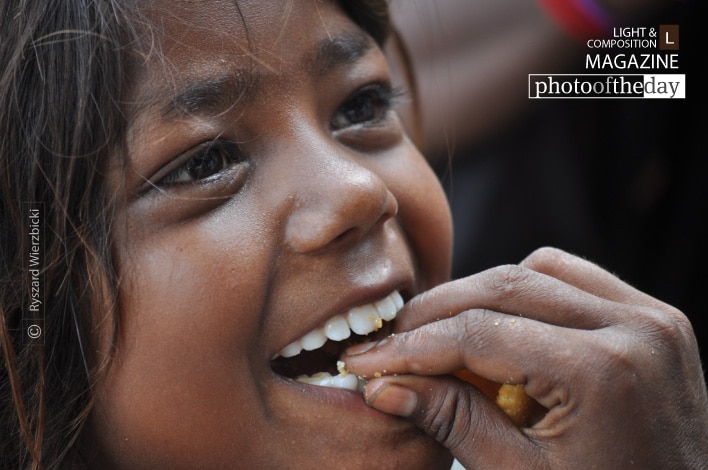
Exposure 1/250sec @ f/5 | ISO 500 | Focal Length 135mm
Ryszard Wierzbicki
Born in 1963 and a graduate of the University of Gdańsk, Ryszard Wierzbicki transitioned from a career in social sciences and marketing to a life defined by travel and photography after emigrating to the UK in 2006. His work is deeply influenced by his volunteer efforts with orphans in South-East Asia and his extensive experiences as a PADI scuba instructor. As the founder of the photography and travel forums Instant Travelling and World Around, Wierzbicki balances his professional life as a marketing advisor with a dedicated pursuit of capturing the human spirit across the globe.
Resonance Score Breakdown
Transparency Note: The resonance score (13.5/20) is calculated based on social engagement metrics collected before the award announcement.
Expert Photography Reviews · 8
The Currency of Grace
Can we ever truly own a moment, or are we merely borrowing the light that passes through us? We often measure our lives by what we accumulate—the weight of our possessions, the security of our walls, the certainty of our next meal.
Read the reflection →The Currency of Kindness
I remember sitting in a small tea shop in a village outside of Jaipur, watching a woman share her chapati with a stray dog. She didn't look for praise or even offer a glance toward the other patrons; she simply broke the bread, placed it down, and went back to her work.
Read the reflection →Reviews & Comments
Share your thoughts about this award-winning photograph. Your reviews contribute to the community engagement score.
Before the eye identifies the dust of Ajmer, something in the chest tightens. It’s the sudden, sharp activation of empathy. That smile isn’t just gratitude; it’s a survival mechanism etched in skin. I’ve looked at this for years, and it still makes me catch my breath, feeling the weight of the girl’s hunger against my own comfort. When I return to it, the joy feels less like a fleeting gift and more like a haunting, persistent ache.
The shutter clicks and the world stops. It’s a tight, 135mm close-up that forces us into her space. The focus is razor-sharp on that smile, a fleeting beat of grace captured before the scene dissolves. I’ve seen a thousand portraits, but this one hits me in the chest. It’s the rhythm of the eyes, the way the light catches her gratitude. The cut would have been a mistake. This is the frame the editor keeps.
Most portraits of poverty lean on exploitation, but this one avoids that trap. The girl’s smile isn’t a performance for the camera; it’s a genuine, unguarded reaction to a kindness received. I’ve seen thousands of shots from India, yet this one sticks because the 135mm compression isolates her joy from the surrounding chaos. It’s a quiet, human anchor. Looking at her, I actually felt my own cynicism soften. That’s why it’ll still matter in thirty years.
At 135mm and f/5, the focal plane is razor-thin, isolating the girl’s expression from the chaotic Rajasthan background. The Nikon’s sensor resolves the subtle diffraction of light across her skin, capturing textures the naked eye would miss. It’s a clinical capture of human warmth. I’m genuinely moved by how the lens renders the micro-contrast in her eyes; it’s not just a smile, it’s a precise optical record of a fleeting, beautiful resilience I’ve rarely seen captured so clearly.
We look at this face and we understand something about the weight of hunger. Ryszard didn’t just point his lens; he shared a meal first. You can see it in the girl’s eyes—that soft, guarded light that only appears when a stranger becomes a friend. It’s a quiet, fleeting grace. I’ve stared at this smile for hours, and it still breaks my heart in the best way. It’s a photograph that asks to be returned to.
The ochre dust of Rajasthan clings to these faces like a Morandi still life, yet it’s the girl’s teeth—a startling, luminous white against the sun-baked, terracotta-dusted skin—that truly breaks one’s heart. I’m breathless at how the light catches that fleeting, fragile joy, turning a simple, dusty encounter into a symphony of warm, earthy tones that feel as timeless as a Vermeer, reminding us that even in poverty, the light doesn’t abandon the soul.
It’s easy to snap a shutter when the subject is already smiling. It’s quite another to earn that expression through a shared meal in the heat of Ajmer. One suspects Wierzbicki didn’t just pass through; he stayed until the transaction of food became a genuine connection. I’ve spent enough afternoons waiting for a subject to drop their guard to know that look isn’t cheap. It’s a rare, honest moment that actually feels earned.
Light here doesn’t merely illuminate; it interrogates. Wierzbicki’s frame forces us to confront the girl’s smile, yet it’s the encroaching darkness behind her that truly haunts. It’s a heavy, suffocating void that threatens to swallow her fleeting joy. I’ve stared at these shadows for an hour, and they feel like a physical weight against my chest. She smiles, but the abyss behind her remains indifferent. It’s a brutal, honest reminder that gratitude is often just a fragile defense against oblivion.