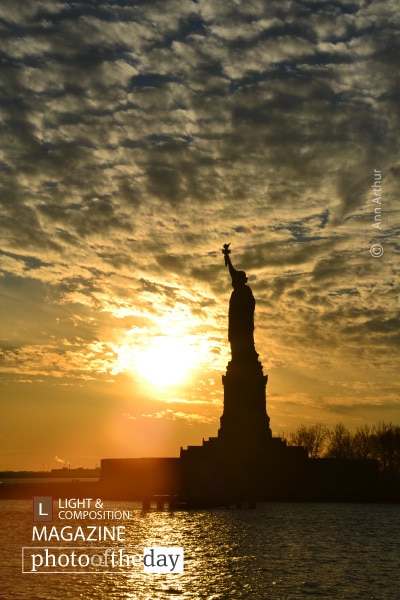
Liberty Sunset by Ann Arthur
Captured during a frigid Statue Cruise in New York, this photograph immortalizes the Statue of Liberty silhouetted against a dramatic winter sunset. Despite the biting cold on the cruise deck, the photographer persisted to frame this iconic landmark at the perfect moment. The image is award-worthy for its masterful use of natural light and composition, turning a challenging, freezing environment into a serene and evocative portrait of one of the world's most recognizable monuments. The interplay between the fading light and the statue's silhouette creates a timeless, atmospheric narrative of a New York winter evening.
Ann Arthur
Born in Malaysia, Ann Arthur is a dedicated photographer currently based in Birmingham, Alabama, where she balances her professional career in hospitality with her creative pursuits. After discovering her passion for the lens during university event coverage, she expanded her repertoire to include travel, landscape, and artistic photography. Though she approaches her work with the humble perspective of a self-taught enthusiast, her ability to capture the world through a unique, evocative lens has earned her recognition as an emerging talent in international photography circles.
Resonance Score Breakdown
Transparency Note: The resonance score (11.0/20) is calculated based on social engagement metrics collected before the award announcement.
Expert Photography Reviews · 5
The Weight of Stilled Light
Can a monument ever truly be free if it is anchored by the weight of what we expect it to represent? We build these towering figures of stone and metal, hoping they will hold our ideals steady against the relentless erosion of time.
Read the reflection →The Weight of the Copper Sky
We often speak of monuments as if they were fixed, immovable anchors in the shifting tides of history. We treat them as stone or metal facts, forgetting that they are subject to the same atmospheric whims as the rest of us.
Read the reflection →Reviews & Comments
Share your thoughts about this award-winning photograph. Your reviews contribute to the community engagement score.
The copper silhouette bleeds into a sky of bruised violet and the pale, sickly apricot of a Turner horizon, a chromatic tension that makes one’s heart ache with the sheer, freezing loneliness of it. It’s not merely a sunset; it’s a Morandi-esque study in atmospheric weight, where the cold, metallic blue of the harbor water drags the light downward, forcing the statue to surrender its form to the encroaching, velvet dark of a New York winter.
The silhouette anchors the frame with necessary gravity. It’s a rigid verticality that interrupts the horizon’s soft gradient. The negative space surrounding the torch provides a brief, sharp clarity, yet the composition doesn’t quite resolve the statue’s placement. It’s too centered, lacking the dynamic tension required for true formal excellence. I’ve seen this geometry before, and frankly, it’s predictable. The structure holds, but it doesn’t challenge the viewer’s eye. It’s merely a competent, static arrangement.
Standing on a tourist boat in a New York winter is a special kind of misery, one I’ve endured far too often. Most would have retreated to the cabin for a hot coffee, but Arthur stayed on deck. The silhouette is crisp, the light honest. It’s not a revolutionary composition, but it’s earned. I find myself shivering just looking at it. She paid the price in frostbite, and for that, she has my respect.
The biting wind must have numbed her fingers, yet she stayed. There’s a profound stillness in how the copper silhouette anchors that bruised, winter sky. I’ve felt that same ache in my own bones, waiting for the light to finally surrender its heat. It’s not just a monument; it’s a quiet prayer against the encroaching dark. She didn’t just capture a sunset; she listened to the cold, fading breath of a city at rest. It’s haunting.
Before the eye identifies the copper silhouette, a sudden stillness anchors the chest. It’s the cold, isn’t it? I feel the phantom bite of that winter wind against my own skin. The light doesn’t just illuminate; it demands a pause in our pulse. When I return to this, I’m not seeing a monument anymore. I’m feeling the quiet, heavy ache of a day ending, a solitude that follows me right into the dark.