Expedition Overview
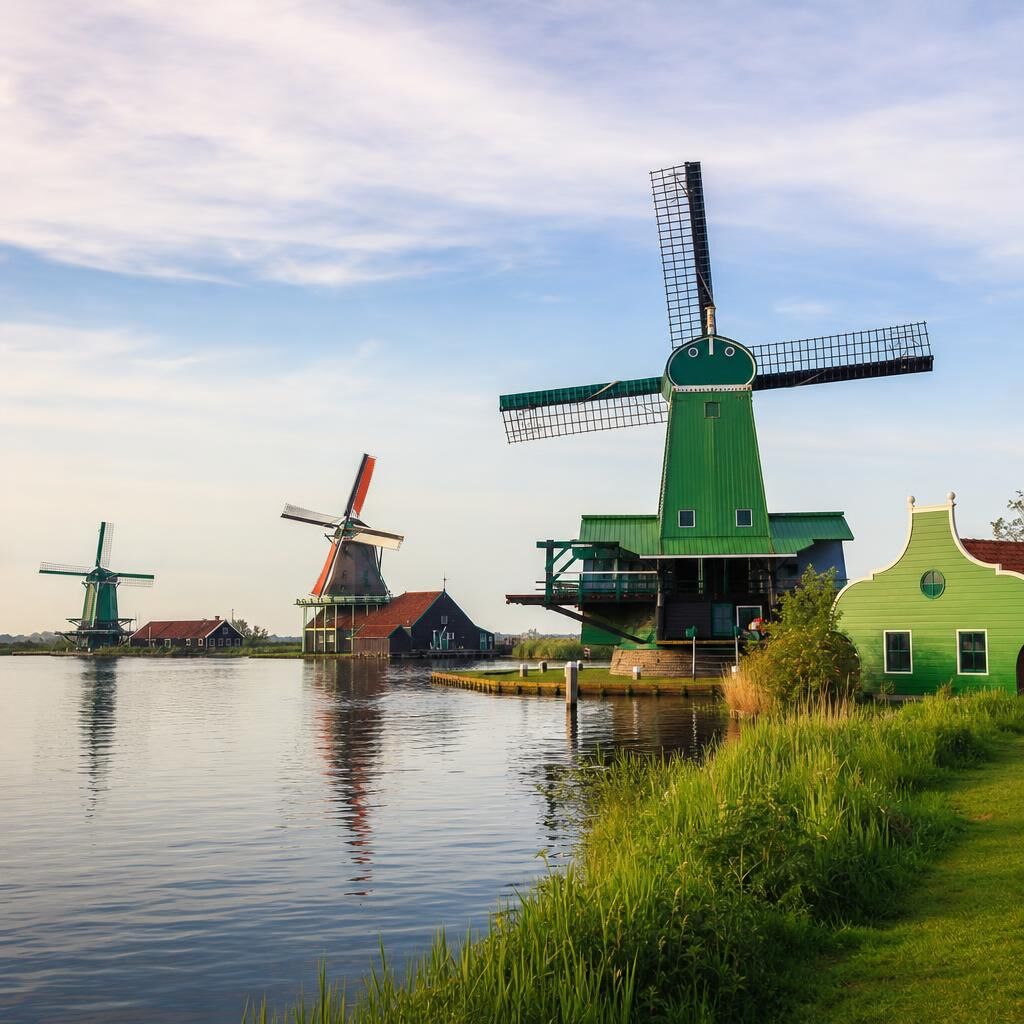
The Zaanse Schans is often described as an open-air museum — which is accurate in structure and misleading in character, because the windmills still operate and the houses are inhabited. In the 17th century this 8-kilometre stretch of the Zaan river had over 1,000 wind-powered sawmills operating simultaneously and was the first industrialised zone in the world; the surviving mills still process linseed oil, paint pigments, and mustard seed. The wooden houses are painted Zaans green — a colour derived from a copper-rich soil pigment specific to this river valley — and on the Zaan's still surface on calm mornings, the reflection of the green mill structures is available in a precise window before the first tourist boats begin their runs at 9am.
Kirsten Bruning approaches Zaanse Schans without the impulse to photograph it as a postcard Dutch scene — the green windmill against a tulip field, the image the site's own marketing produces and that every visitor replicates. The expedition reads the complex as an industrial documentary subject: working machinery, river infrastructure in daily operation, and the specific quality of Dutch riverside light on wooden structures that have weathered for two centuries.
Expedition Itinerary
Day 1: Zaan River — The Green Mills Before the Boats
The Zaan runs alongside the Zaanse Schans from north to south and the morning light enters from the east — which means the mill facades face the light directly at 7am and the copper-green colour is at its most saturated in the first hour. Pre-dawn arrival at the riverbank positions us before the first tourist boats disturb the surface; the reflection of the green mills in the still Zaan at this hour is the most consistent mirror condition the site offers. The De Kat windmill, which processes paint pigments including Prussian blue and ochre, opens its interior from 9am; its wooden gear machinery is still operational and the pigment dust gives the interior a quality of diffused coloured light.
The Goal of the Day: River reflection photography of working mill structures before tourist boat activity; documentary access to 18th-century industrial machinery still in operation.
Day 2: Zaans Vernacular — Wooden Architecture and Working Detail
The Zaans wooden houses are built on a consistent domestic scale — two storeys, steep rooflines, narrow facades — and the copper-green colour reads differently in different light conditions: saturated and warm in direct morning sun, deep teal-grey in overcast, and almost luminous in the low light of an overcast afternoon. We work the village's interior lanes reading the houses' decorative details: the carved shutters, the stepped gable ends, the hoisting beams above the upper windows that are structurally identical to those of the Amsterdam canal houses. The afternoon light catches the south-facing facades directly and produces the warmest conditions for the surface texture of 300-year-old painted timber.
The Goal of the Day: Vernacular wooden architecture photography; surface texture and colour saturation across variable light conditions in a living historic settlement.
Book Your Expedition
Note: Final price may vary based on specific expedition details and customizations.
Expedition Leaders
Kirsten Bruning is a distinguished L&C Faculty Expedition Leader and Art Marketing Specialist based in the vibrant city of Cologne, Germany. Since joining Light & Composition University in 2019, Kirsten has dedicated her expertise to guiding aspiring photographers and promoting the art of visual storytelling. Her photographic work is characterized by a profound appreciation for the subtle beauty found in nature and a unique ability to capture the emotional narratives embedded within everyday moments. Her approach encourages participants to look beyond the obvious, fostering a deeper connection with their surroundings and their craft.
Kirsten's journey into photography began at an early age, sparked by her father's introduction to the timeless art of analogue photography. This foundational experience instilled in her a meticulous eye and a deep respect for the photographic process, influences that are evident in her diverse range of specialties. She masterfully navigates various genres, including Street, Architecture, Portrait, Landscape, Nature, Long Exposure, Travel, and Documentary photography. Whether she's exploring urban environments or serene natural landscapes, Kirsten consistently seeks to uncover and highlight the often-overlooked details that tell a compelling story.
As an experienced Expedition Leader, Kirsten leads immersive photographic journeys across a rich tapestry of European locations, including Germany, Belgium, the Netherlands, Luxembourg, and France. Her expeditions are more than just photo walks; they are carefully curated experiences designed to inspire creativity, enhance technical skills, and provide participants with unforgettable cultural and visual encounters. Through her warm guidance and extensive knowledge, Kirsten empowers photographers of all levels to refine their vision and capture the world with authenticity and artistic flair, embodying the spirit of discovery and artistic expression.
Travel Information
Local Logistics
Most photography locations in Netherlands are well connected by public transport. Trains, trams, and local buses link the key areas. Walking is the best way to explore historic districts.
Health and Safety
Netherlands has excellent healthcare facilities throughout. Emergency services can be reached on 112. Comprehensive travel insurance is recommended for all participants.
Cultural Guidelines for Photographers
Always ask permission before photographing individuals. Observe signage in museums, churches, and private spaces. Photography is widely welcomed in public areas throughout Netherlands.
What to Bring
Here's a packing list for a 2-day easy photography expedition to Zaanse Schans and the Zaan River, focusing on architecture, documentary, and travel photography in a Western European context.---### 1. Photography EquipmentCamera Body:- Main Camera Body (e.g., full-frame mirrorless or DSLR)- (Optional) Compact mirrorless or high-end point-and-shoot as a backup/secondary body for quick shotsLenses (for Architecture, Documentary