Expedition Overview
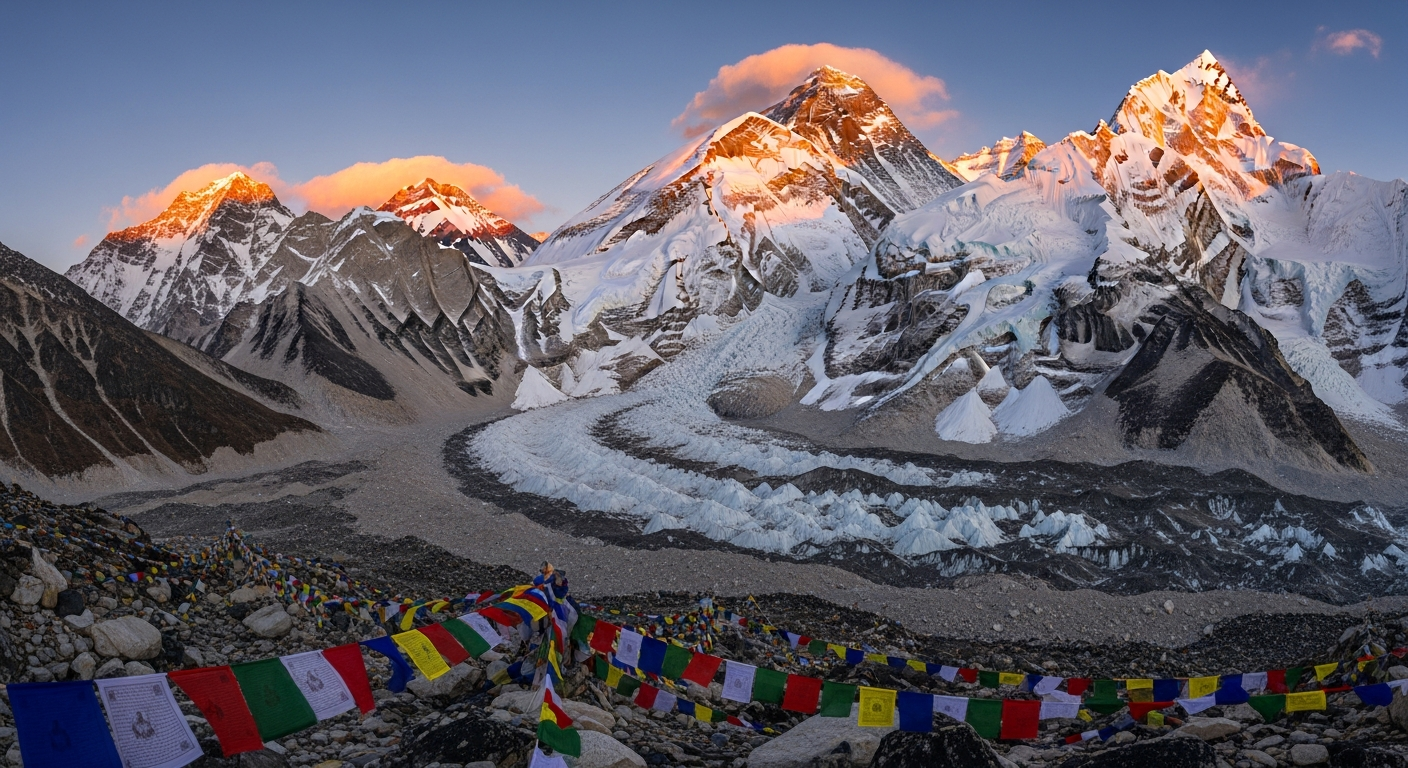
The trek to Everest Base Camp is the most iconic Himalayan journey in the world — and for photography, one of the most rewarding. At 5545m, Kala Patthar delivers the closest unobstructed view of Everest's summit that can be reached without technical climbing, and the composition — the pyramid of the world's highest mountain rising above the South Col in the pre-dawn alpenglow — is one of the defining images of the mountain photography tradition.
But the EBC trek is far more than a single summit photograph. The Khumbu valley is a landscape of extraordinary variety: the subtropical forests of Phakding, the dramatic ascent to Namche Bazaar, the rhododendron groves of Tengboche, and the stark, mineral beauty of the glacier moraine at Base Camp itself. Professor Nasrul Eam has completed this trek seven times and knows exactly where the light falls at every hour.
Expedition Itinerary
Day 1: Fly to Lukla — The World's Most Dramatic Landing
The flight from Kathmandu to Lukla airport (2800m) drops suddenly between valley walls onto a sloping runway cut into the mountainside. Walk to Phakding through pine forest.
The Goal of the Day: Document the arrival — the energy and logistics of entering the Khumbu.
Day 2: Namche Bazaar — The Sherpa Capital
Steep climb to Namche (3440m), the trading hub of the Khumbu. First acclimatisation day with a high hike to the Everest viewpoint — the first clear view of Everest, Lhotse, and Ama Dablam together.
The Goal of the Day: Sherpa community portraiture; first high-altitude Himalayan panorama.
Day 3: Tengboche Monastery
The most photogenic monastery in Nepal, perched on a ridge with Ama Dablam rising behind it. Morning prayer ceremony with the monks. Afternoon light on the peaks turns gold, then pink.
The Goal of the Day: Monastery interior photography; the relationship between human scale and mountain scale.
Day 4: Dingboche & Acclimatisation
High plateau at 4400m. A high hike to 5000m for acclimatisation reveals the whole upper Khumbu. The village of Dingboche with its stone-walled barley fields and prayer flag strings is a graphic landscape photographer's dream.
The Goal of the Day: Alpine graphic photography; graphic patterns in high-altitude agriculture.
Day 5: Lobuche & Gorak Shep
The final approach along the lateral moraine of the Khumbu Glacier. The landscape becomes lunar: no trees, no soil, only rock and ice and the enormous wall of Nuptse. Arrive Gorak Shep (5170m).
The Goal of the Day: Minimalist glacier moraine photography; extreme landscape.
Day 6: Kala Patthar Sunrise & Base Camp
3am departure for Kala Patthar (5545m). The summit pyramid of Everest in pre-dawn alpenglow is one of the world's great mountain photographs. Descent to Everest Base Camp among the expedition tents and prayer flags on the glacier.
The Goal of the Day: The defining image of the trek — pre-dawn Himalayan light at extreme altitude.
Day 7: Return to Lukla — Portfolio Review
Three-day descent, revisiting locations in different light with the knowledge and confidence built over two weeks. Final portfolio review in Lukla before the flight back to Kathmandu.
The Goal of the Day: Return photography with expanded vision; portfolio selection and distillation.
Book Your Expedition
Note: Final price may vary based on specific expedition details and customizations.
Expedition Leaders
Professor Nasrul Eam is a seasoned explorer and visual storyteller who has spent over two decades traversing Asia’s diverse landscapes and cultures. As Dean of the Department of Art and Photography at Light & Composition University, he leads immersive photography expeditions to regions like the Himalayas, Sundarbans, and Bali. These journeys blend cultural exploration with hands-on learning, culminating in a complete photography diploma. With a portfolio of over 50 publications—including The Quintessence of Photography and Illuminating Nature—his work captures the profound beauty of everyday life. His background in advertising, linguistics, and visual arts enriches his mentorship, guiding participants to uncover compelling narratives through their lenses. Professor Eam’s expeditions are transformative experiences, inspiring photographers to engage deeply with the world around them.
Travel Information
Fly Kathmandu–Lukla (35 min, mountain weather-dependent). Kathmandu has international connections from all major Asian hubs. Permits: Sagarmatha National Park entry and TIMS — expedition arranges. Best season: October–November and March–May.
What to Bring
• Down sleeping bag rated to -15°C minimum
• Four-season layering system
• Crampons for Kala Patthar in shoulder season
• 70–200mm for peaks; 24–70mm for valley and monastery work
• Altitude sickness medication (Diamox)
• Trekking poles (essential for descent)
• Water purification tablets or filter