Expedition Overview
The Annapurna Circuit is the great arc of Himalayan trekking — a 200-kilometre journey around the world's tenth-highest mountain that crosses the highest trekable pass on earth, traverses ten distinct climate zones, and delivers the full panorama of Himalayan photography: glaciated peaks, high-altitude desert, subtropical gorges, Buddhist monasteries perched above rivers, and the faces of communities that have lived at altitude for centuries.
Over fourteen days, Professor Nasrul Eam guides participants through the photographic logic of each environment — how light behaves differently at 4,000m than at valley level, how to pre-visualise the Thorung La crossing the evening before, and how to make meaningful portraits of Gurung, Manangi, and Thakali people whose culture is unlike anywhere else on earth.
Expedition Itinerary
Day 1: Besisahar to Bahundanda
Drive from Kathmandu to Besisahar (3 hours). First afternoon walk through subtropical terraces and waterfalls. The Marsyangdi River runs fast and green below. Early light on the first Himalayan peaks is visible by day two.
The Goal of the Day: Calibrate to mountain light; composition on vertical terrain.
Day 2: Chamje to Chame — The Gorge
The valley narrows dramatically into a deep gorge. Apple orchards of Chame in blossom or heavy fruit depending on season. The first close views of Annapurna II (7937m) appear above the canyon wall.
The Goal of the Day: Gorge photography; working within constrained frames.
Day 3: Pisang to Manang — High Desert Begins
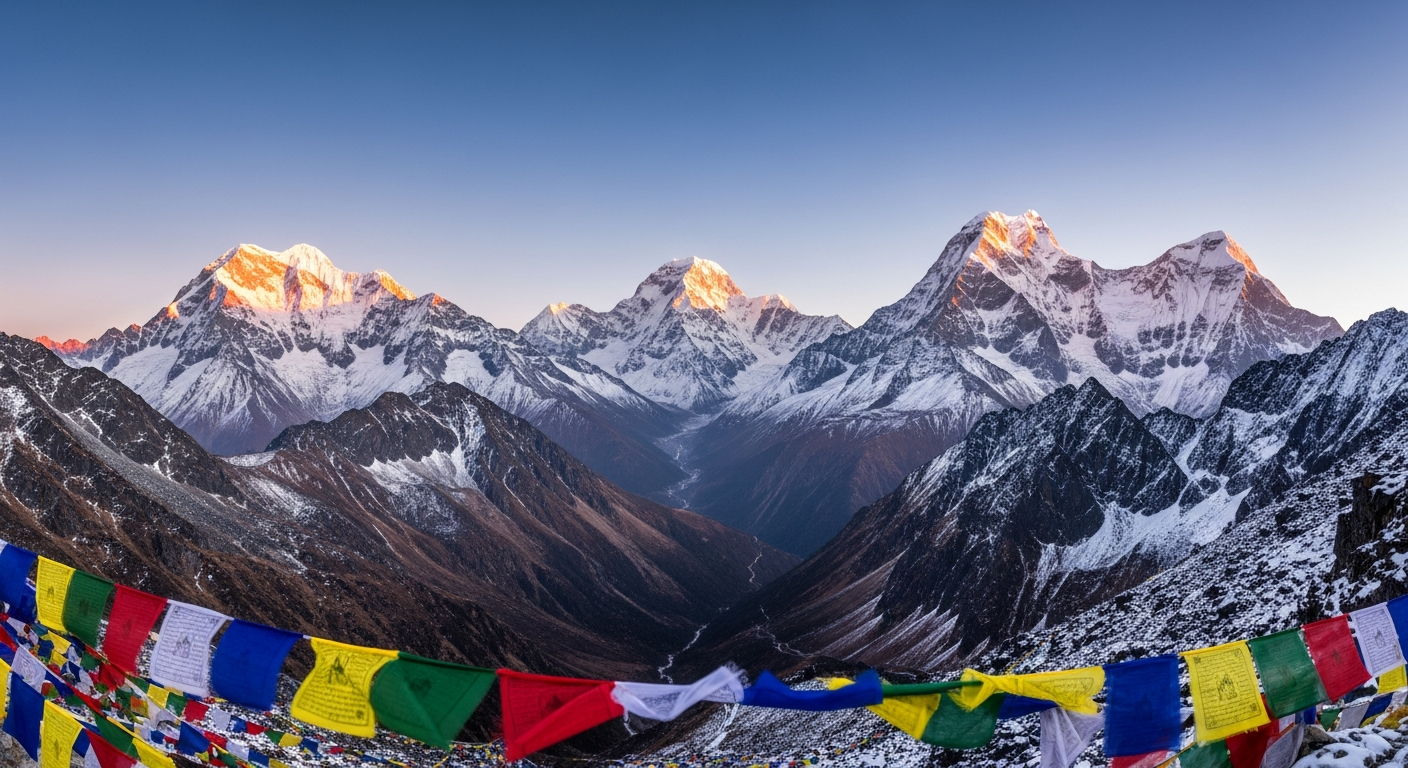
At 3,300m the landscape transforms: shorter scrub, dry alpine air, Buddhist mani walls and prayer flags. Upper Pisang monastery at dawn offers a defining Himalayan composition. Acclimatisation day in Manang with time for portrait work in the village.
The Goal of the Day: High-altitude landscape; monastery and community portraiture.
Day 4: Thorung La Crossing (5416m)
3am departure for the highest point of the circuit. The crossing takes 6–7 hours. Dawn light on the pass is extraordinary — the shadow of the Himalayan range stretches west across the entire Mustang plateau. Descent to Muktinath and its ancient fire temple.
The Goal of the Day: Pre-dawn and dawn photography at extreme altitude.
Day 5: Kagbeni & the Kali Gandaki Gorge
The world's deepest river gorge. Kagbeni is a medieval walled village at the entry to Upper Mustang. The Kali Gandaki winds between Annapurna and Dhaulagiri — both over 8,000m — in the afternoon light.
The Goal of the Day: Scale photography: mountains so large that conventional landscape composition breaks down.
Day 6: Tatopani Hot Springs & Ghorepani
Descend to subtropical warmth and the hot springs at Tatopani. Leeches in season, orchids in flower, and waterfalls everywhere. Climb again to Ghorepani for Poon Hill sunrise the following morning.
The Goal of the Day: Botanical close-up work; forest and waterfall photography.
Day 7: Poon Hill Sunrise & Return to Nayapul
The sunrise from Poon Hill (3210m) gives a panoramic view of the entire Annapurna and Dhaulagiri ranges in a single frame. Descent through rhododendron forest to Nayapul and return to Pokhara for final portfolio review.
The Goal of the Day: Panoramic sunrise photography; circuit portfolio distillation.
Book Your Expedition
Note: Final price may vary based on specific expedition details and customizations.
Expedition Leaders
Professor Nasrul Eam is a seasoned explorer and visual storyteller who has spent over two decades traversing Asia’s diverse landscapes and cultures. As Dean of the Department of Art and Photography at Light & Composition University, he leads immersive photography expeditions to regions like the Himalayas, Sundarbans, and Bali. These journeys blend cultural exploration with hands-on learning, culminating in a complete photography diploma. With a portfolio of over 50 publications—including The Quintessence of Photography and Illuminating Nature—his work captures the profound beauty of everyday life. His background in advertising, linguistics, and visual arts enriches his mentorship, guiding participants to uncover compelling narratives through their lenses. Professor Eam’s expeditions are transformative experiences, inspiring photographers to engage deeply with the world around them.
Travel Information
Fly Kathmandu–Pokhara (25 min) or 6-hour tourist bus. Circuit begins at Besisahar by road. Trekking permit (ACAP, Rs.3000) and TIMS card required — expedition team arranges. Best season: October–November and March–April.
What to Bring
• Layers: base, mid-fleece, down jacket, hard shell (wind/rain)
• Crampons or microspikes for Thorung La winter crossing
• Telephoto zoom for distant peaks (70–200mm minimum)
• Wide-angle for valley compositions
• Spare batteries (cold kills lithium fast above 4000m)
• Headlamp with fresh batteries for 3am departures
• Altitude sickness medication (Diamox — consult doctor)