Uskadar by Keith Goldstein
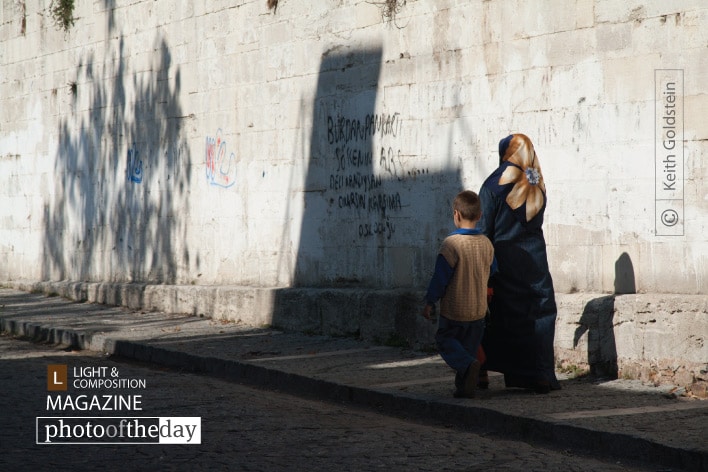
In the bustling, conservative streets of Uskadar, Istanbul, the photographer captured a poignant moment between a Muslim woman and her young son. Drawn to the district’s dense population and traditional atmosphere, the photographer utilized a swift shutter speed to freeze the candid interaction amidst the urban backdrop. This image is award-worthy for its authentic portrayal of daily life in one of Istanbul’s most culturally significant municipalities, demonstrating a keen eye for human connection and the ability to find profound, quiet narratives within a vibrant, complex street environment.
Keith Goldstein
Born in Brooklyn in 1957, Keith Goldstein is a seasoned fine art and commercial photographer based in Hamilton Heights, New York. After earning his BFA from the School of Visual Arts and an MFA from the Cranbrook Academy of Art, he has spent decades refining an emotive, unencumbered approach to the medium. With a career spanning over 40 years, his work has been featured in numerous international publications and exhibitions, reflecting his commitment to exploring the world through a minimalist, observant lens.
Resonance Score Breakdown
Transparency Note: The resonance score (12.5/20) is calculated based on social engagement metrics collected before the award announcement.
Expert Photography Reviews · 5
The Weight of a Hand
There is a particular geometry to the way we hold one another. It is rarely symmetrical. Usually, one hand provides the anchor while the other seeks the tether, a silent negotiation of trust that begins in infancy and persists, in various forms, until the very end.
Read the reflection →The Weight of a Hand
I was walking home from the grocery store this afternoon when I saw a woman holding her young son’s hand. He was trying to pull away to look at a stray cat, but she didn't let go. She didn't pull him back, either.
Read the reflection →Reviews & Comments
Share your thoughts about this award-winning photograph. Your reviews contribute to the community engagement score.
The light in Uskadar doesn’t just fall; it gathers, heavy with history. Keith caught the mother and son in that fleeting, golden-hued pause where the city’s noise simply dissolves. I’ve spent enough dawns waiting for such stillness to know he held his breath, too. It’s a quiet, sacred geometry. Looking at their hands, I feel a sudden, sharp ache for the simplicity of a shared walk. He didn’t rush the land; he let it speak.
At f/9, the EF-S 17-85mm avoids the diffraction limit, rendering the textures of the woman’s hijab with startling, granular clarity. I’m genuinely moved by how the focal plane isolates their interaction from the chaotic Uskadar background. It’s a rare moment where the lens’s resolution perfectly aligns with the emotional weight of the subjects. The light’s behavior across those fabric folds is, in the strictest physical sense, extraordinary. It’s a beautiful, precise capture of human connection.
1/500sec at f/9, ISO 200. A sensible, rigid choice for the Istanbul light. The Canon XSi sensor doesn’t handle high ISOs well, so Goldstein kept it clean. The f/9 aperture ensures the urban chaos remains legible, though it lacks separation. It’s technically competent, yet it feels sterile. I’ve spent years analyzing these files, and honestly, the lack of shallow depth of field here makes me feel nothing. It’s just data, perfectly recorded but emotionally hollow.
Before the eye identifies the figures, a sudden stillness anchors the chest. In Uskadar, the weight of the mother’s veil against the boy’s restless energy creates a friction I feel in my own shoulders. It’s a quiet, gravitational pull. When I return to this, I’m no longer looking at a street in Istanbul; I’m remembering the ache of holding onto something that’s already beginning to outgrow my reach. It’s a haunting, beautiful tether.
Uskadar isn’t merely a street scene; it’s a confrontation with the void. Goldstein’s shadows don’t just frame the mother and child; they swallow the periphery, forcing us into their intimate, heavy silence. I’ve stared at these dark corners until my eyes ached, feeling the crushing weight of their isolation. It’s a brutal, honest geometry. When light refuses to touch the edges, it’s because the truth doesn’t want to be seen. It’s a haunting, necessary darkness.