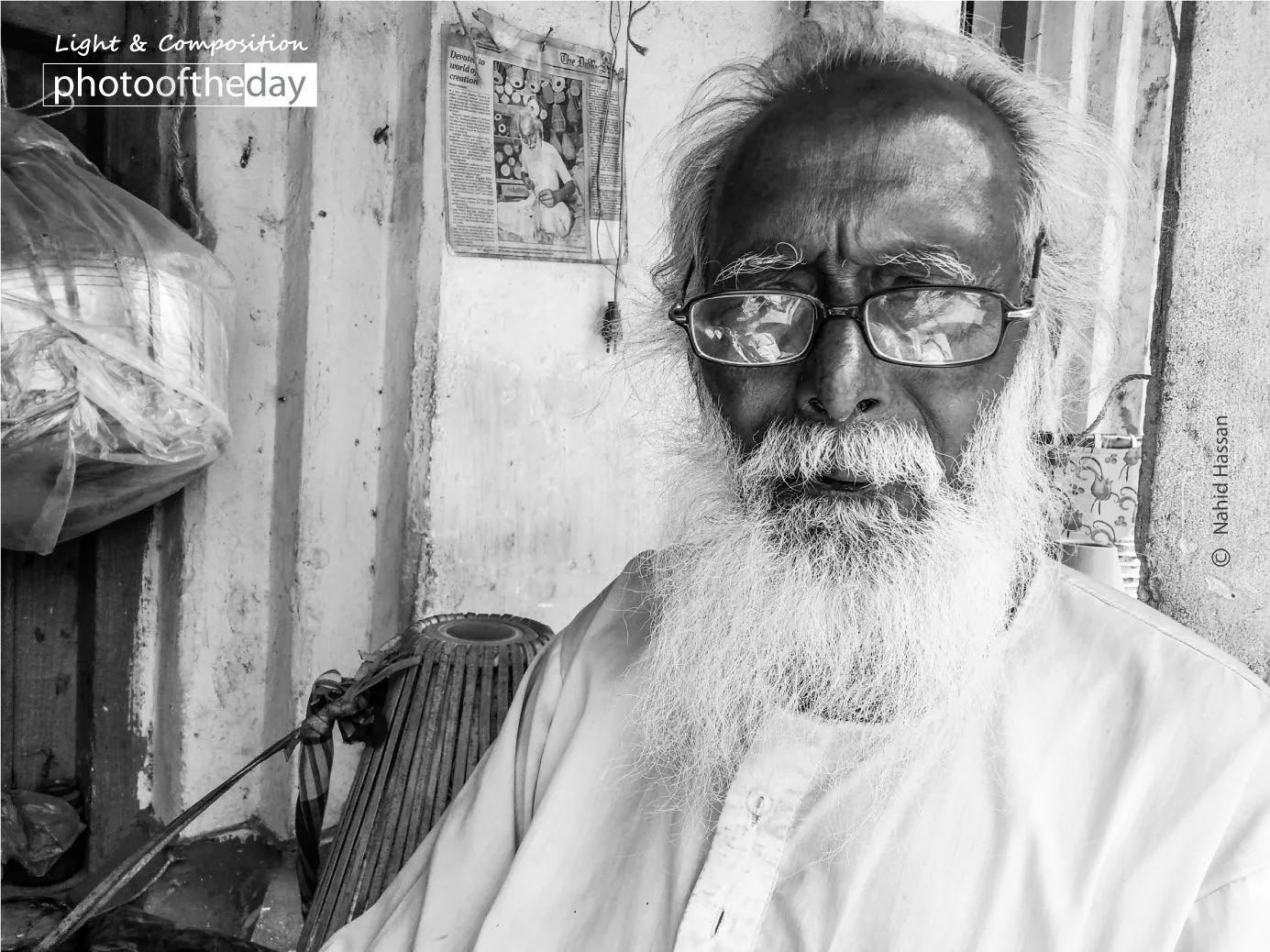
It’s easy to snap a portrait amidst a festival’s chaos, but Hassan clearly sat in that workshop until the noise faded. You don’t capture that specific, weary stillness in a man’s eyes by passing through. I’ve spent enough damp mornings waiting for a landscape to reveal itself to recognize the patience here. It’s a quiet, earned piece of work. I find myself wanting to sit in that room and listen to the instruments.
There’s a tactile gravity here that recalls August Sander’s typological rigor, yet Hassan avoids the clinical distance of the Neue Sachlichkeit. The way light carves those deep, rhythmic furrows in the subject’s face echoes the ethnographic intimacy of Irving Penn’s later portraits. I’m genuinely moved by the quietude; it’s a rare, grounded stillness amidst the festival’s chaos. It doesn't just document a craftsman; it anchors him in a lineage of human endurance I haven't seen captured quite this way.
Most portraits of this Baul saint settle for clinical sharpness, but I’m drawn to the way Hassan lets the workshop’s shadows bleed into the subject’s beard. It’s a deliberate refusal of resolution that feels honest. Why resolve every pore when the man’s essence is found in the blur of his craft? It’s closer to Sugimoto’s long-exposure ghosts than standard portraiture. I find myself wanting to lean in, to touch that soft, unresolved edge of his existence.
The subject’s beard creates a vertical axis that anchors the frame, yet the workshop’s clutter threatens to dissolve the spatial tension. It’s a precarious balance. The background’s chaotic geometry pushes against the man’s stillness, forcing the eye back to the center. I’ve grown weary of such sentimental subjects, but the structural discipline here holds. The frame doesn't collapse under the weight of the narrative. It’s a rare instance where the architecture actually survives the human element.
Does this man’s weathered face exist for his own sake, or merely to satisfy our hunger for the exotic? Hassan frames him as a relic, a Baul saint against the festival’s noise. I’m unsettled by the workshop’s shadows; they feel curated, almost staged to heighten the myth. Why must we romanticize his poverty to find him authentic? It’s a beautiful portrait, sure, but I can’t shake the feeling that we’re consuming his life as a prop.
That beard isn't just hair; it’s a map of Dhaka’s soul. I’m staring at the way the light hits those instrument strings, and I’m hooked. It’s quiet, sure, but is it the decisive moment? One tenth of a second later and the gaze shifts, the tension snaps. Hassan caught the stillness before the festival chaos swallowed it whole. It’s a rare, honest blink in a loud city. I’d have stood there for hours just to watch him work.
The light here doesn't announce itself; it settles, heavy and soft, against the grain of his skin. He stood in that workshop while the festival roared outside, yet he’s anchored in a stillness I’ve spent years chasing. I find myself holding my breath, feeling the dust motes dance in the dim, directional glow. It’s a rare, quiet communion. He wasn’t waiting for a shot; he was waiting for the man to simply be.
Looking at this portrait, I’m struck by the clarity of the man’s eyes. It’s a stark contrast to my world, where light is stolen by the water column and backscatter ruins every close-up. Here, there’s no refractive index to distort his features or color shift to wash out his skin tones. I’d give anything for this kind of sharpness underwater. It’s a beautiful, dry-land stillness that makes me ache for the surface.
Most portraits I review are mere snapshots of a face. Nahid’s work succeeds because he captures the man’s hands resting on the instrument, grounding the saintly beard in the grit of actual labor. It’s that tactile connection to the repair work that makes me stop and stare. Thirty years from now, we won’t care about the festival outside; we’ll care that this man existed. It’s a rare, quiet dignity that most photographers simply miss.
You didn't just photograph a man; you sat in the dust of that workshop and listened. I can feel the weight of those instruments in his hands. It’s rare to find such stillness while a festival rages outside. You waited for the light to settle on his face, and it shows. There’s something honest happening here. I felt a sudden, sharp ache of recognition looking at his eyes. You were really there, weren't you?
You didn’t just photograph a man; you sat in the dust of that workshop and listened. I can feel the weight of those instruments in his hands. It’s rare to find such stillness while a festival rages outside. You waited for the light to settle on his face, and it shows. There’s something honest happening here. I felt a sudden, sharp ache of recognition looking at his eyes. You were really there, weren’t you?
Most portraits I review are mere snapshots of a face. Nahid’s work succeeds because he captures the man’s hands resting on the instrument, grounding the saintly beard in the grit of actual labor. It’s that tactile connection to the repair work that makes me stop and stare. Thirty years from now, we won’t care about the festival outside; we’ll care that this man existed. It’s a rare, quiet dignity that most photographers simply miss.
Looking at this portrait, I’m struck by the clarity of the man’s eyes. It’s a stark contrast to my world, where light is stolen by the water column and backscatter ruins every close-up. Here, there’s no refractive index to distort his features or color shift to wash out his skin tones. I’d give anything for this kind of sharpness underwater. It’s a beautiful, dry-land stillness that makes me ache for the surface.
The light here doesn’t announce itself; it settles, heavy and soft, against the grain of his skin. He stood in that workshop while the festival roared outside, yet he’s anchored in a stillness I’ve spent years chasing. I find myself holding my breath, feeling the dust motes dance in the dim, directional glow. It’s a rare, quiet communion. He wasn’t waiting for a shot; he was waiting for the man to simply be.
That beard isn’t just hair; it’s a map of Dhaka’s soul. I’m staring at the way the light hits those instrument strings, and I’m hooked. It’s quiet, sure, but is it the decisive moment? One tenth of a second later and the gaze shifts, the tension snaps. Hassan caught the stillness before the festival chaos swallowed it whole. It’s a rare, honest blink in a loud city. I’d have stood there for hours just to watch him work.
Does this man’s weathered face exist for his own sake, or merely to satisfy our hunger for the exotic? Hassan frames him as a relic, a Baul saint against the festival’s noise. I’m unsettled by the workshop’s shadows; they feel curated, almost staged to heighten the myth. Why must we romanticize his poverty to find him authentic? It’s a beautiful portrait, sure, but I can’t shake the feeling that we’re consuming his life as a prop.
The subject’s beard creates a vertical axis that anchors the frame, yet the workshop’s clutter threatens to dissolve the spatial tension. It’s a precarious balance. The background’s chaotic geometry pushes against the man’s stillness, forcing the eye back to the center. I’ve grown weary of such sentimental subjects, but the structural discipline here holds. The frame doesn’t collapse under the weight of the narrative. It’s a rare instance where the architecture actually survives the human element.
Most portraits of this Baul saint settle for clinical sharpness, but I’m drawn to the way Hassan lets the workshop’s shadows bleed into the subject’s beard. It’s a deliberate refusal of resolution that feels honest. Why resolve every pore when the man’s essence is found in the blur of his craft? It’s closer to Sugimoto’s long-exposure ghosts than standard portraiture. I find myself wanting to lean in, to touch that soft, unresolved edge of his existence.
There’s a tactile gravity here that recalls August Sander’s typological rigor, yet Hassan avoids the clinical distance of the Neue Sachlichkeit. The way light carves those deep, rhythmic furrows in the subject’s face echoes the ethnographic intimacy of Irving Penn’s later portraits. I’m genuinely moved by the quietude; it’s a rare, grounded stillness amidst the festival’s chaos. It doesn’t just document a craftsman; it anchors him in a lineage of human endurance I haven’t seen captured quite this way.
It’s easy to snap a portrait amidst a festival’s chaos, but Hassan clearly sat in that workshop until the noise faded. You don’t capture that specific, weary stillness in a man’s eyes by passing through. I’ve spent enough damp mornings waiting for a landscape to reveal itself to recognize the patience here. It’s a quiet, earned piece of work. I find myself wanting to sit in that room and listen to the instruments.