Pocket Watches by Des Brownlie
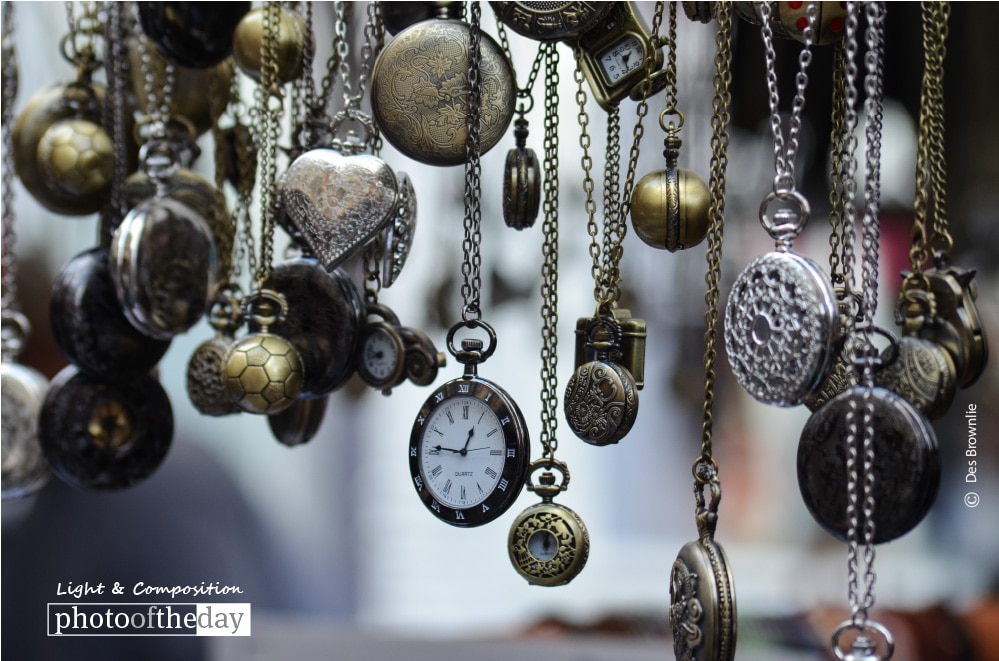
While wandering through a bustling street market on Bleaker Street during the autumn of 2014, the photographer was captivated by a stall displaying an array of vintage pocket watches. Drawn to the interplay of light and texture, the photographer focused on a cluster of timepieces suspended in the sunlight. By utilizing a manual focus lens on a Nikon D5100, the photographer captured the intricate details and metallic reflections of the watches. This image is award-worthy for its keen observation of ordinary objects, transforming a simple market display into a compelling study of light, geometry, and timeless craftsmanship.
Des Brownlie
Originally hailing from Glasgow, Scotland, Des Brownlie relocated to New York City nearly two decades ago and has since made Manhattan his home. He is a dedicated street photographer who finds beauty in both the mundane and the extraordinary aspects of urban life. With a philosophy that every day presents a new photographic opportunity, Brownlie maintains a constant readiness to document the vibrant color and diverse subjects that define the character of New York City.
Resonance Score Breakdown
Transparency Note: The resonance score (12.0/20) is calculated based on social engagement metrics collected before the award announcement.
Expert Photography Reviews · 7
The Currency of Stolen Time
We often treat the city as a static backdrop, a container for our daily errands, forgetting that every corner is a repository of discarded histories.
Read the reflection →The Weight of Seconds
I remember sitting in a dusty repair shop in Marseille, watching an old man named Henri work on a watch that hadn't ticked since the war. He didn't speak much, just adjusted the tiny gears with hands that looked like gnarled oak roots.
Read the reflection →Reviews & Comments
Share your thoughts about this award-winning photograph. Your reviews contribute to the community engagement score.
These pocket watches evoke the clinical precision of Karl Blossfeldt’s plant studies, yet they’re draped in the chaotic light of a Bleecker Street market. It’s a curious tension. While the metallic geometry recalls the industrial fetishism of the 1920s New Objectivity movement, the manual focus here feels surprisingly intimate. I’ve spent decades cataloging such still lifes, but the way these gears catch the autumn sun actually made me pause. It’s a rare, quiet alchemy of time.
The composition relies on a dense cluster of circular forms, creating a tight, interlocking grid that defies the chaos of Bleaker Street. By anchoring the primary focal point in the upper-right quadrant, Brownlie establishes a diagonal tension against the negative space below. It’s a brilliant spatial equation. I’m genuinely struck by how the metallic reflections disrupt the geometry, turning rigid circles into fluid light. It’s a perfectly solved problem of mass and metallic repetition.
You caught the light hitting those gears just right. It’s easy to get lost in the metallic shine, but I keep looking for the hands that wound these springs. There’s a quiet ache in seeing timepieces sitting idle on a street corner. You waited for the sun to reveal their history, and I can feel the weight of those years. It’s a sharp, honest look at what we leave behind. You’ve got a good eye.
The focal plane here is razor-thin, catching the metallic oxidation on those watch casings with startling precision. By pushing the manual focus, Brownlie has navigated the diffraction limit beautifully, rendering the gear teeth as sharp, geometric abstractions. I’m genuinely moved by how the bokeh, a function of that wide aperture, softens the chaotic Bleaker Street background into a warm, golden haze. It’s a rare moment where the lens resolves textures the human eye usually ignores. Truly exquisite work.
Before the eye identifies the gears, something in the chest tightens. It’s the weight of stalled time. These suspended watches don’t just reflect light; they anchor a frantic Bleaker Street afternoon into a singular, metallic stillness. When I return to this, I feel a strange, phantom pulse against my palm. It’s an ache for the mechanical precision we’ve traded for digital ghosts. I’ve never liked clocks, but here, I’d give anything to hear them tick.
Most street photography gets lost in the noise, but these watches anchor time itself. Of the thousands of market shots I’ve reviewed, this one succeeds because the manual focus isolates the gears, turning a cluttered stall into a precise study of decay. It’s haunting. I’d hang this in my study because it reminds me that even mass-produced objects eventually demand our reverence. It’s not just a snapshot; it’s a quiet, metallic argument for slowing down.
Gilded brass catches the light like a Vermeer interior, casting shadows in the bruised, oxidized umber of a Morandi still life. It’s a rhythmic dance of metallic warmth that makes my heart ache for the lost precision of a ticking gear. One finds the palette isn’t merely decorative; it’s a tactile resonance, where the sun-drenched gold bleeds into the cool, melancholic grey of a New York autumn, creating a symphony of suspended, silent, and shimmering time.