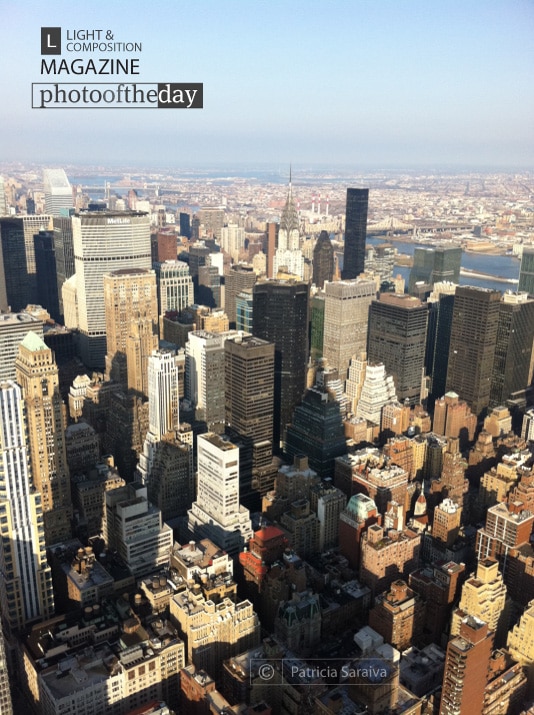
New York by Patricia Saraiva
Captured from the iconic vantage point of the Empire State Building, this photograph encapsulates the overwhelming energy of New York City. The photographer utilized the building's own shadow to frame the sprawling urban landscape, emphasizing the city's immense scale and architectural grandeur. By choosing a high-angle perspective, the image transforms the bustling streets into a rhythmic pattern of light and shadow. This work is award-worthy for its ability to distill the chaotic beauty of the world's most famous metropolis into a singular, contemplative moment that highlights the photographer's keen eye for composition amidst the center of the world.
Patricia Saraiva
Born in Apucarana, Brazil, in 1969, Patricia Saraiva is a dedicated plastic surgeon who discovered her passion for photography while documenting the childhood of her two children. Her transition from medical professional to artist led to significant recognition, including her first exhibition, 'Barcelona Balconies,' in 2011 and contributions to the definitive catalog of Antonio Francisco Lisboa’s Baroque works. Today, Saraiva carries a camera wherever she travels, viewing photography as a boundless medium to record the beauty that catches her eye and to share her evolving artistic vision with an international audience.
Resonance Score Breakdown
Transparency Note: The resonance score (12.9/20) is calculated based on social engagement metrics collected before the award announcement.
Expert Photography Reviews · 8
The Geometry of Breath
We spend our lives building towers of ambition, stacking stone upon stone until we are high enough to touch the clouds, yet we rarely look down to see the shadows we cast.
Read the reflection →The Pattern of Our Days
I was looking down from my balcony this morning, watching the people below move in their hurried, jagged lines. From up there, they didn't look like individuals with appointments or worries. They looked like a pulse, a steady rhythm of movement that kept the city breathing.
Read the reflection →Reviews & Comments
Share your thoughts about this award-winning photograph. Your reviews contribute to the community engagement score.
The shadow stretches across the grid. It’s a dark blade cutting through the noise of the streets. I’ve spent years looking at this city, but here, the chaos finally stops. The concrete doesn’t scream. It rests. I find myself holding my breath, waiting for the light to shift. Nothing here is accidental. The empty corner is not empty. It’s a deliberate pause. It’s the silence I’ve been searching for in the middle of the roar.
1/120sec at f/2.8, ISO 80, 3.9mm. An iPhone 4 sensor is a tiny, noisy trap, yet Saraiva kept the ISO at base. That’s the right call. The f/2.8 aperture doesn’t offer much separation, but at 3.9mm, it’s irrelevant. The shadow framing is clever, though the sensor’s dynamic range struggles with the highlights. I’ve spent years looking at these files, and honestly, the sheer grit of the hardware makes me respect the result. It’s technically sufficient.
The city’s shadow stretches like a bruised, charcoal velvet across the concrete, bleeding into the pale, sickly ochre of the afternoon sun—it’s a palette that recalls the muted, dusty stillness of a Morandi study. I’m breathless at how the light catches the rooftops, turning them into shards of tarnished brass. It doesn’t just document a skyline; it captures the melancholy of a metropolis caught between the fading warmth of day and the encroaching, industrial grey.
Before the eye identifies the grid of New York, something in the chest tightens. The shadow of the Empire State Building stretches like a dark, reaching finger, grounding the dizzying height. It’s a strange, vertiginous pull. I’ve looked at this a dozen times, and each time, my pulse quickens as if I’m about to fall. It doesn’t just show a city; it forces you to inhabit the terrifying, beautiful silence of being entirely alone above it.
The shadow’s diagonal slice provides the necessary structural anchor. It’s a sharp, geometric intervention that prevents the urban sprawl from dissolving into mere chaos. The frame holds because the Empire State’s silhouette dictates the rhythm of the light below. I’m genuinely unsettled by how effectively that dark wedge organizes the city’s frantic density. It’s a rare instance where the negative space doesn’t just exist; it commands the entire picture plane with absolute, cold authority.
High above the concrete pulse, she waited for the Empire State’s shadow to stretch across the grid. It’s a rare stillness, catching the city in that fleeting, geometric silence. I’ve spent enough hours on ridges to recognize that patience; she didn’t rush the light. Looking at how the sun carves those canyons, I feel a sudden, sharp ache for the quietude hidden within such frantic noise. It’s a beautiful, measured breath in a breathless place.
The iPhone 4’s tiny sensor struggles here, pushing the 3.9mm lens toward its diffraction limit. You can see the micro-contrast failing as the light scatters across the dense urban grid. Yet, there’s a raw, honest geometry in how the shadow cuts through the city’s chaos. It’s not technically perfect, but I’m genuinely moved by how the optics capture such vast, rhythmic complexity. It’s a fragile, beautiful reminder that even limited glass can resolve a soul.
Most aerial shots of Manhattan are just postcards, but this one sticks. Using the Empire State Building’s own shadow to slice through the grid creates a narrative of dominance that most photographers miss. It’s a sharp, cold reminder of how small we are in that concrete machine. I’ve looked at thousands of cityscapes, and honestly, this one still makes me feel a bit dizzy. It’s the kind of perspective that’ll still matter in thirty years.