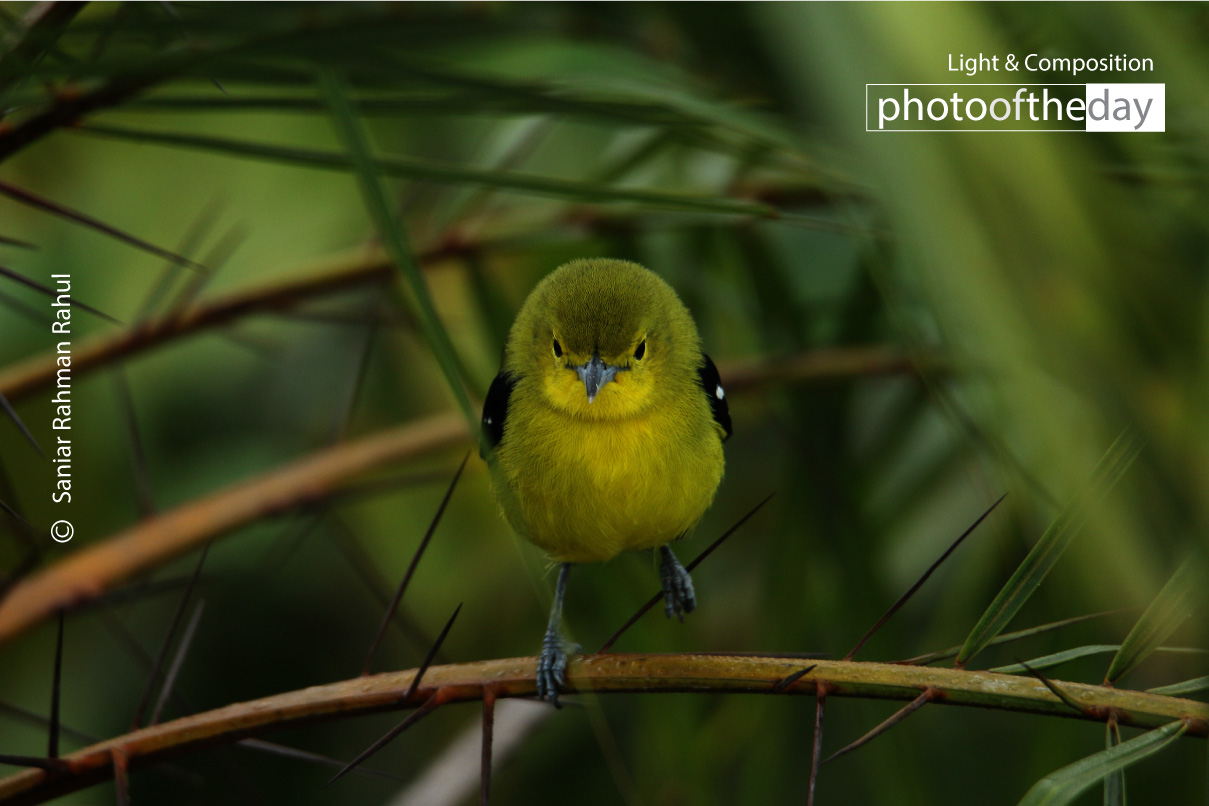
Snapshot of a Common Iora by Saniar Rahman Rahul
Captured in the lush Sundarbans during December 2023, this photograph features a Common Iora perched serenely on a tree branch. The photographer skillfully utilized the soft winter sunlight to illuminate the bird's vibrant plumage, creating a striking contrast against the verdant backdrop. The image captures a quiet, rhythmic moment of stillness amidst the swaying foliage, reflecting the unique atmosphere of the Sundarbans. This shot is award-worthy for its technical precision and its ability to transform a simple wildlife encounter into a compelling, evocative narrative of nature's subtle beauty.
Saniar Rahman Rahul
Saniar Rahman Rahul is a distinguished photographer and Art Director based in Dhaka, Bangladesh. His creative journey began in childhood, inspired by his father's photography, and was later refined through a successful career in graphic design and advertising with global agencies like Grey Worldwide. Since winning his first major photography award in 2010, Rahul has balanced his professional expertise in visual communication with a deep passion for capturing the natural world. His work reflects a sophisticated eye for composition, honed by years of experience in the pre-press and advertising industries.
Resonance Score Breakdown
Transparency Note: The resonance score (6.4/20) is calculated based on social engagement metrics collected before the award announcement.
Expert Photography Reviews · 7
The Weight of a Small Breath
Dear reader, I have been thinking about the things we overlook because they are too quiet to demand our attention.
Read the reflection →The Unmapped Resident
We often define a city by its density—the height of its glass towers, the width of its thoroughfares, and the frantic pace of its human traffic. We view the urban landscape as a strictly human project, a grid designed for commerce and transit.
Read the reflection →Reviews & Comments
Share your thoughts about this award-winning photograph. Your reviews contribute to the community engagement score.
The shutter speed hits like a crisp edit. It’s a freeze-frame that breathes, catching the Iora in a moment of absolute stillness before the next movement. I love how the light catches that yellow plumage; it’s a perfect key light against the deep, blurred greens of the Sundarbans. The composition holds the tension of a long take. It’s the frame the editor keeps because it’s where the story finally stops moving and starts living.
The Sundarbans don’t reveal themselves to the hurried. Rahul stood in the cooling, filtered light of a December morning, waiting for the forest to exhale. That Common Iora didn’t just land; it arrived when the air was ready. I find myself holding my breath looking at the soft, golden plumage against that deep, verdant blur. It’s a quiet, sacred stillness. He didn’t capture a bird; he listened to the light until it finally spoke back.
The Iora’s sulfurous yellow plumage vibrates against the deep, mossy umber of the Sundarbans, a palette reminiscent of a Morandi study where light doesn’t merely land, but breathes. It’s a chromatic tension that makes my heart ache, as if the bird were a single, luminous brushstroke suspended in a humid, verdant void. One finds here a rare, liquid harmony, where the winter sun’s pale gold dissolves into the shadows, turning the foliage into a soft, breathing velvet.
The Iora sits, yet it doesn’t quite belong to the light. Rahul has caught the bird in a fragile truce with the Sundarbans’ encroaching gloom. I’m struck by how the shadows here aren’t merely negative space; they’re the weight of the forest pressing inward. It’s a quiet, cold defiance. When I look at those dark, blurred leaves, I feel a sudden, sharp loneliness. It’s not just a bird; it’s a small, yellow pulse against the inevitable dark.
A 600mm lens is a heavy burden to haul through the Sundarbans, yet one suspects Rahul didn’t mind the weight. It’s a clean shot, certainly, but it’s the stillness that catches me. I’ve spent enough damp mornings in the brush to know that bird didn’t just sit there for the sake of the sensor. He waited for that light, and he earned the silence. It’s a decent bit of work, provided he went back twice.
The Common Iora sits perfectly isolated, yet I’m left wondering about the cost of this clarity. Does the 600mm lens erase the Sundarbans’ actual density to serve our aesthetic hunger for the pristine? It’s technically sharp, sure, but it feels like a sterile specimen rather than a living inhabitant. I find myself craving the mess of the forest floor. Why do we insist on stripping nature of its context just to make it look pretty?
You waited for this. I can feel the stillness in your hands when you pressed that shutter. It’s easy to get lost in the gear, but you didn’t. You let the Sundarbans breathe. That Iora isn’t just a subject; it’s a quiet pulse in a vast, green world. I’ve spent enough time in the brush to know that patience is the hardest part of the craft. You earned this moment. It’s honest, and that’s enough.