Love by Keith Goldstein
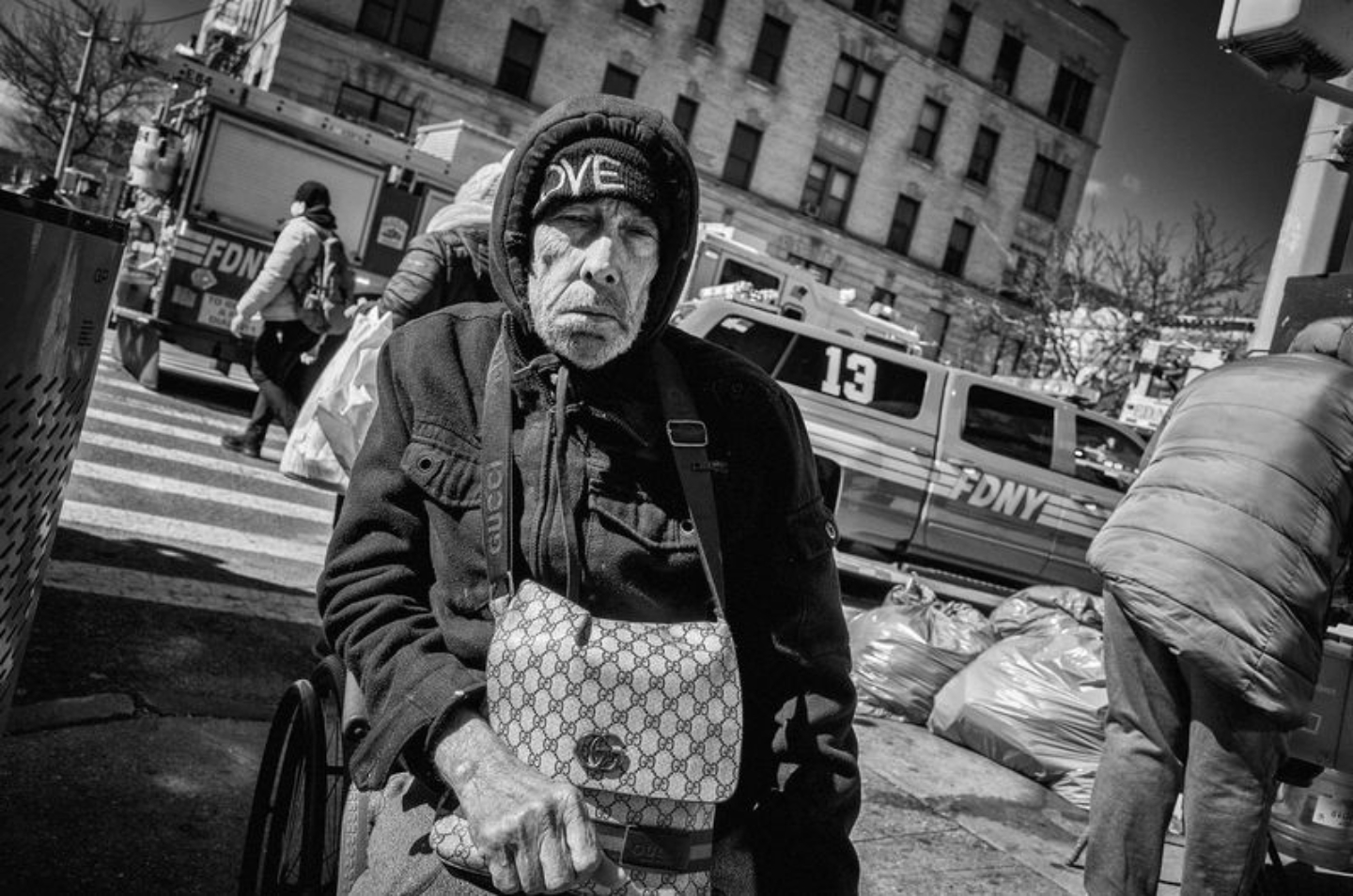
During a routine photo walk, the photographer encountered a striking scene of contrast: emergency vehicles surrounding a corner where a legless man sat in a wheelchair, entirely unmoved by the commotion. Capturing the moment before the subject noticed his presence, the photographer utilized a wide-angle perspective to frame the man against the backdrop of urban activity. This image is award-worthy for its raw, candid observation of human stoicism amidst chaos, demonstrating a keen eye for street photography that finds profound stillness in the heart of an unfolding, albeit mysterious, emergency situation.
Keith Goldstein
Born in Brooklyn, New York, Keith Goldstein developed a deep fascination with photography during his youth, eventually earning a BFA with Honors from the School of Visual Arts and an MFA from the Cranbrook Academy of Art. Throughout his extensive career, he has explored emotive expression through a minimalist approach, favoring a simple kit to maintain creative freedom. His work has been widely exhibited since 1980 and featured in numerous prestigious publications, ranging from international news outlets to major book covers, establishing him as a versatile and accomplished fine art photographer.
Resonance Score Breakdown
Transparency Note: The resonance score (6.7/20) is calculated based on social engagement metrics collected before the award announcement.
Expert Photography Reviews · 5
The Eye of the Storm
I remember a Tuesday in London when the sirens were so loud they seemed to vibrate in my teeth. Everyone on the platform was leaning over the yellow line, necks craned, phones held high, desperate to catch a glimpse of the drama unfolding on the tracks.
Read the reflection →The Stillness in the Storm
Dear traveler, I have been thinking about how we choose to anchor ourselves when the world decides to unravel. We are taught that survival is a frantic, loud business—that we must run, shout, and scramble to be seen against the backdrop of disaster.
Read the reflection →Reviews & Comments
Share your thoughts about this award-winning photograph. Your reviews contribute to the community engagement score.
The frame’s geometry hinges on the wheelchair’s rigid silhouette, anchoring the chaos of the emergency vehicles. It’s a masterclass in spatial tension. The wide-angle lens forces a brutal proximity, pushing the background into a blurred, kinetic smear. I’m genuinely unsettled by how the subject’s stillness slices through the frame’s frantic energy. The composition doesn’t just hold; it demands total submission. It’s a rare instance where the architecture of the scene justifies the lens choice perfectly.
The emergency lights blur, but the subject’s stillness is absolute. In athletics, we look for the exact millisecond of peak tension; here, it’s the inverse. He isn’t reacting to the chaos, and that’s the frame. If he’d turned his head, the tension would’ve snapped. It’s a rare, quiet discipline I’ve only seen in elite sprinters waiting for the gun. I find his composure unsettling, but I can’t look away. It’s the perfect, frozen instant of indifference.
I’ve spent weeks in a blind waiting for a shy lynx to emerge, so I recognize when a moment is earned. Here, the proximity feels like an intrusion. Using a 28mm lens on a man in crisis isn’t observation; it’s extraction. It makes me feel deeply uncomfortable. Did the photographer ask for consent, or just take? Street photography shouldn’t treat human vulnerability like a trophy. I’d rather watch an animal in its own home.
There’s a coldness here that bothers me. You’ve framed a man in his most vulnerable moment, yet you’ve done it from behind a veil of anonymity. He doesn’t know you’re there, and he hasn’t invited you into his world. It’s a clean composition, sure, but it feels like a theft. I look at his hands and see a life of profound isolation, yet I feel no connection. It’s just a scene, not a soul.
Emergency lights bleed into the frame, yet the man in the wheelchair remains the anchor. Why does the photographer prioritize this juxtaposition of trauma and stillness? It’s a classic street trope, but I find the voyeurism here unsettling. Does the subject’s disability serve as a prop for the photographer’s aesthetic contrast? I’m left wondering if we’re celebrating the man’s resilience or merely consuming his vulnerability. It’s a sharp composition, but at what cost to the subject?