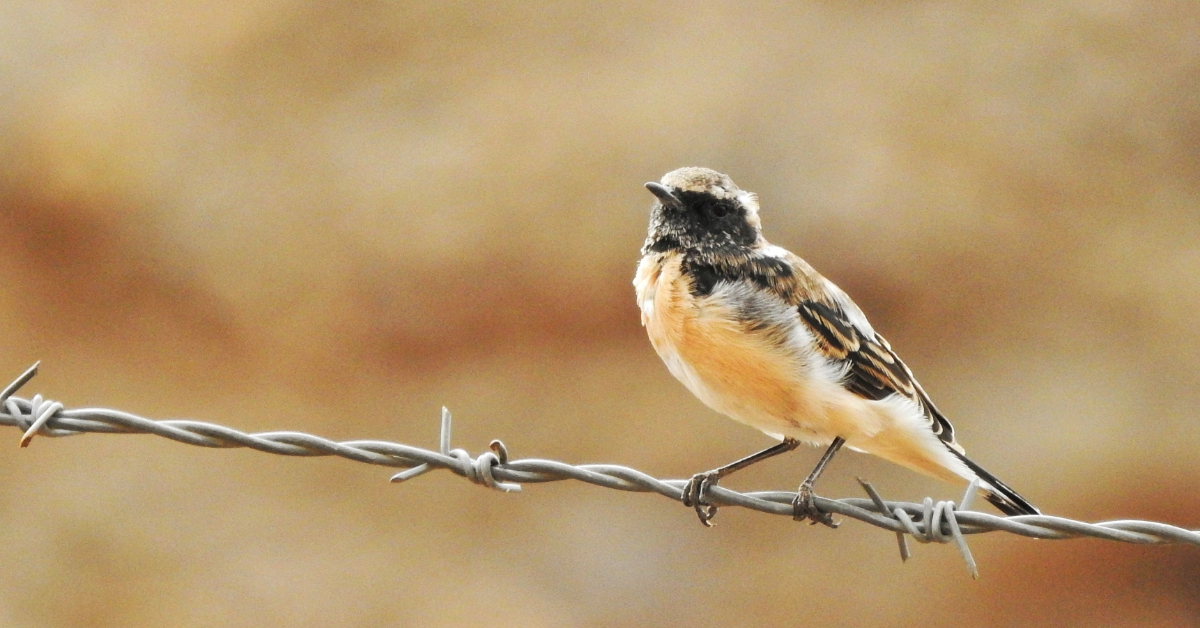
Black-eared wheatear by Sarvenaz Saadat
While traversing the Taleghan region, the photographer encountered a Black-eared wheatear perched solitary upon a barbed wire fence. The bird remained undisturbed by the photographer's presence, allowing for a serene and intimate capture of the moment. This image is award-worthy for its ability to transform a simple, fleeting encounter in the wild into a striking portrait of avian life. The composition highlights the delicate balance between the subject and its rugged environment, showcasing the photographer's patience and keen eye for the natural biodiversity that defines the Taleghan landscape.
Sarvenaz Saadat
Born in 1988, Sarvenaz Saadat is an architect and dedicated amateur photographer based in Karaj, Iran. With a deep-seated passion for nature, landscape, and wildlife, she has cultivated her craft since her high school years, transitioning from early equipment to her current focus on birdwatching and wilderness exploration. Her work reflects a growing artistic vision as she pursues a professional path in nature photography, consistently seeking to document the unique subjects found within the diverse ecosystems of her home country.
Resonance Score Breakdown
Transparency Note: The resonance score (7.6/20) is calculated based on social engagement metrics collected before the award announcement.
Expert Photography Reviews · 4
The Weight of a Song
When I was seven, my grandfather kept a small wooden bird in his study that he claimed could hear the secrets of the wind. He would place it on the windowsill, and I would watch it for hours, waiting for it to turn its head or ruffle its feathers.
Read the reflection →The Weight of a Song
I remember a morning in the high country where the wind was so sharp it felt like it could carve stone. I had stopped to catch my breath near a rusted fence line that stretched toward the horizon, marking a boundary that no longer seemed to matter.
Read the reflection →Reviews & Comments
Share your thoughts about this award-winning photograph. Your reviews contribute to the community engagement score.
At 1400mm, the compression is suffocating, yet I’m drawn to the way the barbed wire dissolves into a painterly, abstract smear. It’s a relief to see the background surrendered to such aggressive bokeh. Why resolve the landscape when the bird’s isolation is the point? It’s closer to Sugimoto’s blurred horizons than typical wildlife portraiture. I find myself wishing she’d pushed the motion further, letting the wheatear’s silhouette bleed into the atmosphere entirely. It’s wonderfully defiant.
A bird on barbed wire is a common enough sight, but one rarely captures such stillness at 1400mm. It’s a precarious reach, yet the focus holds firm. I’ve spent enough mornings shivering in the Alborz foothills to know that the wheatear doesn’t just sit there for anyone. One suspects Sarvenaz didn’t stumble upon this; she waited until the bird forgot she existed. It’s a quiet, earned victory. I find myself quite envious of that patience.
At 1400mm, the compression is immense, yet it’s the stillness that catches me. A Black-eared wheatear perched on wire in Taleghan, captured at 1/400sec. It’s a terrestrial moment, but I can’t help thinking of the photons hitting that sensor. They’ve traveled across the vacuum, past distant galaxies, just to illuminate this small bird. It’s a quiet, fragile intersection of biology and deep time. I find myself holding my breath, watching this tiny life endure.
That bird perched on rusted wire feels like a quiet truce. I’ve spent years chasing subjects who don’t want to be seen, but here, the wheatear isn’t hiding. It’s just existing, indifferent to the lens. There’s a stillness in its eye that makes me want to hold my own breath. It’s a rare, honest exchange between wild life and a patient observer. You can’t fake that kind of calm. It’s a beautiful, fleeting gift.