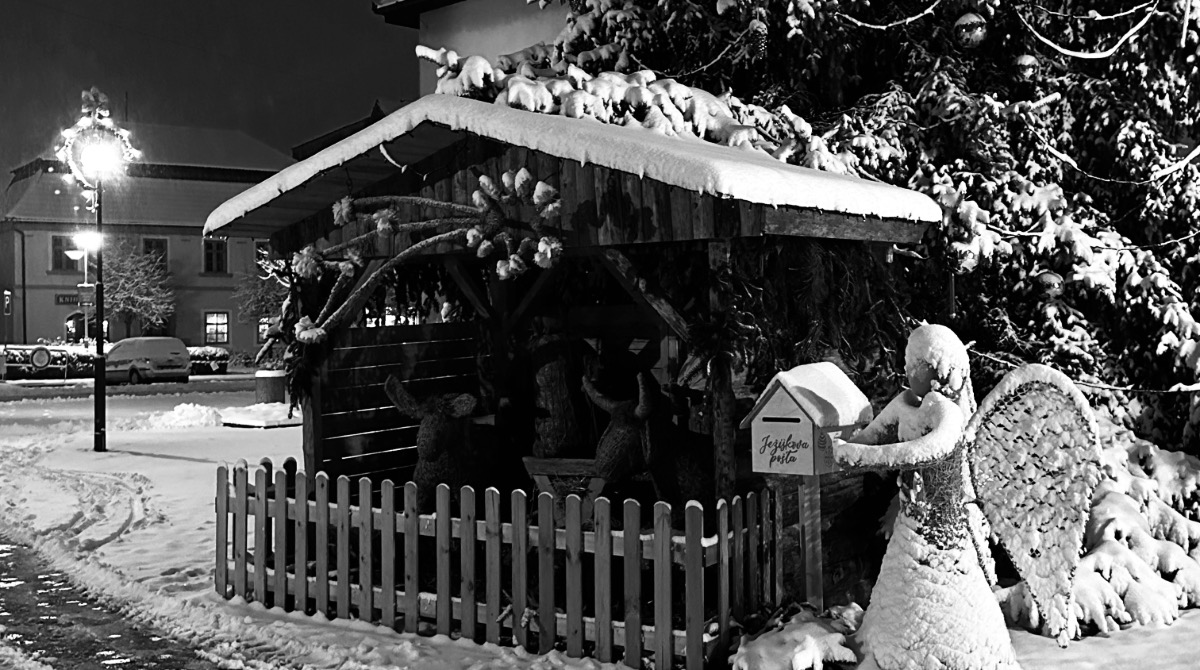
Christmas time in Hradec Králové by Mirka Krivankova
Captured during a quiet December moment in the Sundarbans, this photograph features a Common Sandpiper navigating the mud and water with effortless grace. The photographer masterfully contrasts the bird's modest, unassuming presence against the vast, atmospheric backdrop of the landscape. This image is award-worthy for its ability to find profound beauty in simplicity, highlighting the unique charm of the environment through a keen, observant eye. By focusing on the interplay between the subject and its natural habitat, the photographer creates a serene and evocative narrative that celebrates the quiet rhythms of the wild.
Mirka Krivankova
Based in Mestec Kralove, Czech Republic, Mirka Krivankova is a promising photographer recognized for her evocative documentation of the Czech countryside and compelling portraiture. Her work is defined by a sophisticated use of formalism, where natural light and shadow are expertly balanced to guide the viewer's eye and enhance the narrative depth of her subjects. Constantly evolving and refining her portfolio, Krivankova demonstrates a dedicated commitment to her craft, consistently producing bodies of work that capture both the beauty of her surroundings and the human experience.
Resonance Score Breakdown
Transparency Note: The resonance score (6.6/20) is calculated based on social engagement metrics collected before the award announcement.
Expert Photography Reviews · 7
The Quietude of Presence
Epictetus taught that we must learn to distinguish between what is within our control and what lies beyond it. He argued that the man who concerns himself only with his own character and his immediate actions finds a freedom that the rest of the world cannot touch.
Read the reflection →The Echo of Empty Streets
It is 3:14 am. The silence in the hallway is thick enough to touch, a heavy velvet curtain that keeps the rest of the world at bay. In these hours, the ghosts of who we were seem to pace the floorboards, looking for a place to sit.
Read the reflection →Reviews & Comments
Share your thoughts about this award-winning photograph. Your reviews contribute to the community engagement score.
Watching this Common Sandpiper, I’m struck by the stillness of the Sundarbans mud. It’s a stark contrast to the chaotic, light-starved depths I usually inhabit. Here, the water doesn’t steal the spectrum; there’s no backscatter to fight, no strobe angle to calculate. It’s refreshing to see such clarity without battling the refractive index of water. The bird’s delicate movement across the silt is beautiful, a quiet reminder of life at the edge of the tide.
The iPhone 11 Pro’s 13mm lens struggles here with the diffraction limit, yet it’s precisely that optical constraint that softens the mud’s texture into a painterly wash. I’m genuinely moved by how the sensor’s limited dynamic range forces the sandpiper into a silhouette, turning a simple bird into a stark, geometric study. It doesn’t resolve every feather, but it captures the quiet, cold physics of a winter afternoon perfectly. It’s a beautiful, fragile optical compromise.
A sandpiper in the mud isn’t street, but the timing hits. It’s quiet, precise, and patient. I’ve spent years chasing the chaos of Winogrand, yet this stillness catches me off guard. It’s a clean, sharp slice of life. One tenth of a second later and the bird’s posture shifts, the composition loses its tension. You caught the rhythm perfectly. It’s rare to find such clarity in the wild. Honestly? It makes me want to slow down.
The frame holds a breath. That sandpiper isn’t just walking; it’s pacing a scene, caught in the low-tide rhythm of a film that refuses to cut. I’m struck by how the mud pulls at the light, grounding the bird in a vast, lonely geography. It’s a quiet sequence, perfectly edited. The shutter speed caught the exact moment of stillness before the next movement. I’d keep this frame. It’s the shot that defines the entire scene.
The sandpiper is mid-stride, but the timing is off. The bird’s center of gravity hasn’t shifted into the forward lean required for a true peak moment. It’s a static record of a bird walking, not the explosive extension of a creature in motion. I’ve spent my life watching bodies hit their apex; this frame misses the tension entirely. It’s technically clean, sure, but it lacks the visceral snap of a perfectly timed shutter release. It’s just a bird.
The frame’s geometry fails to anchor the subject. The bird drifts in a void, lacking the spatial tension required to justify its placement. It’s a loose arrangement that doesn’t command the picture plane. While the tonality offers a certain starkness, the composition lacks a fulcrum. I’ve seen this lack of discipline before, and frankly, it’s exhausting. The negative space is merely empty rather than weighted. It doesn’t hold. The architecture is simply too fragile.
Shadows here don’t merely fall; they interrogate the mud. Krivankova’s sandpiper navigates a monochrome void where light is stripped of its warmth, leaving only the cold, existential weight of the Czech winter. It’s haunting. I’ve spent hours staring at the bird’s silhouette, feeling the crushing silence of that landscape. When we refuse to illuminate the periphery, we finally force the subject to confront its own isolation. It doesn’t invite us in; it demands we endure its stillness.