Stair Frames by Amit K Sharma
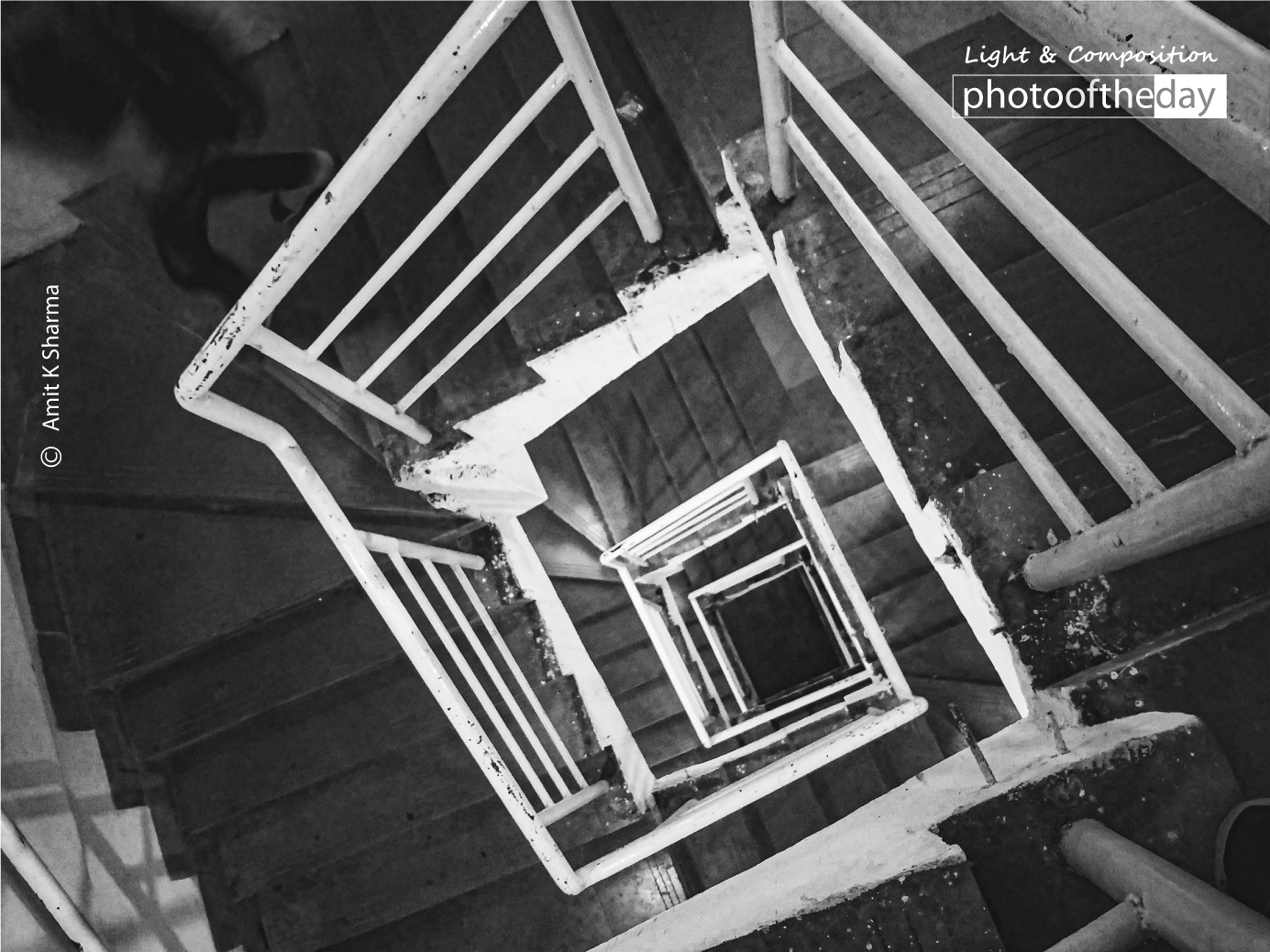
Stair Frames captures a serendipitous moment of discovery, transforming an ordinary office transition into a striking geometric study. While descending a staircase, the photographer was struck by the rhythmic, repetitive patterns of the architecture viewed from above. By choosing to bypass the lift, the photographer opened the door to this unique perspective, capturing the interplay of light and structural lines with a mobile device. The image is award-worthy for its ability to elevate a mundane, everyday environment into a compelling abstract composition, demonstrating a keen eye for finding beauty in the overlooked details of the built world.
Amit K Sharma
Born and raised in Dewas, Madhya Pradesh, Amit K Sharma balances a professional career as a software engineer with a deep-seated passion for visual storytelling. His creative practice spans both photography and videography, often capturing the spontaneous beauty found within his daily surroundings. Driven by a desire to address social issues through his work, he is currently developing a dedicated channel for short films. Amit views his camera as an essential creative partner, using it to document the world around him and express his unique perspective on life.
Resonance Score Breakdown
Transparency Note: The resonance score (7.6/20) is calculated based on social engagement metrics collected before the award announcement.
Expert Photography Reviews · 7
The Echo of Footsteps
The smell of cold concrete always brings me back to the damp basements of my childhood, where the air felt thick and heavy, like wool against the skin.
Read the reflection →The Geometry of Ascent
Seneca once remarked that life is like a play; it matters not how long it lasts, but how well it is performed. We often treat our daily movements as mere transitions, hurried passages from one obligation to the next, never pausing to consider the architecture of our own routine.
Read the reflection →Reviews & Comments
Share your thoughts about this award-winning photograph. Your reviews contribute to the community engagement score.
Geometry often masks a void. By stripping these stairs of human presence, Sharma turns a functional office space into a sterile, abstract pattern. It’s technically sharp, sure, but I’m left cold by the erasure. Why must we aestheticize the mundane by removing the people who actually inhabit it? Does this framing serve the architecture or just the photographer’s ego? I find myself craving a smudge, a footprint, or a soul to break this relentless, perfect symmetry.
Geometry is a cage, yet here, the shadows offer an escape. By descending, the lens captures a rhythmic descent into the void, where the concrete stairs dissolve into pure, ink-stained abstraction. It’s haunting. I’ve spent hours staring at these sharp, jagged lines, feeling the weight of the architecture pressing against the silence. Most photographers fear this darkness, but Sharma lets it breathe. It’s not just a staircase; it’s a meditation on the gravity of our own vanishing.
The geometry is clean, but the timing is sluggish. In sports, you’d miss the apex of the jump; here, you’ve missed the rhythm of the descent. The figures are blurred, caught in a transition that lacks the snap of a decisive movement. I’ve spent my life chasing that perfect, frozen millisecond of peak tension. This isn’t it. It’s a near miss, a frame too late. I wanted to feel the impact, but it’s just soft.
Stairs are the heartbeat of a building, yet we usually treat them as mere conduits. Here, the rhythm of the balustrades creates a compelling datum, turning a mundane descent into a study of solid and void. The light raking across those concrete treads reveals a tactile weight I rarely see in mobile captures. It’s a rare, honest look at the architecture of transit. Honestly, it makes me want to walk those steps myself to feel the geometry.
It’s a relief to see such clean, sharp lines. Down where I work, light is a thief; it’s swallowed by the water column, leaving us to battle backscatter and chromatic loss. Here, the geometry is crisp, untainted by the refractive index shifts that turn my world into a hazy, blue-shifted blur. I find myself craving this kind of absolute clarity. It’s a stark, beautiful contrast to the murky, unpredictable depths I usually navigate.
The staircase descends into a quiet geometry. It’s a rhythmic pulse of shadow and concrete. I find myself holding my breath, waiting for a footfall that never comes. The frame doesn’t crowd the eye. It invites a pause. Nothing here is accidental. The empty corner is not empty. It’s a weight. A stillness. I’ve walked past such stairs a thousand times, but I’ve never truly seen the silence they hold until now. It’s beautiful.
Moholy-Nagy would’ve adored this. It’s a classic Bauhaus exercise, echoing the rhythmic, top-down structuralism of the New Vision movement. Sharma’s geometry pulls the eye into a dizzying descent, reminiscent of Rodchenko’s vertiginous perspectives. Using a Realme’s sensor to find such stark, rhythmic abstraction in a mundane stairwell is genuinely thrilling. It’s rare to see a mobile device capture this level of formal rigor. I’m genuinely impressed by how he’s turned a simple transit space into pure, kinetic architecture.