Muddy Boys by Ryszard Wierzbicki
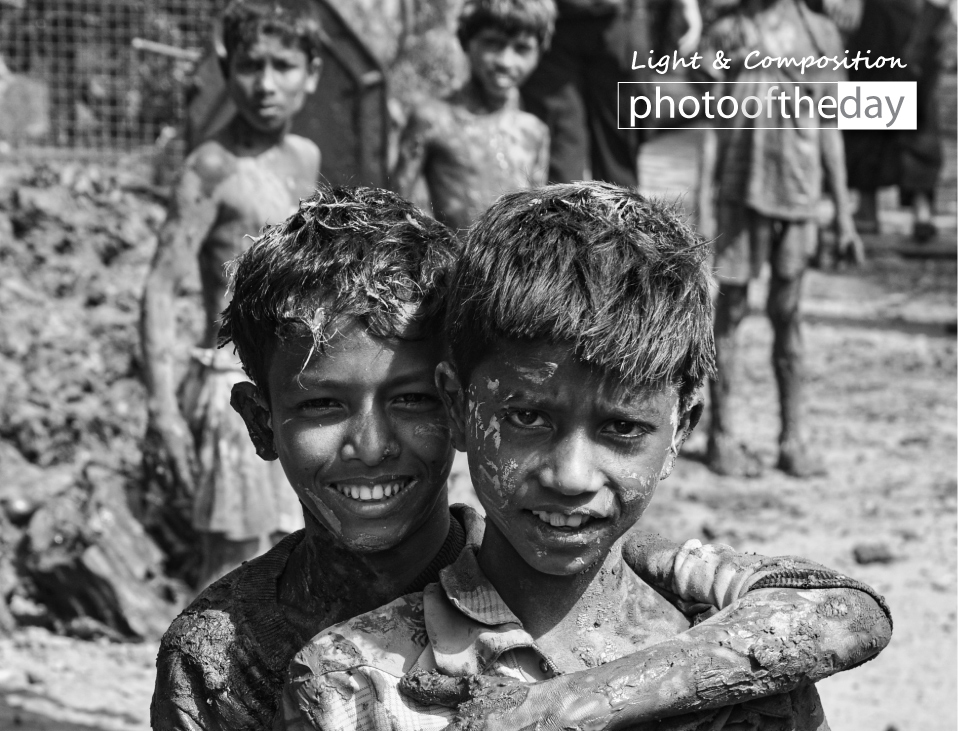
Captured during a river journey from Sittwe to Mrauk U in Myanmar, this photograph documents a spontaneous moment of childhood joy along the banks of the Kaladan River. The photographer encountered a group of local boys fully immersed in play, their bodies coated in mud, reflecting the simple, uninhibited entertainment found in rural life. The image is award-worthy for its authentic portrayal of human connection and the raw, tactile quality of the scene, where the muddy environment becomes a canvas for the children's exuberant spirit and genuine happiness.
Ryszard Wierzbicki
Born in 1963 and a graduate of the University of Gdańsk, Ryszard Wierzbicki transitioned from a diverse career in social sciences and marketing to become a dedicated travel photographer and tour organizer. After moving to the United Kingdom in 2006, he focused his lens on South-East Asia, often volunteering with organizations supporting orphaned children. As the founder of the Instant Travelling and World Around forums, Wierzbicki combines his professional expertise with a deep-seated passion for exploration, scuba diving, and documenting the vibrant cultures he encounters across the globe.
Resonance Score Breakdown
Transparency Note: The resonance score (8.0/20) is calculated based on social engagement metrics collected before the award announcement.
Expert Photography Reviews · 7
The Weight of Earth
In the damp, heavy air that precedes a summer storm, the light loses its clarity. It becomes thick, almost tactile, pressing against the skin like a wet wool blanket.
Read the reflection →The Weight of the Earth
When I was seven, my cousin Tunde and I found a patch of red clay behind the shed after a heavy rain. We didn't see dirt; we saw a second skin. We smeared it over our arms and legs until we were no longer just boys, but statues carved from the garden itself.
Read the reflection →Reviews & Comments
Share your thoughts about this award-winning photograph. Your reviews contribute to the community engagement score.
Before the eye identifies the boys, something in my chest loosens. It’s the visceral, cooling weight of that river mud, a tactile memory that triggers a sudden, sharp longing for unburdened play. I’ve returned to this frame three times today; each time, their exuberant, smeared faces pull me further from my own composure. It’s a rare, messy joy that doesn’t just sit on the page—it settles into the pulse, lingering long after I’ve turned away.
1/250sec at f/8, ISO 200, 55mm. The D5000’s sensor isn’t a powerhouse, but f/8 keeps the mud-caked subjects sharp across the frame. It’s a calculated choice. The shutter speed is sufficient to freeze the movement without introducing noise. I’ve seen enough soft portraits to appreciate this discipline. It’s technically sound, though the mid-range focal length feels a bit detached. It’s not art; it’s a clean, clinical capture of a moment that I actually find quite refreshing.
It’s easy to snap a shutter when the light hits a riverbank, but capturing this level of unvarnished exuberance suggests Wierzbicki didn’t just pass through. He clearly sat in the muck until the boys forgot he was there. I’ve spent enough hours shivering in damp reeds to recognize the patience required to dissolve into the background. It’s a rare, tactile honesty. One suspects he waited for the mud to dry just enough to tell the story.
Of the thousands of portraits I’ve reviewed, most rely on staged emotion. What separates this is the visceral texture of the mud, which acts as a second skin for these boys. It’s not just a snapshot of play; it’s a document of pure, unvarnished existence. I’ll admit, the sheer, chaotic joy here actually made me smile. In thirty years, this won’t just be a memory of Myanmar; it’ll be a reminder of what childhood feels like.
The Kaladan’s silt-heavy water acts as a natural filter, scattering light in ways that usually ruin a shot. Here, the mud isn’t a technical nuisance; it’s the medium. I’ve spent my life fighting the refractive index of water, but these boys have mastered it. Their joy feels so tactile, almost like watching bioluminescence erupt in the dark. It’s rare to see such clarity in a riverbed environment. Honestly, it makes me want to dive right in.
The riverbank isn’t just mud. It’s a stage for stillness. These boys don’t need the frame to be full. They’ve carved a pocket of joy out of the silt. I’m struck by the way the grey light clings to their skin. It’s quiet, despite the play. Nothing here is accidental. The empty corner is not empty. It’s a breath held in the heat. I’ve rarely seen such heavy silence in a portrait. It’s enough.
We look at these boys and we don’t just see mud; we see the ancient, unburdened rhythm of the Kaladan. They’ve turned the riverbank into a kingdom, their laughter echoing through the frame. I’m struck by how they’ve invited us into their play, not as observers, but as kin. It’s a rare, tactile joy that makes me miss the simplicity of my own childhood. This is a photograph that asks to be returned to, again and again.