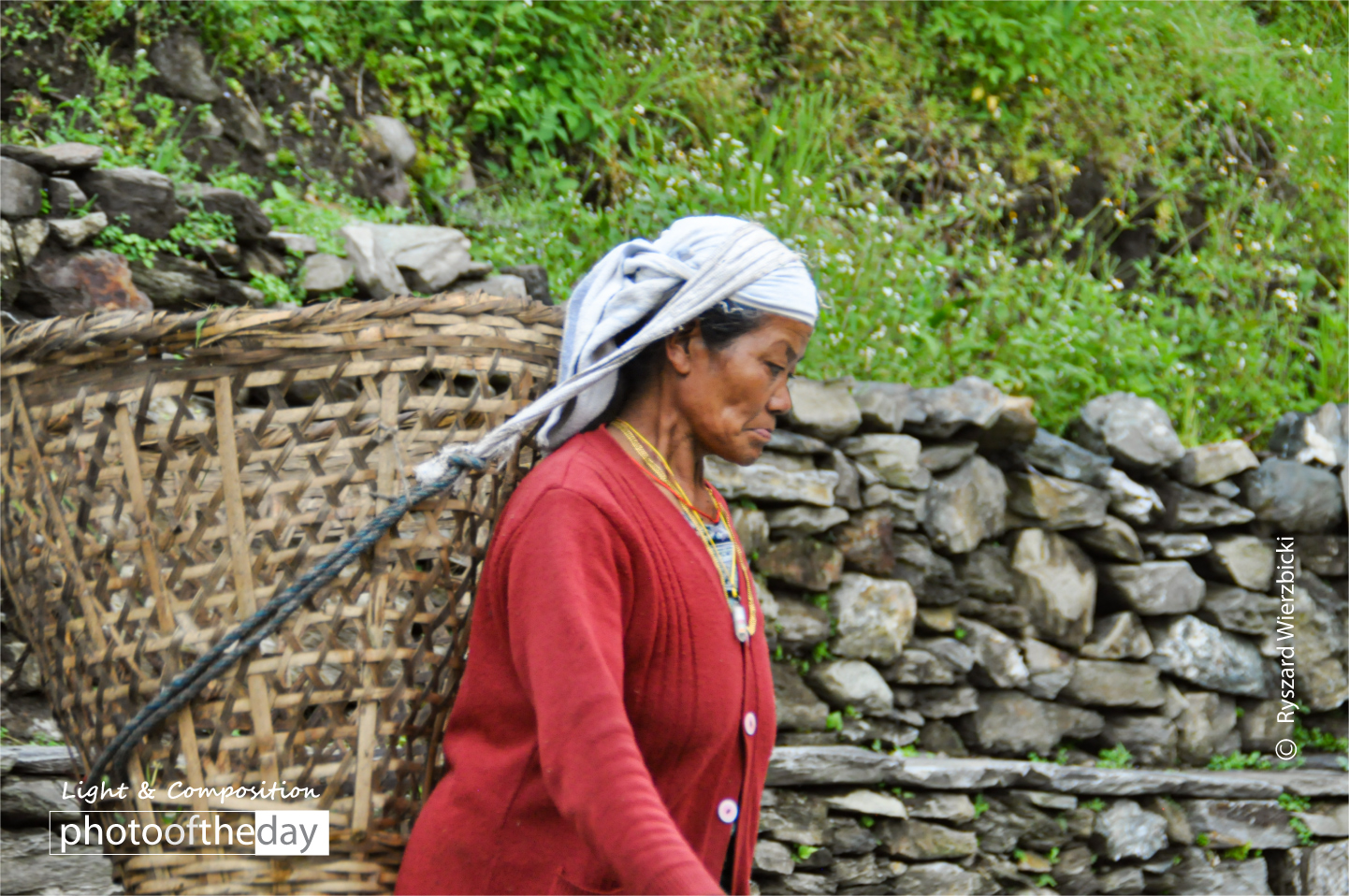
A Himalayan Woman Bearer by Ryszard Wierzbicki
Captured amidst the rugged terrain of the Himalayas, this photograph documents the arduous daily reality of local women who perform labor-intensive tasks alongside their male counterparts. Using a 150mm focal length to isolate the subject, the photographer highlights a woman bearer carrying a heavy basket used for harvesting mountain grass. The image is award-worthy for its poignant social commentary and the respectful, observant gaze it casts upon the strength and resilience of Himalayan women, transforming a fleeting moment of mountain labor into a powerful visual narrative of endurance.
Ryszard Wierzbicki
Born in 1963, Ryszard Wierzbicki is a Polish-born photographer and educator who transitioned from a career in social sciences and marketing to a life of global exploration. After relocating to the United Kingdom in 2006, he dedicated himself to documenting the world through travel and photography, often focusing on humanitarian efforts in South-East Asia. Currently based in Swindon, he balances his professional life as a marketing advisor with his passion for scuba diving and capturing the authentic, often challenging, lives of people in remote regions.
Resonance Score Breakdown
Transparency Note: The resonance score (8.0/20) is calculated based on social engagement metrics collected before the award announcement.
Expert Photography Reviews · 6
The Weight of the Ascent
The alpine ibex carries its own weight across vertical rock faces where gravity seems to be a suggestion rather than a law, its hooves finding purchase on ledges no wider than a thumb.
Read the reflection →The Weight of the World
How much of our own identity is defined by the burdens we choose to carry? We often speak of strength as a quality of the spirit, yet it is so frequently measured by the physical toll exacted upon the frame.
Read the reflection →Reviews & Comments
Share your thoughts about this award-winning photograph. Your reviews contribute to the community engagement score.
1/500sec at f/6.3, ISO 900, 150mm. The shutter speed is adequate, but ISO 900 on a D5000 introduces unnecessary luminance noise in the shadows. It’s a technical compromise that muddies the texture of the basket. I’ve spent enough time in the mountains to know the light is harsh, yet the exposure doesn’t justify the grain. The 150mm compression is the right call for isolation, but the sensor noise distracts from the subject’s grit. It’s technically sloppy.
The 150mm lens flattens the mountain, turning a human life into a graphic element of endurance. Why does the basket dominate the frame while her face remains obscured by shadow? It’s a classic aesthetic of poverty that makes me deeply uncomfortable. Does this woman know she’s being framed as a symbol of resilience for a gallery wall? We’ve turned her labor into a commodity. Is this actually respect, or just another tourist’s convenient, silent capture?
At f/6.3, the 150mm focal length compresses the Himalayan atmosphere, rendering the background into a soft, creamy bokeh that isolates her form with surgical precision. I’m genuinely moved by the way the lens resolves the texture of the woven basket against her weathered skin; it’s a masterclass in micro-contrast. The diffraction limit hasn’t compromised the fine detail of her gaze. It’s rare to see such optical clarity capture the raw, heavy weight of human endurance so perfectly.
You didn’t just snap a portrait; you caught the weight of her life in that basket. I’ve spent enough time in the mountains to know that look—it’s not just fatigue, it’s a quiet, iron-clad endurance. Because you stepped back with that 150mm lens, you let her be. You didn’t intrude. I felt a sudden, sharp ache in my own shoulders looking at her. There’s something deeply honest happening here. You waited, and you saw her.
The mountain air feels thin here. She carries the weight of the harvest, yet the frame doesn’t crush her. It’s the space around her shoulders that catches my breath. The sky isn’t just background; it’s a vast, quiet relief. I’ve spent minutes watching the way the light touches her basket. Nothing here is accidental. The empty corner is not empty. It’s the silence of the climb. It’s the pause before the next step.
The basket’s weight isn’t just physical; it’s a crushing geometry of survival. Wierzbicki doesn’t shy away from the harsh, high-altitude glare, yet it’s the deep, unforgiving shadows beneath her burden that truly haunt me. I’ve stared at those dark pockets for an hour, feeling the cold ache in my own shoulders. It’s a brutal, honest dialogue between light and exhaustion. When the shadow swallows her form, it’s not hiding her—it’s revealing the gravity of her existence.