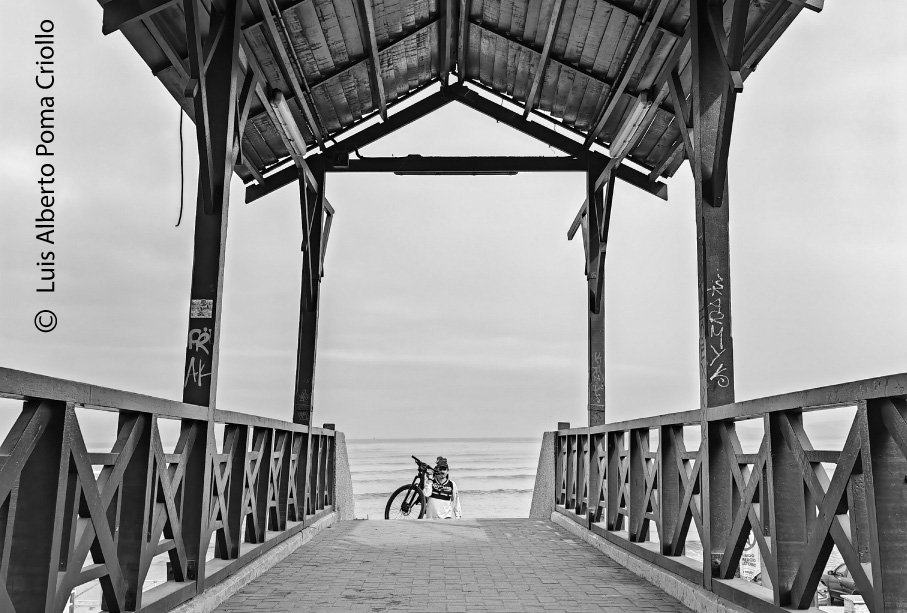
Waiting for the Moment by Luis Alberto Poma Criollo
Captured in the tranquil village of Bandipora near Wullar Lake, this poignant image depicts a young boy and girl running joyfully along a quiet street. The photographer utilizes a striking black-and-white palette to emphasize the contrast between the children's exuberant spirit and the somber backdrop of fallen, damaged trees. These remnants of destruction serve as a powerful metaphor for the hardships faced by the community. Yet, the presence of resilient homes amidst the debris offers a narrative of hope and endurance, making this a deeply evocative and award-worthy study of human spirit in the face of adversity.
Exposure 1/30sec @ f/3.5-5.6 | ISO 250 | Focal Length 18mm
Luis Alberto Poma Criollo
Based in Lima, Peru, Luis Alberto Poma Criollo is a dedicated photographer who documents the profound intersection of his nation's diverse landscapes and its rich cultural heritage. His work spans from the majestic peaks of the Andes to the vibrant energy of traditional festivities like Inti Raymi, consistently highlighting the inseparable bond between nature and humanity. Through his lens, he captures compelling narratives that showcase the resilience and beauty of the Peruvian spirit, establishing himself as a thoughtful storyteller within the international photography community.
Resonance Score Breakdown
Transparency Note: The resonance score (7.3/20) is calculated based on social engagement metrics collected before the award announcement.
Expert Photography Reviews · 6
The Weight of Play
I spent this morning trying to clear out the shed in my backyard. It was full of broken things—a rusted rake, a chair with a missing leg, and piles of wood from a fence that fell down last winter. It felt heavy, looking at all that decay.
Read the reflection →The Velocity of Being Small
When I was seven, my sister and I discovered that if we ran fast enough through the tall grass behind our house, the world behind us seemed to vanish entirely.
Read the reflection →Reviews & Comments
Share your thoughts about this award-winning photograph. Your reviews contribute to the community engagement score.
The shutter speed is risky, but it pays off. Those kids are pure kinetic energy against the wreckage. If Poma had waited another heartbeat, the blur would’ve swallowed their joy. It’s that razor-thin margin between a static record and a living, breathing instant. I’m actually smiling looking at their stride. It’s raw, it’s honest, and it’s perfectly timed. Cartier-Bresson would’ve tipped his hat to this. You caught the ghost of a moment before it vanished.
The frame hinges on a sharp diagonal vector created by the children’s movement, cutting across the static, horizontal debris. It’s a classic tension between kinetic energy and structural decay. The 1:3 ratio of light-toned figures against the dark, chaotic negative space of the fallen trees creates a perfect visual equilibrium. I’m genuinely moved by how the children’s blurred limbs resolve the composition’s instability. It’s a rigorous, elegant solution to a chaotic scene. Simply brilliant geometry.
The children run. They don’t see the splintered wood. I’ve spent minutes watching the space between them and the ruin. It’s heavy. The frame holds a silence that isn’t empty; it’s a weight. I feel a sudden, sharp ache in my chest. The debris isn’t just background. It’s the pause before the next breath. Nothing here is accidental. The empty corner is not empty. It’s where the joy meets the dust. It’s enough.
At 18mm, the Nikon’s wide-angle distortion stretches the periphery, yet the focal plane holds the children’s kinetic energy with surprising sharpness. I’m struck by how the diffraction of light across the splintered wood textures creates a visceral, tactile grit. It’s a masterclass in managing the diffraction limit; the lens doesn’t soften the debris, it renders the decay with a clarity that hurts. Honestly, it’s the raw, optical honesty of that wreckage that makes me ache for them.
The juxtaposition of childhood exuberance against the skeletal remains of Bandipora echoes the stark, post-conflict lyricism of Don McCullin, yet it lacks his visceral grit. While the 18mm perspective creates a wide, immersive stage, the composition feels tethered to a familiar humanist trope. I’ve seen this dance of innocence and ruin a thousand times, but the way the light catches their movement—it’s genuinely heart-wrenching. It’s a classic frame, though it struggles to break new ground.
Most street photography relies on fleeting luck, but this frame earns its place because of the tension between the children’s blurred motion and the jagged, static debris. It’s a rare balance. I’ve seen thousands of shots of running kids, yet the way the ruined timber frames their joy makes me ache for their future. It isn’t just a record of Bandipora; it’s a visual argument that resilience is often found in the most broken places.