Arrangement by Hanks Tseng
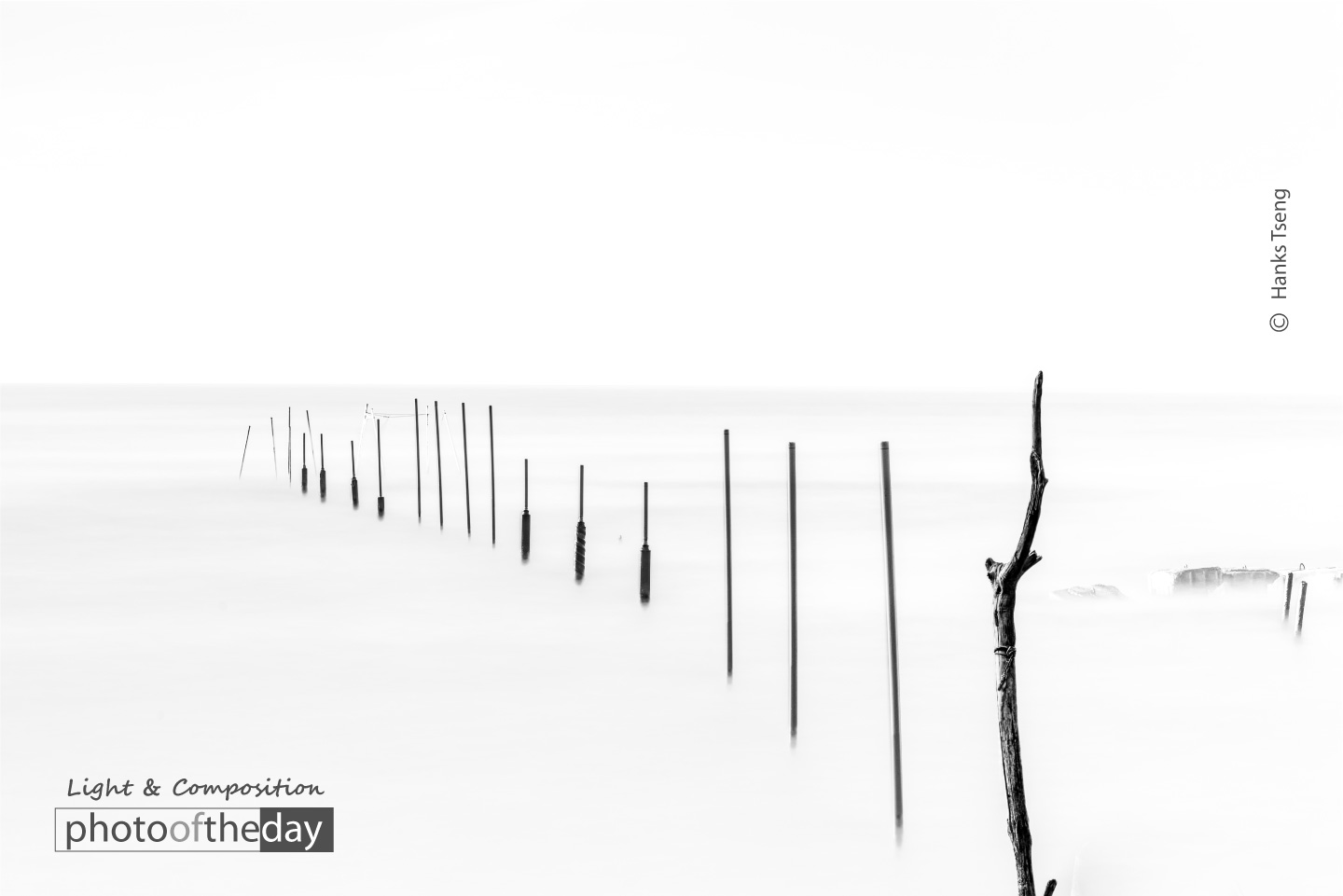
The photographer captured a rhythmic scene along the coast of Taoyuan City, where iron poles erected by fishermen stand in disciplined formation like a silent army awaiting the tide. By employing a long exposure technique, the photographer successfully smoothed the turbulent waves, creating a serene, minimalist backdrop that emphasizes the verticality of the poles. The decision to render the image in black and white strips away chromatic distraction, focusing the viewer’s attention on the stark geometry and peaceful atmosphere of the shoreline. This evocative composition transforms a functional fishing site into a meditative study of structure, stillness, and coastal beauty.
Hanks Tseng
Born in Taoyuan, Taiwan, Hanks Tseng is a dedicated photographer who turned his passion for the lens into a central pursuit during his retirement. He specializes in landscape photography, frequently capturing the tranquil essence of seascapes, forests, and streams through the deliberate use of slow shutter speeds. His work is characterized by a commitment to recording the natural beauty of his surroundings, aiming to share a sense of peace and quietude with an international audience through his evocative, long-exposure imagery.
Resonance Score Breakdown
Transparency Note: The resonance score (9.0/20) is calculated based on social engagement metrics collected before the award announcement.
Expert Photography Reviews · 8
The Architecture of Silence
We often mistake stillness for an absence, a hollow space where nothing happens. But look closer at the way the tide retreats, leaving behind the memory of its weight upon the sand.
Read the reflection →The Patience of Iron
There is a particular kind of silence that only exists where the land decides to stop and the water begins.
Read the reflection →Reviews & Comments
Share your thoughts about this award-winning photograph. Your reviews contribute to the community engagement score.
The tide doesn’t care about your tripod, but here, the stillness hits hard. It’s a rhythmic, silent army. I love the way those iron poles cut through the long-exposure mist. It feels like a breath held underwater. Cartier-Bresson hunted the human pulse, but Tseng found the pulse of the coast. One second later and the light shifts, the geometry softens. It’s a clean, sharp slice of time. I’d have stood there for hours waiting for this.
Before the eye identifies the poles, something in the chest tightens. It’s a rhythmic, held-breath stillness. The long exposure doesn’t just smooth the water; it erases the noise of the world, leaving only that stark, vertical ache. When I return to this, I feel the cold salt air against my skin. It’s a quiet, lonely geometry that follows me into sleep. I’ve never felt so comforted by such a silent, rigid army.
The tide was retreating, leaving these iron sentinels to hold the silence of the Taoyuan coast. I’ve spent enough hours waiting for the sea to soften to know that Hanks didn’t rush this. He stood in the cooling air, listening to the water’s rhythm until the world blurred into a velvet stillness. It’s haunting, really. Looking at these poles, I feel a sudden, sharp ache for that kind of quiet. It’s a beautiful surrender.
The tide doesn’t care for your schedule, yet these poles suggest a photographer who spent a fair few shivering hours waiting for the water to behave. It’s a disciplined study in geometry. I’ve spent enough mornings on similar coastlines to know the salt spray ruins gear and patience alike. One suspects Tseng didn’t just stumble upon this stillness. He earned it. It’s a quiet, cold sort of triumph that I find genuinely refreshing.
The long exposure here is a safe, predictable choice, yet it’s undeniably effective. It’s closer to Sugimoto’s meditative seascapes than to standard coastal reportage. I’m struck by the way the iron poles slice through the ether, but I can’t help but wonder: what if Tseng had let the water keep its teeth? By smoothing the turbulence, he’s traded raw energy for a polite, minimalist silence. It’s technically clean, but I’m craving more friction.
Long exposure is the antithesis of the peak moment. By blurring the water, Tseng has effectively erased the kinetic energy of the tide. I’m looking for the precise millisecond where the wave hits the pole, the spray at its maximum arc, but it’s all gone. It’s too soft, too static. I miss the violence of the ocean. It’s technically clean, sure, but it feels like a race where the runners never actually left the blocks.
We look at these iron poles and we don’t just see geometry; we see a gathering. They’ve been placed by fishermen, and in their silent, rhythmic formation, they wait for the tide like elders listening to a story. It’s a portrait of labor without the laborer. I feel a profound, aching stillness here. It’s a photograph that asks to be returned to, because it’s not just about the coast; it’s about the patience of waiting.
The long exposure effectively pushes the diffraction limit, smoothing the turbulent Taoyuan surf into a laminar flow. By stripping away chromatic aberration, Tseng forces the eye to resolve the iron poles against a near-infinite depth of field. It’s a clinical, yet hauntingly beautiful, reduction of coastal physics. I’m genuinely moved by how the stillness of the water contrasts with the rigid geometry of the steel. It’s a rare moment where optics perfectly serve the silence.
My eyes got lost at the end of the image, nice work of building composition and focus.