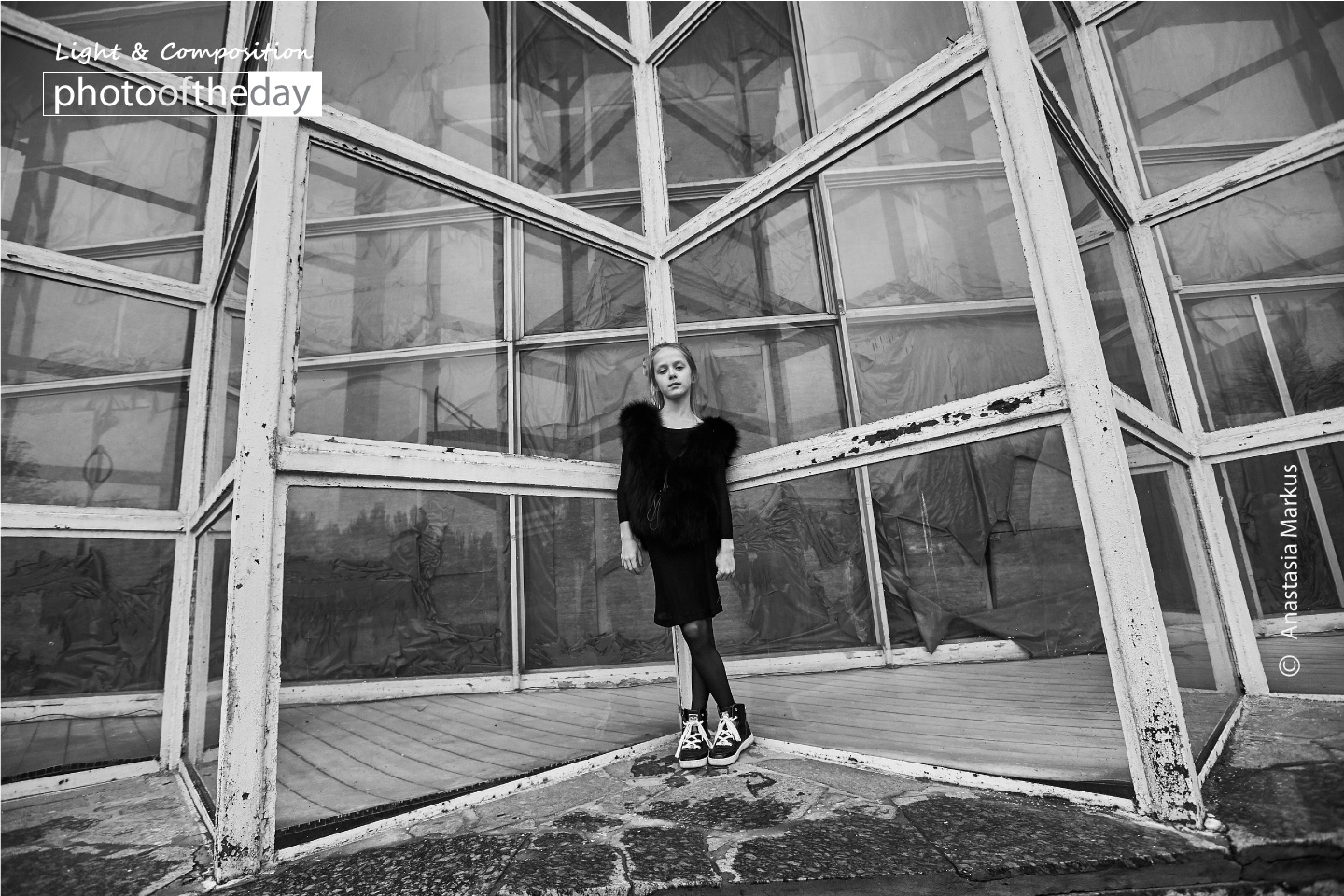
A Little Girl at the Big Wall by Anastasia Markus
Captured against the imposing backdrop of a historic cultural center, this portrait masterfully explores the visual tension between a small child and the massive, geometric architecture surrounding her. Despite challenging weather conditions that necessitated a high ISO setting, the photographer successfully leveraged the stark contrast and structural lines to create a compelling narrative. The image stands out for its thoughtful composition, which transforms a simple portrait into a profound study of scale and human presence, earning recognition for its artistic vision and technical execution under difficult lighting.
Anastasia Markus
Born in Donetsk, Ukraine, Anastasia Markus transitioned from a background in business to a dedicated career in photography, specializing in children’s, family, and wedding portraiture. After a decade-long hiatus, she has returned to the craft with a renewed passion for competition and creative growth. Currently based in Beer Sheva, Israel, Markus views the challenges of the photographic process as a vital means of discovering new facets of her artistic identity.
Resonance Score Breakdown
Transparency Note: The resonance score (8.4/20) is calculated based on social engagement metrics collected before the award announcement.
Expert Photography Reviews · 8
The Weight of Stone
I keep a small, smooth river stone on my desk, worn down by years of water and friction until it fits perfectly into the hollow of my palm. It is heavy for its size, a dense anchor that reminds me of how much time it takes to shape something solid.
Read the reflection →The Weight of Stone
There is a specific silence that lives in the shadow of a wall built to outlast the people who laid its stones. I remember the heavy, limestone garden wall of my grandmother’s house, a structure that felt like a mountain to a child of five.
Read the reflection →Reviews & Comments
Share your thoughts about this award-winning photograph. Your reviews contribute to the community engagement score.
You waited for the right moment, and it shows. That massive wall could have swallowed her whole, but you kept her presence front and center. It’s a quiet, heavy scene, and I felt a lump in my throat looking at her small frame against all that cold stone. You didn’t let the technical noise get in the way of the feeling. Because you were patient, you found the truth in her stillness. That’s real work.
At high ISO, the sensor’s noise floor threatens the micro-contrast, yet the lens resolves the child’s hair against that brutalist stone with startling acuity. The focal plane is razor-thin, isolating her against the diffraction limit of the distant masonry. It’s a delicate optical dance. I’m genuinely moved by how the glass captures her fragile presence amidst such overwhelming geometry; it’s a rare moment where the physics of light perfectly articulates the weight of her small world.
That massive wall in Kyiv doesn’t care about the girl, but Anastasia caught the exact heartbeat where she does. It’s all about the scale. One tenth of a second later and the shadow shifts, the geometry loses its bite, and the tension collapses. I’ve spent years chasing these fractions, and honestly, this one makes my pulse race. She didn’t just frame a kid; she pinned a fleeting, fragile defiance against the concrete. Perfect timing.
The child against that massive wall feels like a diver suspended in the blue, dwarfed by the crushing scale of the abyss. I’m struck by how the high ISO grain mimics the backscatter I’m always fighting to eliminate. It’s a stark, monochromatic world where light doesn’t just fall; it’s absorbed. She’s navigating a structural current, small and fragile, much like a juvenile reef fish caught in the vast, geometric silence of the deep. It’s haunting.
The architecture doesn’t merely loom; it interrogates. Markus forces the child into a brutal, geometric silence where the shadows aren’t just voids, but the heavy, suffocating weight of history itself. I’ve stared at this grain, at the way the darkness swallows the girl’s edges, and it makes my chest ache. It’s a terrifying confrontation. She isn’t just standing before a wall; she’s being erased by the very scale of a world that’s forgotten how to be gentle.
Before the eye identifies the child, something in the chest tightens. The scale of that brutalist wall doesn’t just dwarf her; it threatens to erase her. I feel a sudden, sharp urge to reach into the frame and pull her toward me. When I return to this a year later, the graininess of the high ISO feels like static in my own memory, a lingering hum of anxiety that refuses to fade. It’s haunting.
It’s a striking composition, but I find myself searching for the pulse of the subject. In my field, we learn that proximity without connection is just theft. This child is dwarfed by stone, yet she seems like a prop placed for geometry rather than a living, breathing presence. I’ve spent weeks in freezing blinds waiting for a fox to trust me; I wish I saw that same earned intimacy here. It’s technically sharp, but emotionally hollow.
The high ISO grain here feels like the static of a dying star. Anastasia’s subject stands against that brutalist wall, a tiny spark of life dwarfed by stone. I’ve spent my life measuring light that traveled eons to reach my sensor, yet this child’s presence feels just as ancient. It’s a fragile, fleeting collision of history and biology. I find myself holding my breath, terrified that she might simply vanish into the dark, cold geometry.