Light towards the Words by Rohit Patil
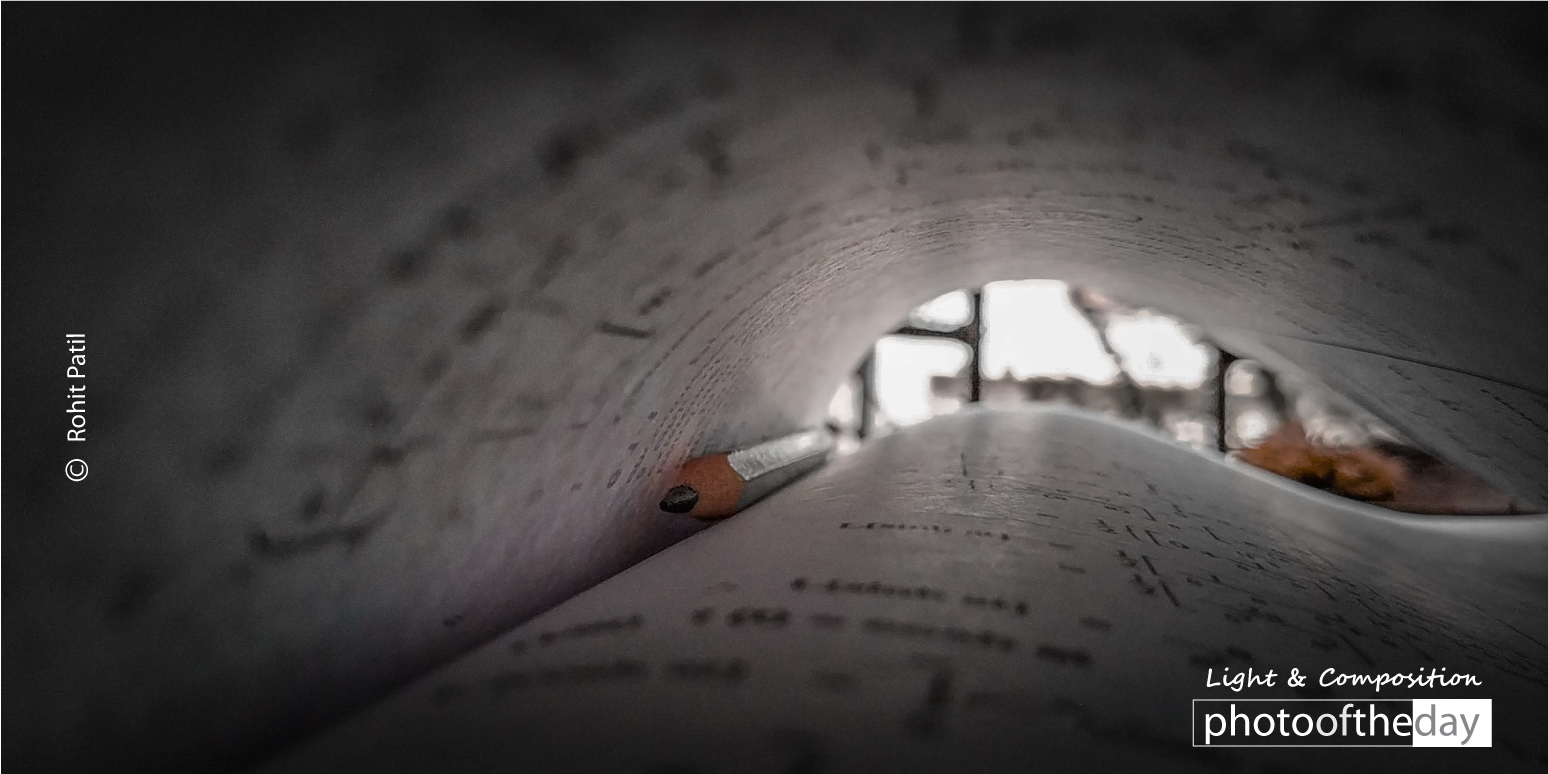
In this evocative study of light and literature, the photographer captures a quiet moment where direct sunlight streams through a window to illuminate the pages of an open book. By focusing on the interplay between the radiant light, the texture of the paper, and the humble presence of a pencil, the image transforms a mundane scene into a poetic narrative. The composition is celebrated for its intentional use of natural light to create depth and focus, turning a simple domestic setting into a compelling visual story that highlights the beauty found in everyday objects.
Rohit Patil
Residing in Ghansoli, Navi Mumbai, India, Rohit Patil is an emerging photographer who balances his academic pursuits as a BSc.IT student with a profound dedication to the visual arts. Though his journey began with smartphone photography, his work demonstrates a keen eye for capturing the subtle beauty of his surroundings. Driven by a genuine passion for learning and creative growth, Patil continues to refine his craft, transforming everyday moments into thoughtful photographic compositions that resonate with an international audience.
Resonance Score Breakdown
Transparency Note: The resonance score (9.3/20) is calculated based on social engagement metrics collected before the award announcement.
Expert Photography Reviews · 5
The Weight of a Page
When I was seven, my grandfather kept a heavy, leather-bound dictionary on a pedestal in the hallway. I remember the way the afternoon sun would hit the top edge of the pages, turning the paper into something that looked like solid gold.
Read the reflection →The Architecture of Illumination
When a forest canopy closes, the plants on the floor enter a state of patient dormancy, waiting for a single, precise break in the leaves to allow a shaft of light to reach the soil. This is not merely a matter of survival; it is a trigger for germination.
Read the reflection →Reviews & Comments
Share your thoughts about this award-winning photograph. Your reviews contribute to the community engagement score.
It’s a relief to see light behave so predictably. Up here, photons don’t vanish into the blue abyss or scatter off suspended silt. The paper’s texture is crisp, untouched by the refractive index shifts that turn my world into a blurry, monochromatic struggle. I’m genuinely envious of how easily that sunbeam hits the pencil. Down in the mangroves, I’d be fighting backscatter and losing my reds, but here, the warmth just stays. It’s beautifully, impossibly clear.
Sunlight hitting a page isn’t a sprint, but it’s still a race against the shifting earth. You’ve caught the light mid-transition, but the pencil’s shadow is soft, lacking the sharp, decisive edge of a true peak moment. It’s a quiet study, sure, but I’m left wanting the intensity of a harder light. I’ve spent my life chasing the perfect millisecond; this feels like the frame just before the sun truly ignited the paper. It’s close, but not quite there.
The frame divides into a sharp diagonal, slicing the page into a high-contrast triangle of light against a muted, shadowed quadrant. It’s a precise 1:2 ratio of illumination. The pencil acts as a vector, anchoring the composition’s center of gravity. I’m genuinely struck by how the paper’s texture disrupts the light’s vector, creating a tactile geometry. It’s a beautifully solved spatial equation; the math here doesn’t just hold the frame together—it makes the silence feel heavy.
1/100sec at f/1.8, ISO 250, 4.07mm. A smartphone sensor pushed to its physical limit. The f/1.8 aperture creates a shallow depth of field that’s frankly aggressive for a 4mm lens. It’s a gamble that barely pays off. The focus on the paper texture is sharp, but the chromatic aberration at the edges is distracting. I’ve seen enough digital noise to last a lifetime, yet this light-play almost makes me forget the hardware’s inherent limitations. Almost.
Sunlight hits the page, but what are we actually reading? Patil frames a quiet domesticity, yet I’m left wondering whose literacy is being curated here. Is this an authentic slice of Ghansoli life, or a staged aesthetic of intellectualism for a digital audience? The pencil feels placed, almost performative. It’s a pretty light, sure, but it feels hollow. Why do we insist on romanticizing the mundane when the real story sits just outside the frame?