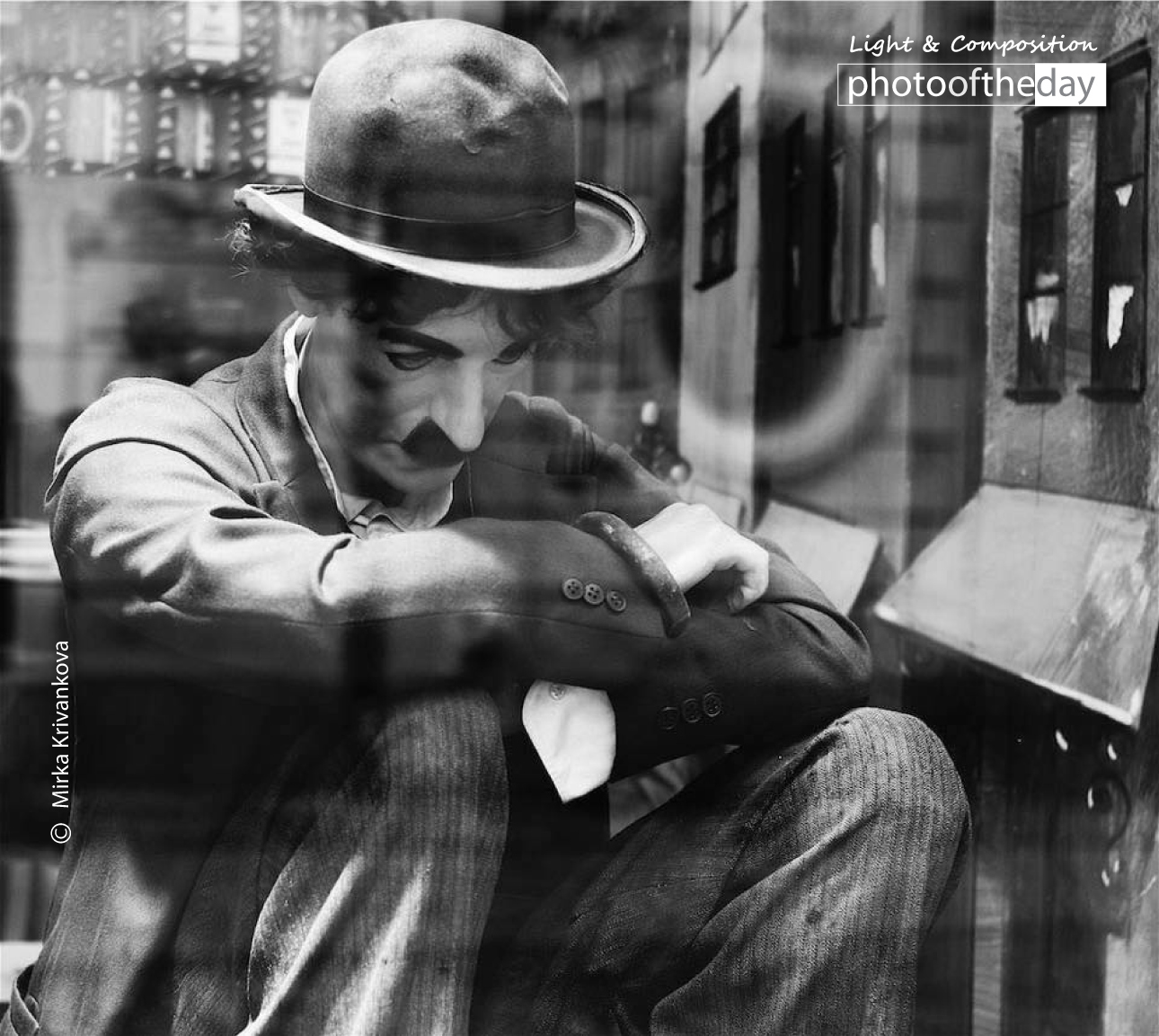
Charlie Chaplin by Mirka Krivankova
Captured within the historic Grévin Wax Museum in Prague, this photograph presents a striking study of the iconic Charlie Chaplin figure. The photographer utilized a 50mm lens at a wide aperture of f/2.5 to isolate the subject, creating a shallow depth of field that emphasizes the intricate details of the waxwork. By focusing on the interplay of light and texture, the image transforms a popular tourist attraction into a compelling portrait. The composition is award-worthy for its ability to breathe life into a static figure, capturing the essence of the legendary performer through a thoughtful and technically precise lens.
Mirka Krivankova
Hailing from Městec Králové, Czech Republic, Mirka Krivankova is an emerging talent whose work spans the diverse landscapes of the Czech countryside and intimate portraiture. Her photographic style is defined by a sophisticated use of formalism, expertly balancing natural light and shadow to guide the viewer’s eye through her subjects' environments. Constantly refining her portfolio, Krivankova demonstrates a dedicated commitment to her craft, evolving her bodies of work with a keen eye for detail and a growing mastery of visual storytelling.
Resonance Score Breakdown
Transparency Note: The resonance score (8.4/20) is calculated based on social engagement metrics collected before the award announcement.
Expert Photography Reviews · 4
The Echo of a Silent Step
I often find myself wandering the backstreets of Prague in my mind, tracing the cobblestones that lead away from the main squares and into the quiet, dusty corners where time seems to have folded in on itself.
Read the reflection →The Echo of a Silent Step
We are all, in some measure, ghosts of the people we once intended to be. We carry our pasts like heavy coats, buttoned tight against the wind, walking through rooms that hold the dust of other lives.
Read the reflection →Reviews & Comments
Share your thoughts about this award-winning photograph. Your reviews contribute to the community engagement score.
You’ve managed to pull a ghost out of the wax. It’s a strange thing, photographing a statue, but you’ve found the sadness behind the paint. I felt a genuine shiver looking at those eyes; they’re hollow, yet they hold the weight of a man who spent his life making us laugh while he was breaking. And you waited for the light to catch that stillness. You didn’t just document a museum piece. You found the soul.
We look at this waxen Chaplin and we don’t see a museum piece; we see a ghost waiting for the spotlight. Mirka’s lens caught the stillness of a performer who’s forgotten how to move. It’s haunting, really. I’ve spent minutes staring into those painted eyes, wondering if he’s listening for the laughter that once filled the room. It’s a quiet, lonely conversation between the camera and a memory. This is a photograph that asks to be returned to.
The shallow depth of field isolates the subject, yet the background blur lacks the necessary architectural weight to ground the figure. It’s a precarious balance. The focus on the waxen eye creates a sharp, unsettling fulcrum, but the frame doesn’t quite resolve the surrounding negative space. I’m bothered by the lack of geometric tension. It’s technically precise, sure, but the composition doesn’t hold the gaze long enough to justify the silence of the frame.
The vertical axis here is anchored by the bowler hat’s curve, creating a precise 1:2 ratio between the subject’s face and the blurred negative space. Krivankova’s f/2.5 aperture effectively flattens the background into a soft, geometric gradient, forcing the eye toward the sharp, triangular vector of the cane. It’s a beautifully solved spatial equation. I’m genuinely struck by how the shallow depth of field turns a waxwork into a living, breathing mathematical constant.