Selling Irons by Willeke Tjassens
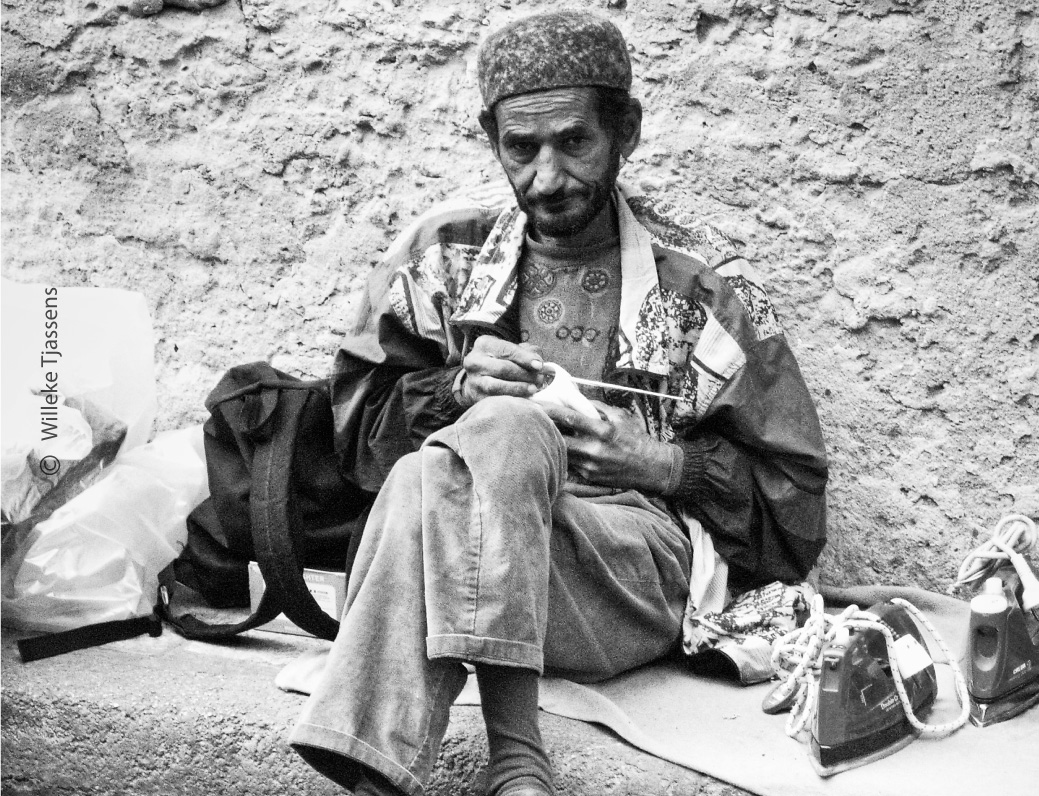
In the bustling streets of Morocco, the photographer encountered a man whose quiet dignity amidst hardship left a lasting impression. After striking up a conversation, the photographer learned of the man’s struggle to make ends meet by selling household irons. Captivated by the juxtaposition of his humble wares and his gentle spirit, the photographer captured this poignant moment of human connection. The image is award-worthy for its raw, empathetic storytelling, transforming a simple street encounter into a powerful portrait of resilience and the shared humanity found in the most unexpected places.
Willeke Tjassens
Born on February 25, 1972, Willeke Tjassens is a dedicated street photographer based in Duiven, Holland. Her practice is defined by extensive travels to global destinations such as Morocco, New York, and Egypt, though she frequently finds inspiration in the streets of Amsterdam. Known for her rigorous selection process, she often captures hundreds of images during long walks to curate a final few that prioritize originality and narrative depth. Her work reflects a keen eye for the human condition and a commitment to authentic, spontaneous storytelling.
Resonance Score Breakdown
Transparency Note: The resonance score (8.8/20) is calculated based on social engagement metrics collected before the award announcement.
Expert Photography Reviews · 3
The Weight of Things
In the quiet corners of a house, objects often outlive the hands that once held them. We accumulate things—a heavy iron, a worn chair, a stack of books—and we imbue them with a strange, silent gravity.
Read the reflection →The Weight of Small Things
We carry our lives in the palms of our hands, often balancing the heavy against the hollow. There is a quiet gravity to the objects we gather—the tools of a trade, the remnants of a day, the iron that smooths the wrinkles of a shirt but cannot iron out the creases of a life.
Read the reflection →Reviews & Comments
Share your thoughts about this award-winning photograph. Your reviews contribute to the community engagement score.
f/2.8 at 50mm, 1/250s, ISO 400. A standard portrait configuration, yet it’s effective here. The shallow depth of field isolates the subject from the chaotic Moroccan backdrop, forcing focus onto the irons and the man’s hands. It’s a calculated choice that works. I’ve seen too many street shots ruined by f/8 clutter. This isn’t just a snapshot; it’s a disciplined execution. Honestly, the sharpness on those rusted irons actually made me wince. Good work.
The irons sit like relics of a domesticity the subject can’t afford. I’m struck by how the frame isolates his poverty, turning his struggle into a curated aesthetic. Does his dignity belong to him, or is it something we’ve projected onto his exhaustion? Why does the composition prioritize the texture of his worn coat over his actual voice? It’s a polished portrait, but I can’t shake the feeling that we’re consuming his hardship as a souvenir.
The vertical axis of the man’s posture creates a perfect counter-weight to the rhythmic, horizontal stacking of the irons. It’s a precise 1:3 ratio of human form to industrial object, anchoring the frame’s negative space. I’m genuinely moved by how the diagonal of his gaze intersects the grid of his wares; it’s a beautifully solved spatial equation. The geometry doesn’t just hold the subject—it defines his quiet, structural resilience against the chaotic Moroccan street.