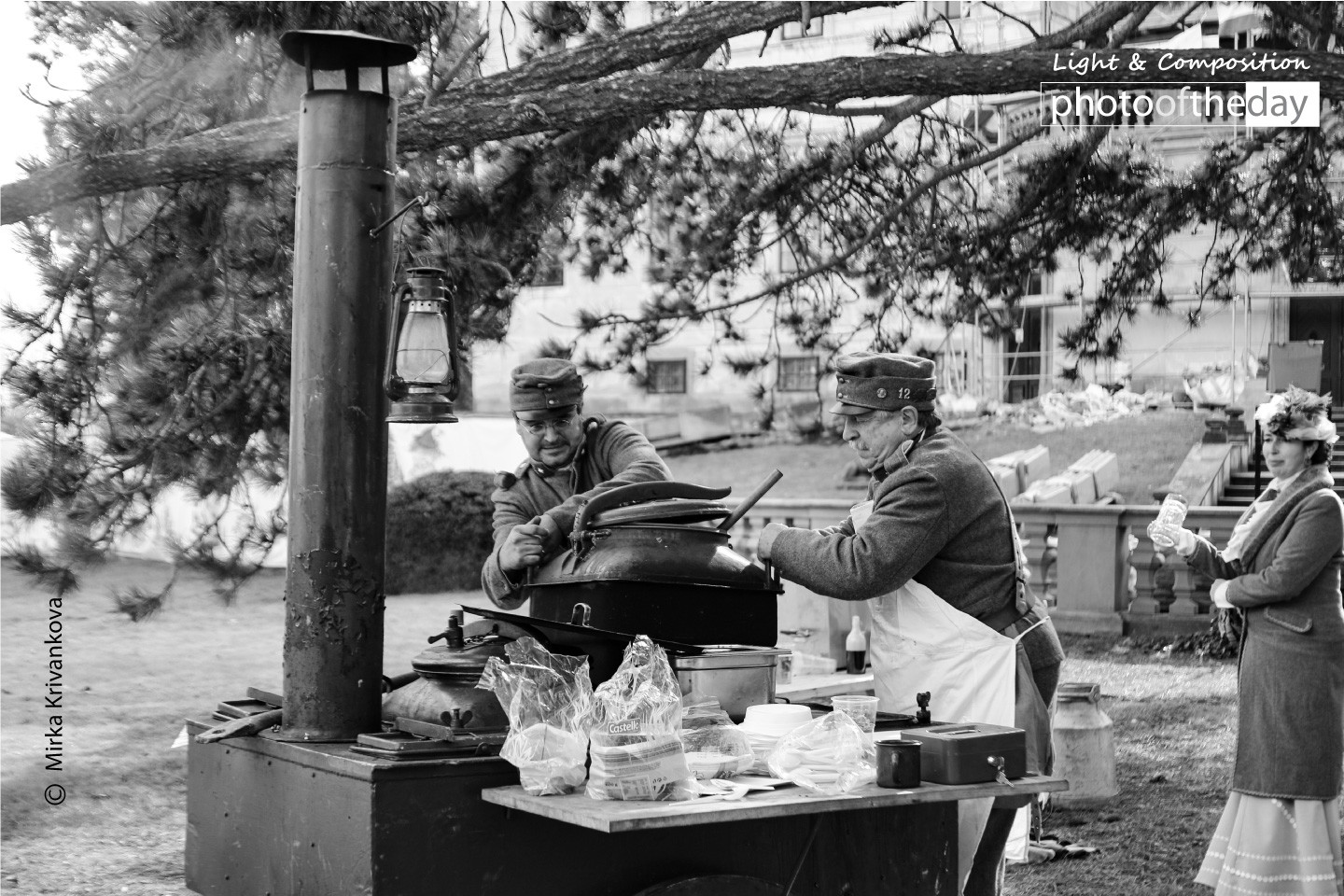
Soldiers in the Field Kitchen by Mirka Krivankova
Captured during the centennial celebrations of the First Republic in Chlumec nad Cidlinou, this photograph documents a historical reenactment set against the backdrop of the majestic Karlova Koruna castle. The photographer skillfully utilizes a 35mm focal length to frame the soldier within the field kitchen, emphasizing the juxtaposition of historical performance and Baroque architecture. By focusing on the authentic textures of the scene, the image serves as a poignant bridge to the era of Tomáš Garrick Masaryk. Its award-worthy quality lies in the precise composition and the evocative, timeless atmosphere that brings a century of Czech history to life through a single, well-composed moment.
Mirka Krivankova
Hailing from Městec Králové, Czech Republic, Mirka Krivankova is an emerging talent whose work captures the diverse spirit of her homeland. Her portfolio spans from the serene beauty of the Czech countryside to intimate, formalist portraits that masterfully utilize natural light and shadow to guide the viewer's gaze. Constantly refining her craft and organizing her work into comprehensive bodies, Krivankova demonstrates a dedicated evolution as an artist, consistently seeking to elevate her visual storytelling through both candid documentation and deliberate, structured portraiture.
Resonance Score Breakdown
Transparency Note: The resonance score (9.8/20) is calculated based on social engagement metrics collected before the award announcement.
Expert Photography Reviews · 4
The Quiet After the March
There is a profound stillness that settles over the world when the noise of history fades into the background. We often look at the past as a series of grand events, of marches and heavy footsteps, yet the true weight of time is found in the quiet intervals between those actions.
Read the reflection →The Persistence of Memory
Deciduous trees do not merely shed their leaves; they undergo a process of abscission, a deliberate sealing off of the connection between branch and stem to ensure the tree survives the coming frost. It is a quiet, structural letting go that allows the organism to endure.
Read the reflection →Reviews & Comments
Share your thoughts about this award-winning photograph. Your reviews contribute to the community engagement score.
The frame’s geometry is tight. Krivankova anchors the soldier against the rigid verticality of the field kitchen, creating a necessary spatial tension. The Baroque architecture in the background provides a brutal, static counterweight to the human element. It’s a disciplined arrangement of mass. I’ve rarely seen such cold, calculated balance in a reenactment scene. The composition doesn’t falter; it holds the viewer in a state of absolute visual stillness. It’s a rare, precise success.
The soldier’s ladle is mid-air, but the kinetic energy is already dissipating. It’s a split second too late. The wrist has already begun its follow-through, losing the tension required for a true peak moment. I’ve spent my life chasing that singular, explosive frame where effort meets stillness, and this isn’t it. It’s a clean shot, sure, but it lacks the visceral snap of a body fully committed. I wanted to feel the soup splash.
We look at this soldier and we don’t just see a reenactor; we see the weight of a century pressing against his brow. Mirka Krivankova didn’t just point her lens at the field kitchen; she listened to the silence of the history surrounding him. It’s a quiet, dusty intimacy that makes me ache for a time I’ve never known. This is a portrait that asks to be returned to, over and over again.
Reenactments are usually a chore to photograph, mostly because the participants are far too aware of the lens. Yet, here, the soldier’s focus on his task feels genuine. One suspects Krivankova didn’t just stumble upon this; she likely stood in the mud for hours, waiting for the tourists to clear and the light to hit that Baroque facade just so. I’ve been that cold, and I respect the commitment. It’s a quiet, earned moment.