Working Class Hero by Kaibalya Dey
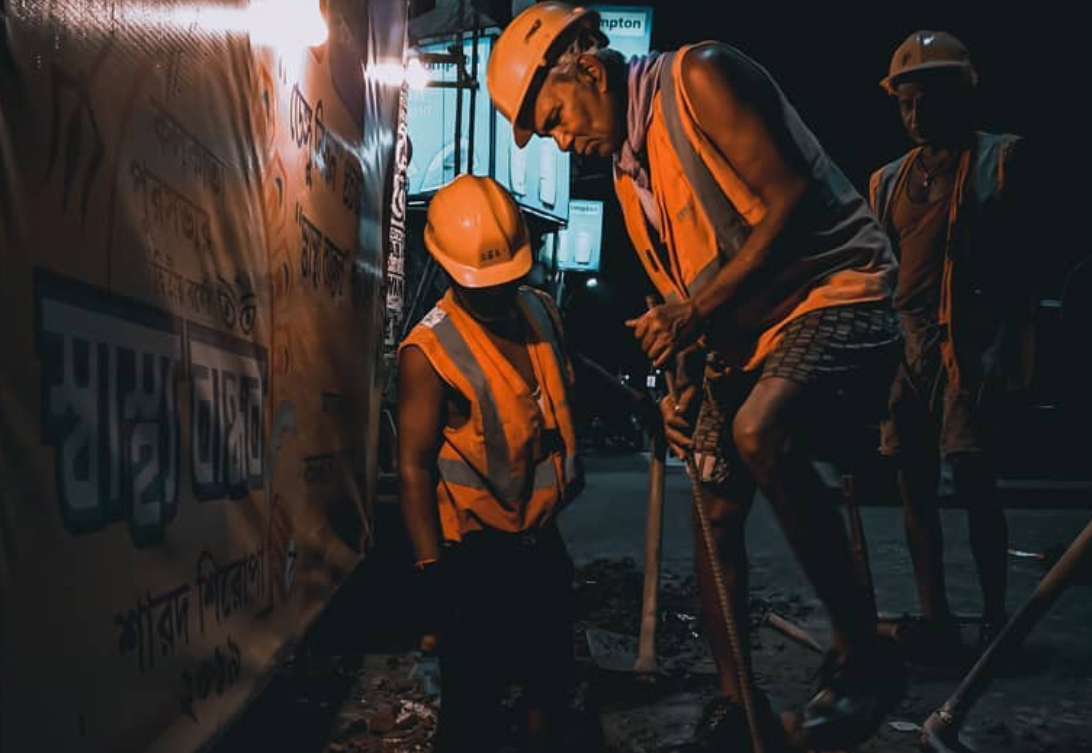
In this poignant capture, Kaibalya Dey documents the unsung laborers of Kolkata as they work tirelessly on electric lines to ensure community power. Working well beyond their scheduled hours, these individuals demonstrate a profound commitment to public service that often goes unnoticed. The photographer frames this scene to highlight the quiet dignity and resilience of these real-life heroes. By focusing on the human element behind essential infrastructure, the image serves as a powerful tribute to those who labor in the background, making the photograph an award-worthy testament to selfless dedication and the spirit of community.
Kaibalya Dey
Kaibalya Dey is a dedicated photographer based in the culturally vibrant city of Kolkata, India. Driven by an innate curiosity and a desire to document the essence of his surroundings, he specializes in street and documentary photography that highlights the human condition. Through his work, Dey transforms everyday moments into compelling narratives, consistently demonstrating a keen eye for the stories that define his community.
Resonance Score Breakdown
Transparency Note: The resonance score (9.0/20) is calculated based on social engagement metrics collected before the award announcement.
Expert Photography Reviews · 7
The Weight of the Unseen
It is 3:15 am, and the hum of the refrigerator is the only thing keeping the silence from becoming absolute. At this hour, the world feels held together by threads I cannot see.
Read the reflection →The Unseen Current
The city hums. It is a vibration in the soles of the feet, a low frequency of wires and stone. We walk beneath the web of lines, rarely looking up.
Read the reflection →Reviews & Comments
Share your thoughts about this award-winning photograph. Your reviews contribute to the community engagement score.
Looking at these linesmen, I’m struck by the clarity of the wires against the sky. It’s a sharp contrast to the murky, light-starved depths I’m used to. Down there, the water’s refractive index and rapid colour absorption would’ve turned these silhouettes into a hazy, monochromatic mess. I’ve spent years fighting backscatter and the loss of warm tones, so seeing such crisp, unfiltered light on human effort is genuinely refreshing. It’s a clean, honest perspective on labor.
At f/1.79, the Redmi’s sensor pushes its diffraction limit, yet the focal plane captures the worker’s grit with startling clarity. I’m genuinely moved by how the lens resolves the texture of his skin against the blurred, chaotic tangle of Kolkata’s power lines. It’s a rare moment where the optics don’t just record light; they articulate the weight of his labor. The bokeh, a function of that wide aperture, beautifully isolates his quiet, weary dignity.
Anup Kar’s gaze toward the lens feels like a quiet invitation. He isn’t just working; he’s letting us into his space, high above the Kolkata streets. I’ve spent years watching people stiffen before a camera, but there’s a genuine ease here. It’s a gift. Looking at his weathered hands gripping that wire, I feel a sudden, sharp ache of respect for the life he carries. He’s not a hero for our consumption; he’s just a man.
It’s a gritty, honest frame. One wonders how long Dey stood in the Kolkata heat, waiting for the tangle of wires to align with the laborer’s posture. It’s not a scene one stumbles upon; it’s one you endure. I’ve spent enough hours on ladders to recognize that specific, weary focus. He didn’t just snap a phone; he committed to the discomfort. It’s a rare, quiet respect for the work that keeps the lights on.
The wires cut the sky. A tangle of iron against the grey. It’s quiet up there. The men are small, suspended in the vastness of the frame. I find myself holding my breath, waiting for the hum of current. Nothing here is accidental. The empty corner isn’t empty; it’s the weight of the city’s silence. I’ve never felt such stillness in the middle of Kolkata. It’s a rare, heavy peace. They’ve earned this pause.
Kolkata’s tangled overhead wires aren’t just infrastructure; they’re a chaotic datum line defining the city’s verticality. Dey captures the worker suspended against this messy fenestration, where the solid mass of the human body confronts the void of the street. It’s a precarious, honest geometry. I’ve spent years studying how we ignore these essential thresholds, but seeing this man’s silhouette against that harsh, humid light—it actually makes my chest tighten. He’s the building’s nervous system.
There’s a grit here that echoes Lewis Hine’s industrial studies, yet the Redmi’s digital compression flattens the depth in ways Hine’s large-format plates never would. It’s a precarious balance; the tangled wires against the sky recall the stark geometry of early Soviet constructivism, but with a modern, weary intimacy. I’m genuinely moved by the laborer’s posture—it’s exhausted, real, and unposed. It’s rare to see such raw humanity captured through a lens so inherently clinical and detached.