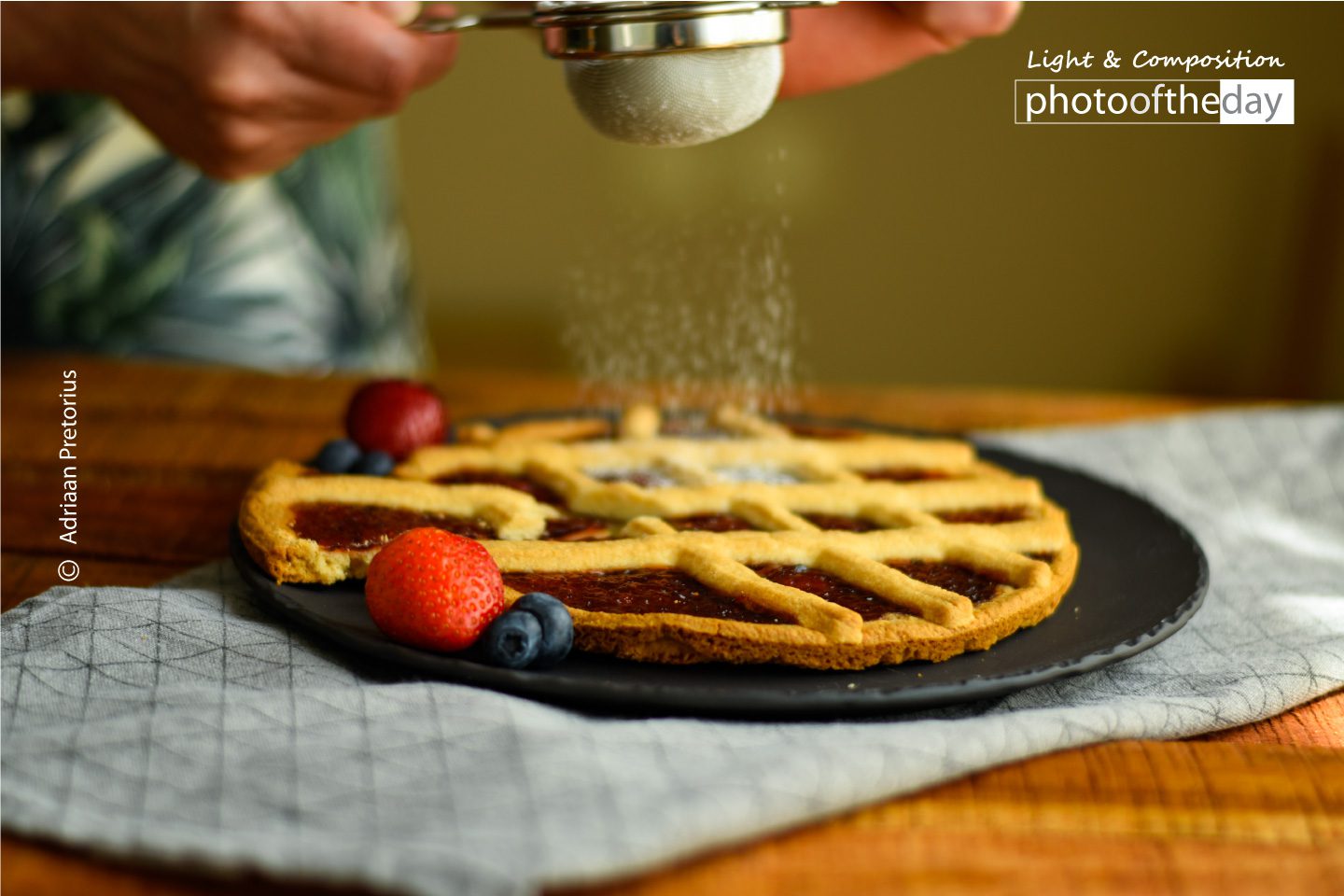
Sugar Dusting with Love by Adriaan Pretorius
Captured in a moment of culinary artistry, this photograph highlights the delicate process of finishing a homemade strawberry and blueberry pie. The photographer utilized natural side-lighting to accentuate the texture of the crust and the ethereal quality of the falling sugar dust. By timing the shutter release perfectly, the image freezes the dusting motion, turning a simple kitchen task into a graceful, cinematic scene. This work is award-worthy for its masterful use of light and its ability to elevate a domestic, intimate moment into a visually compelling narrative that celebrates the joy of baking.
Adriaan Pretorius
Born in South Africa and currently based in Kuwait, Adriaan Pretorius channels his deep appreciation for global culinary traditions into his photography. He views food as a universal language that bridges cultural divides, frequently traveling to explore the vibrant offerings of international street markets. His work reflects a genuine passion for storytelling through the lens, capturing the intersection of human connection and the diverse flavors of the world.
Resonance Score Breakdown
Transparency Note: The resonance score (10.0/20) is calculated based on social engagement metrics collected before the award announcement.
Expert Photography Reviews · 8
The Weight of Sweetness
I keep a small, tarnished silver sifter in the back of my kitchen drawer, its mesh clogged with the ghosts of a thousand cakes.
Read the reflection →The Weight of Small Things
It is 3:14 am. The house is holding its breath, and I am staring at the dust motes dancing in the sliver of moonlight that cuts across my floor. We spend our days building monuments to things that do not matter, chasing the heavy, loud milestones that we think define a life.
Read the reflection →Reviews & Comments
Share your thoughts about this award-winning photograph. Your reviews contribute to the community engagement score.
f/2.8 at 1/500s, 85mm. A shallow plane of focus that isolates the sugar particles effectively. The shutter speed is fast enough to freeze the motion, preventing blur. It’s a calculated choice that works. I’m actually impressed by the sharpness on the crust’s texture. Most people would’ve fumbled the focus here, but Pretorius nailed the plane. The optics support the narrative. It’s technically sound, and honestly, it’s refreshing to see someone respect the glass.
Before the eye identifies the pie, something in the chest softens. It’s the suspension of gravity in those white, falling grains that catches me; I’ve felt that same quiet stillness in my own kitchen, a rare, suspended grace. When I return to this a year later, the sugar doesn’t just look like dust—it feels like a held breath. It’s a gentle, tactile activation of memory that makes me want to reach out and touch the crust.
The kitchen’s cool, neutral surfaces provide a quiet stage for the warmth of the pie. That side-light catches the sugar mid-air, turning a mundane chore into a fleeting, crystalline performance. I’m truly moved by how the environment here isn’t just a backdrop; it’s the very vessel for this intimacy. The baker’s hands are secondary to the atmosphere. It’s a beautiful, tactile conversation between the maker and the flour-dusted air. I’d love to taste that moment.
There’s a quiet grace in those hands, but I’m left wondering who they belong to. It’s a beautiful scene, yet it feels like a performance for the lens rather than a life being lived. I’d trade that perfect sugar dust for a glimpse of the baker’s eyes. I feel a strange loneliness looking at this; it’s technically flawless, but it lacks the warmth of a shared moment. It’s a lovely picture, but it’s missing a soul.
We watch the sugar fall like snow, a quiet benediction over the berries. It’s not just a pie; it’s a memory of hands that have labored for love. I’m struck by the stillness here, the way the light catches the dust, turning a kitchen into a sanctuary. We don’t see the baker, yet we feel their presence in every grain. It’s a portrait of devotion, and honestly, it makes me miss my grandmother’s kitchen.
That sugar dust hangs in the air like a ghost. It’s a fleeting, fragile geometry that vanishes the second you blink. Most people miss the dance of the particles, but Pretorius caught the exact vibration. One tenth of a second later and the magic settles, the frame collapses into a boring kitchen chore. I’m genuinely moved by how he turned a mundane sprinkle into a cinematic event. He was paying attention. That’s the street, right there.
Sugar crystals suspended in mid-air mimic the chaotic beauty of a distant nebula. I’ve spent decades chasing photons that have traveled eons, yet here, the light travels only inches to catch a dusting of flour. It’s a quiet, domestic gravity. Watching these particles freeze in the side-light, I feel a sudden, sharp ache for the simplicity of a kitchen. It’s a different kind of cosmic dust, but it’s just as fleeting as any star.
The chiaroscuro here recalls the domestic intimacy of Dutch Golden Age painting, yet the suspended sugar particles evoke Harold Edgerton’s high-speed strobe work. It’s a curious collision of the seventeenth century and the mid-twentieth. While the composition feels a bit safe, that ethereal, frozen dust genuinely made me catch my breath. It’s rare to see such a mundane kitchen gesture treated with the technical rigor of a scientific study. I’m quite taken by this quiet, suspended grace.