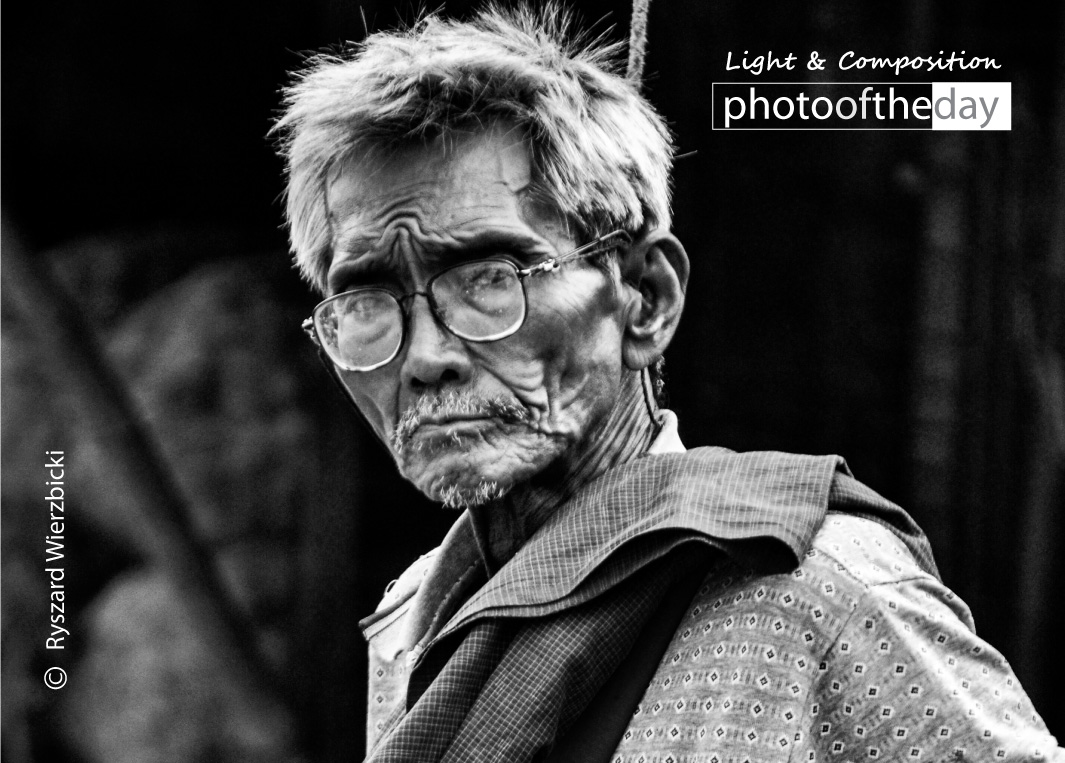
A Wise Man by Ryszard Wierzbicki
Captured in the serene Inle Lake area of Myanmar, this portrait serves as a profound study of the human condition. The photographer was drawn to the subject’s face, where the passage of time has etched a narrative of dignity, wisdom, and simplicity. By focusing on the intricate textures and stories written upon the man's features, the image transcends a mere portrait to become a testament to the beauty of aging. The composition is award-worthy for its ability to distill complex human experience into a single, quiet moment of connection, highlighting the photographer's deep empathy and keen observational eye.
Ryszard Wierzbicki
Born in 1963, Ryszard Wierzbicki is a Polish-born photographer and educator who transitioned from a career in social sciences and marketing to a life of global exploration. After relocating to the United Kingdom in 2006, he dedicated himself to documenting the cultures of South-East Asia, often combining his photography with volunteer work for orphanages. A passionate traveler and PADI-certified scuba instructor, Wierzbicki manages his own travel forums and marketing consultancy, using his lens to bridge the gap between diverse cultures and his international audience.
Resonance Score Breakdown
Transparency Note: The resonance score (10.0/20) is calculated based on social engagement metrics collected before the award announcement.
Expert Photography Reviews · 6
The Map of Our Years
Dear traveler, I have been thinking about the way we try to hide our history. We treat our skin like a secret, smoothing it over, pretending that the sun and the wind and the long, hard winters haven't left their marks.
Read the reflection →The Map of Years
We spend our youth trying to smooth the surface. We want the skin to be tight, the path to be straight, the story to be without interruption. We fear the lines that gather around the eyes and the mouth, seeing them as failures of time.
Read the reflection →Reviews & Comments
Share your thoughts about this award-winning photograph. Your reviews contribute to the community engagement score.
Wierzbicki’s subject isn’t merely aging; he is eroding into the dark. Look at how the shadows swallow the left side of his face, turning skin into landscape. It’s a brutal, honest erasure. I’ve stared at these deep, ink-stained crevices for an hour, and I’m unsettled by how much of the man has already vanished. He doesn’t invite our gaze; he resists it, hiding his secrets in the black. It’s a haunting, necessary silence.
The stillness here isn’t empty; it’s the physiological equivalent of a sprinter holding their breath at the blocks. I’ve spent my life chasing that singular, perfect millisecond of tension. Wierzbicki caught the exact flicker of light in the man’s eyes before the gaze shifts. It’s not early, it’s not late. It’s the precise frame where wisdom settles into the skin. Honestly, it makes me want to slow down and just breathe for a second.
We look at this face and we understand something. Ryszard didn’t just point a lens; he sat with this man until the Inle Lake silence became a shared language. Those deep lines aren’t just age; they’re a map of a life lived in rhythm with the water. I feel a sudden, quiet ache in my chest looking at him. It’s a portrait that asks to be returned to, because it’s truly listening.
The vertical axis of the subject’s face bisects the frame with surgical precision, creating a near-perfect bilateral symmetry that anchors the composition. I’m struck by how the deep, rhythmic furrows of his skin function as parallel vectors, pulling the eye toward the central focal point. It’s a beautifully solved spatial equation where the negative space of the background balances the heavy, textured mass of the portrait. It’s rare to see such elegant, geometric equilibrium in human form.
Most portraits of the elderly rely on heavy contrast to force a sense of gravitas, but Wierzbicki avoids that trap. The soft, directional light here doesn’t just map the wrinkles; it honors the man’s stillness. I’ve seen thousands of faces in this category, yet this one feels like a quiet conversation I’m lucky to overhear. It’s the restraint in the shadows that makes me believe we’ll still be looking at this thirty years from now.
Before the eye identifies the man, something in the chest tightens. The deep, topographical lines of his skin pull at my own face, a phantom ache of sun and salt. It’s a quiet, heavy stillness. When I return to this portrait, I don’t see wisdom; I feel the weight of his silence pressing against my ribs. It’s haunting. I’ve found myself tracing those furrows in the dark, wondering if he’s still breathing there.