A Form of Life by Moslem Azimi
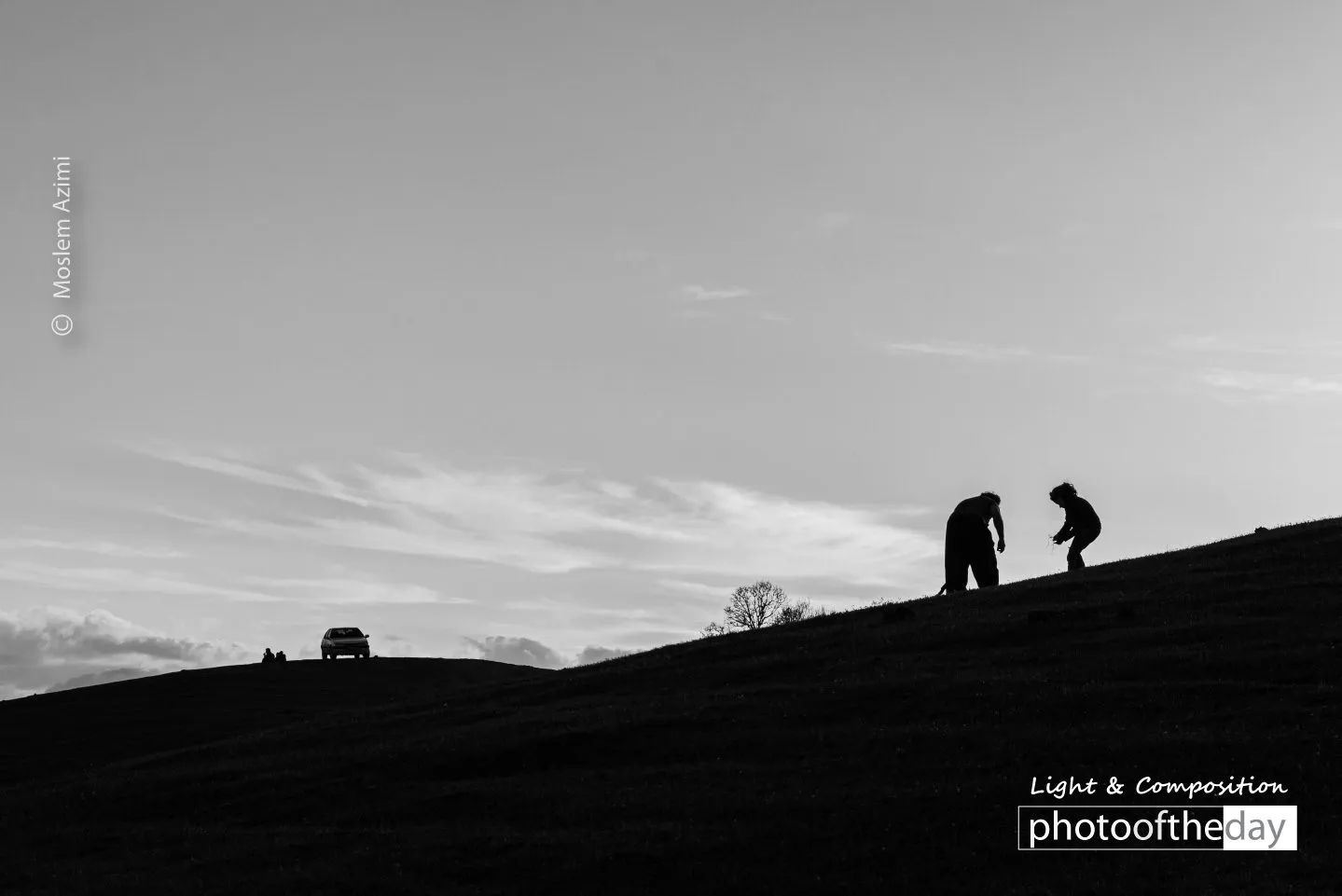
In this evocative minimalist composition, Moslem Azimi captures a quiet, expansive moment atop a hill in Javanroud. The frame is anchored by a young girl and her father gathering plants, while a distant couple gazes out toward the horizon, emphasizing the vastness of the natural landscape. By stripping away visual clutter, Azimi highlights the profound connection between humanity and the environment. The image is award-worthy for its masterful use of negative space and its ability to transform a simple, everyday scene into a contemplative study of life, stillness, and the enduring beauty of the Kurdish highlands.
Moslem Azimi
Moslem Azimi is a self-taught photographer of Kurdish origin based in the Kermanshah Province of Iran. Holding a Bachelor of Arts in English Translation, he has dedicated his creative practice to documenting the rich traditions, culture, and daily lifestyle of the Kurdish people. Through his active participation in national and international exhibitions, Azimi has established a distinct visual voice that bridges the gap between his heritage and the global photography community, consistently seeking to preserve the essence of his homeland through his lens.
Resonance Score Breakdown
Transparency Note: The resonance score (8.8/20) is calculated based on social engagement metrics collected before the award announcement.
Expert Photography Reviews · 4
The Weight of the Horizon
I keep a small, dried sprig of lavender pressed between the pages of a ledger from my grandfather’s shop. It has lost its scent, and the petals crumble if I touch them too firmly, yet it remains a heavy anchor to a summer I barely recall.
Read the reflection →The Weight of the Horizon
I remember sitting on a dry ridge in the Flinders Ranges with an old surveyor named Elias. He spent his days measuring land that didn't belong to him, yet he moved across the scrub with the quiet reverence of a man walking through his own living room.
Read the reflection →Reviews & Comments
Share your thoughts about this award-winning photograph. Your reviews contribute to the community engagement score.
The vast, hollow sky in Javanroud doesn’t invite us; it demands our silence. Azimi understands that light here isn’t for illumination, but for carving out the void. Those figures, small against the crushing horizon, aren’t just gathering plants—they’re clinging to existence against an encroaching emptiness. I’ve felt that same cold ache in a Tarkovsky frame. It’s a haunting, heavy stillness. When the shadows swallow the earth, we finally see what it costs to simply remain.
The hill stretches. It doesn’t ask for attention. A girl, a father, a distant pair. They are small against the slope. I feel a sudden, sharp ache in my chest looking at the horizon. It’s the weight of the sky. Nothing here is accidental. The empty corner is not empty. It’s the breath between heartbeats. Azimi trusts the silence. He leaves enough room for the wind to move through the frame. It’s enough.
The vast, empty sky here feels like a canvas waiting for a chemical reaction. I’m struck by how Azimi resists the urge to resolve the distant couple into sharp detail; it’s a choice that pushes the frame toward abstraction. It’s closer to Sugimoto’s long-exposure theatres than conventional landscape practice. Why resolve the horizon when the blur captures the weight of the air itself? It’s a brave, quiet refusal to let the camera dictate reality.
You waited for the wind to settle, didn’t you? There’s a quiet ache in how that father and daughter lean into the earth, small against the vastness of Javanroud. I’ve spent years in places like this, and it’s rare to see such stillness captured without feeling staged. You didn’t force the moment; you let the landscape breathe. It makes me miss the silence of the highlands. You’ve found something true here. Keep looking.