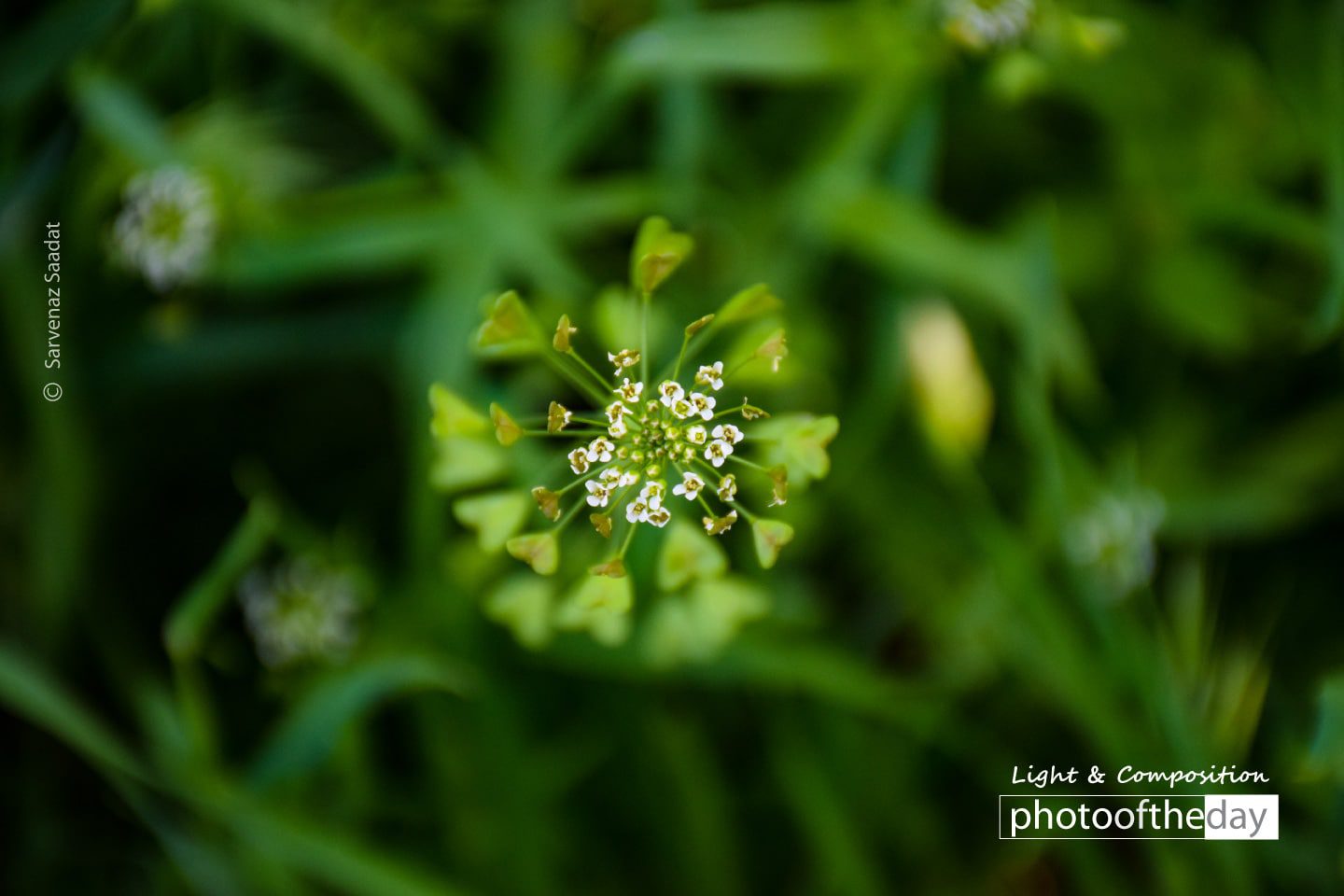
White Flower by Sarvenaz Saadat
Captured during a spring excursion in a park in Mehrshahr, Karaj, this photograph highlights the delicate beauty of a common local flower. The photographer, newly equipped with a fresh camera, was drawn to the ephemeral charm of the bloom, a subject that has long held a special place in her portfolio. By focusing on the intricate textures and soft petals of the flower, the image transforms a familiar sight into a compelling study of nature. Its award-worthy quality lies in the precise composition and the photographer's ability to elevate a simple, everyday subject into a serene and evocative piece of botanical art.
Sarvenaz Saadat
Born in 1988, Sarvenaz Saadat is an architect and dedicated amateur photographer based in Karaj, Iran. Her work is deeply rooted in a passion for nature, landscape, and wildlife, often inspired by her experiences as a birdwatcher and traveler. Currently refining her artistic vision, she aspires to transition into a professional career in nature photography, building upon a creative foundation that began with her early experiments with a Nikon Coolpix 3200 during her high school years.
Resonance Score Breakdown
Transparency Note: The resonance score (10.1/20) is calculated based on social engagement metrics collected before the award announcement.
Expert Photography Reviews · 6
The Weight of Petals
I keep a pressed carnation inside a heavy dictionary, its edges now the color of tea-stained lace. It was tucked into a book by a lover who did not stay, a small, brittle ghost of a summer that felt like it would never end.
Read the reflection →The Quiet Persistence of Bloom
In the seventeenth century, the Dutch masters began to paint flowers not as they appeared in the garden, but as they existed in the mind—transient, fragile, and stubbornly alive. They understood that to look at a petal is to witness a countdown.
Read the reflection →Reviews & Comments
Share your thoughts about this award-winning photograph. Your reviews contribute to the community engagement score.
Karl Blossfeldt’s rigorous, taxonomic approach to botanical form haunts this frame, yet Saadat’s soft focus feels like a deliberate departure from that clinical precision. It’s a delicate dance between the objective and the ethereal. I’m genuinely moved by how she captures the translucency of these petals; it’s a quiet, luminous intimacy that feels entirely her own. She’s moved past mere documentation, finding a lyrical rhythm in the light that makes me stop and truly look again.
Petals don’t sprint, but they have a peak tension point just like a sprinter’s hamstring. Saadat caught the bloom when the light hit the curvature perfectly, but it’s a static study, not a kinetic one. I’ve spent my life chasing the millisecond where gravity loses its grip. This flower is beautiful, sure, but it’s resting. I find myself wishing for a gust of wind to force a real, physiological reaction. It’s technically sound, but it’s missing the pulse.
Most botanical close-ups are forgettable, but this one lingers. Of the thousands I’ve reviewed, few capture such quiet stillness. The soft, deliberate focus on the petal’s translucent veins elevates a common bloom into something timeless. It’s not just a flower; it’s a study in fragility that I’d happily revisit in thirty years. I felt a genuine, sharp pang of nostalgia looking at it. It’s rare to see such restraint in a new photographer’s work.
You’ve captured a quiet stillness here that’s hard to find in the noise of a city like Karaj. It’s a simple bloom, but you didn’t just document a plant; you looked at it until the petals revealed their own fragility. I felt a sudden, sharp sense of peace looking at this. And that’s the point, isn’t it? You didn’t rush. You waited for the light to settle, and it shows. There’s something honest happening here.
Before the eye identifies the petals, something in the chest softens. It’s a quiet, rhythmic activation, like the steady pulse of a spring morning. I find myself holding my breath, tracing the translucent veins of this white bloom. It doesn’t demand attention; it simply exists, pulling me into a stillness I’ve been craving. When I return to it, the memory of that fragile, pale light lingers, a soft ache that follows me into sleep.
The frame’s geometry is tight, yet the petal’s curvature lacks the necessary structural resistance. It’s a soft study that drifts toward the edge of the picture plane without anchoring the gaze. While the negative space is handled with competence, the central mass doesn’t hold the tension required for true formal rigor. I’ve seen this botanical motif a thousand times, and frankly, it’s exhausting. The composition needs more spine to justify its own existence.
very good
I think this photo is one of the best!
I love this photo!