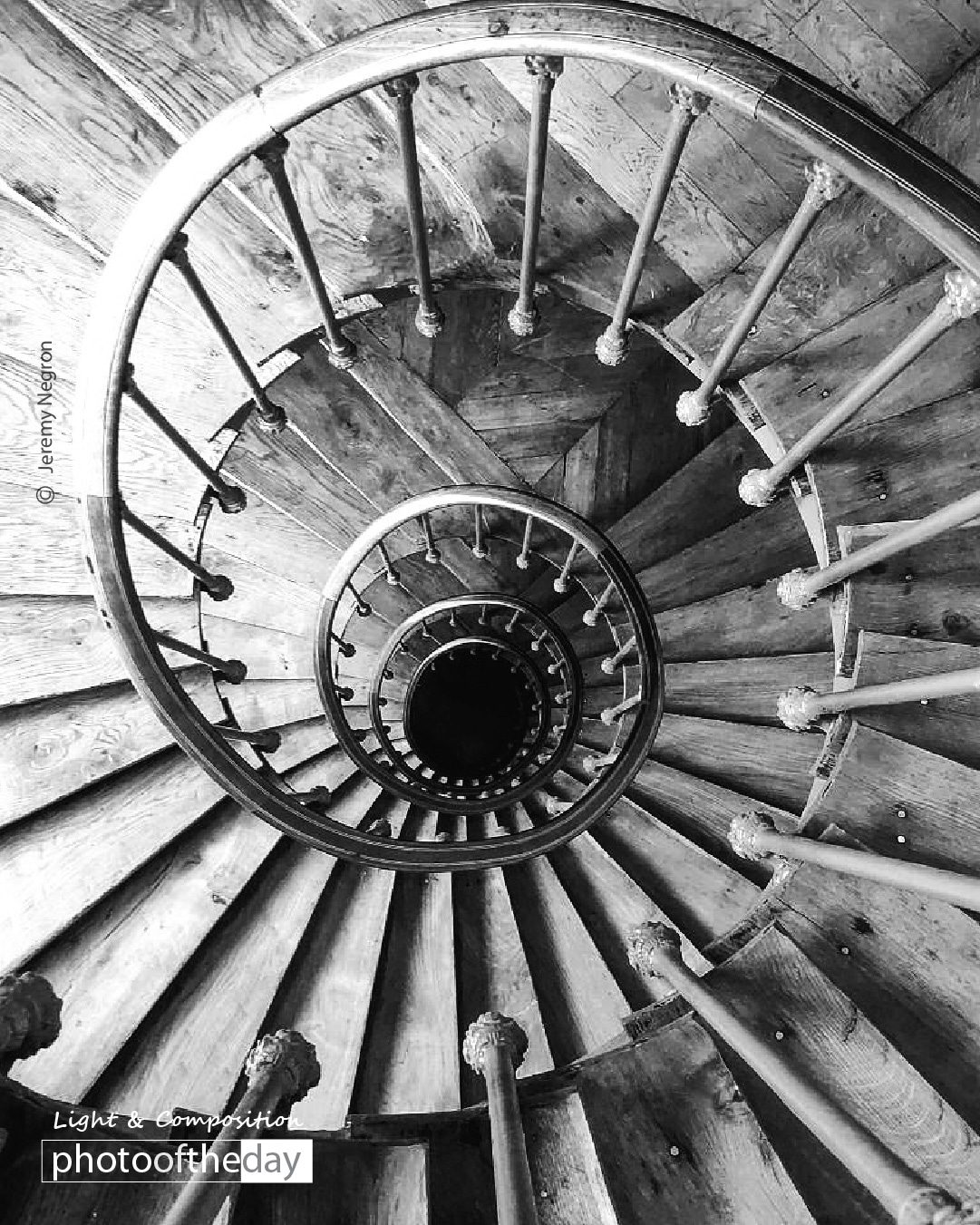
Turn in Black and White by Jeremy Negron
Captured during an October afternoon in Paris, this striking image explores the vertigo-inducing geometry of a local staircase. The photographer, struck by the architectural intensity of the structure, chose a perspective from the summit that challenges the viewer's sense of balance and height. By stripping away color, the composition emphasizes the stark, rhythmic lines and the daring nature of the vantage point. This photograph is award-worthy for its ability to transform a mundane urban feature into a compelling study of form, light, and the psychological thrill of looking down from great heights.
Jeremy Negron
Born in France, Jeremy Negron is a Paris-based photographer whose work is deeply influenced by the urban environment and the search for creative inspiration within his home city. His artistic practice is driven by a passion for global travel, where he documents diverse life conditions and landscapes to maintain a profound harmony with the natural world. Through his lens, Negron strives to share unique perspectives of the world, offering viewers a glimpse into the beauty and complexity he discovers during his extensive explorations.
Resonance Score Breakdown
Transparency Note: The resonance score (10.3/20) is calculated based on social engagement metrics collected before the award announcement.
Expert Photography Reviews · 3
The Spiral of Exclusion
Architecture is rarely neutral. Every staircase, every corridor, and every threshold is a silent instruction on how to move and who is permitted to occupy the verticality of a city.
Read the reflection →The Weight of the Descent
It is 3:14 am. The house has finally stopped settling, and the silence is heavy enough to touch. At this hour, I often think about the things we choose to climb and the things we are terrified to fall from.
Read the reflection →Reviews & Comments
Share your thoughts about this award-winning photograph. Your reviews contribute to the community engagement score.
The vertical axis here is a masterclass in recursive geometry. Negron exploits a 1:1 ratio between the central void and the spiraling balustrades, creating a dizzying, non-Euclidean pull toward the negative quadrant. It’s a perfectly solved spatial equation. I’ve spent minutes tracing these rhythmic, converging diagonals, and honestly, the sheer mathematical tension makes my stomach drop. It’s rare to see such a chaotic architectural sprawl forced into such rigorous, elegant order. It’s a brilliant, calculated vertigo.
Staring down this spiral, I feel that familiar, sharp pull in my gut—the vertigo of a high-dive platform. It’s a study in kinetic potential. The geometry is tight, but the timing feels static. It’s missing the human element that anchors the physics. I’d have waited for a figure to hit the landing, that split second where gravity finally claims them. It’s a clean architectural shot, but it’s waiting for a pulse that isn’t there.
Staircases are the medium’s oldest trap, yet Negron’s vertigo-inducing descent avoids the clichéd echoes of Rodchenko’s constructivist angles. It’s a rhythmic, brutalist study that recalls the stark geometry of Berenice Abbott’s New York, though stripped of her human scale. I’m genuinely unsettled by the way the vanishing point pulls the eye into a void. It’s a rare, dizzying thrill to see such familiar Parisian architecture rendered with this much cold, calculated, and refreshing formal precision.